

132
M. Fukuda et al.
works, we have reported that the local description of the torque for the electron spin
is available in quantum field theory due to the existence of the zeta force, while in
relativistic quantum mechanics we cannot use the local description. In quantum mechanics, when the Heisenberg equation of the electron spin is considered at a point,
this equation gives nonzero result even for spin steady states [16], though the expectation value of the whole region is zero, of course. Hence, the zeta force plays an
important role to describe the local picture of the spin even for the stationary state.
In this article, we study the local spin torque and zeta force following our preceding
works.
This paper is organized as follows. In Sect. 7.2, we introduce the definitions of
the spin angular momentum density and the zeta potential. The spin torque and the
zeta force are derived from the equation of motion of the spin angular momentum
density. We also mention the comparison with the Heisenberg equation in relativistic
quantum mechanics. In Sect. 7.2.2, we explain computational details. In Sect. 7.3,
our results of the spin torque, the zeta force, and the zeta potential of allene-type
molecules (C 3 H 4 , C 3 H 2 Li 2 ) are shown. The last section is devoted to our conclusion.
7.2 Theory and Calculation Method
In this section, we briefly review the equation of motion of the spin angular momentum density and the quantities of the spin torque density and the zeta force
density [1–4]. These quantities play important roles to investigate the local electronic spin dynamics. In this work, relativistic quantum field theory is adopted. It is
known that the electronic spin is intrinsically included in the Dirac equation. In the
relativistic quantum theory, the electronic spin and orbital angular momentums are
not conserved separately, for example due to the spin-orbit interaction. Hence, if we
treat the spin degree of freedom correctly, we should rely on the relativistic quantum theory. In addition, we adopt the quantum field theory, which is considered to
be more correct than quantum mechanics, since one of the authors found the novel
contribution to the torque for the electron spin, the zeta force.
7.2.1 Spin Torque Density and Zeta Force Density
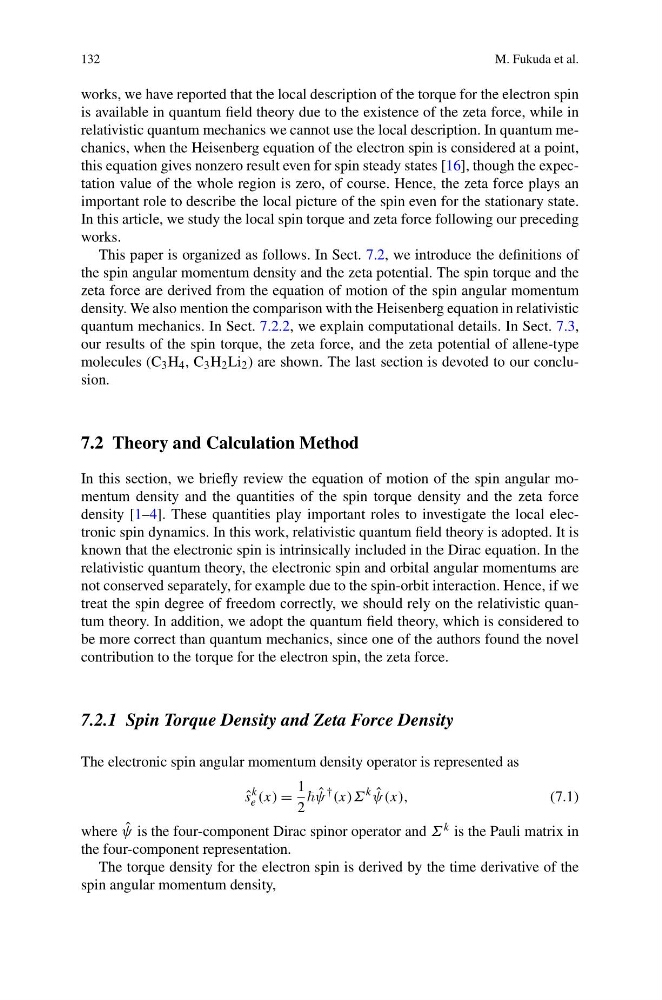
The electronic spin angular momentum density operator is represented as
ˆ
s
k
e (x) =
1
2
ˆ
ψ
† (x)Σ
k ˆ
ψ(x),
(7.1)
where ˆ
ψ is the four-component Dirac spinor operator and Σ k is the Pauli matrix in
the four-component representation.
The torque density for the electron spin is derived by the time derivative of the
spin angular momentum density,
M. Fukuda et al.
works, we have reported that the local description of the torque for the electron spin
is available in quantum field theory due to the existence of the zeta force, while in
relativistic quantum mechanics we cannot use the local description. In quantum mechanics, when the Heisenberg equation of the electron spin is considered at a point,
this equation gives nonzero result even for spin steady states [16], though the expectation value of the whole region is zero, of course. Hence, the zeta force plays an
important role to describe the local picture of the spin even for the stationary state.
In this article, we study the local spin torque and zeta force following our preceding
works.
This paper is organized as follows. In Sect. 7.2, we introduce the definitions of
the spin angular momentum density and the zeta potential. The spin torque and the
zeta force are derived from the equation of motion of the spin angular momentum
density. We also mention the comparison with the Heisenberg equation in relativistic
quantum mechanics. In Sect. 7.2.2, we explain computational details. In Sect. 7.3,
our results of the spin torque, the zeta force, and the zeta potential of allene-type
molecules (C 3 H 4 , C 3 H 2 Li 2 ) are shown. The last section is devoted to our conclusion.
7.2 Theory and Calculation Method
In this section, we briefly review the equation of motion of the spin angular momentum density and the quantities of the spin torque density and the zeta force
density [1–4]. These quantities play important roles to investigate the local electronic spin dynamics. In this work, relativistic quantum field theory is adopted. It is
known that the electronic spin is intrinsically included in the Dirac equation. In the
relativistic quantum theory, the electronic spin and orbital angular momentums are
not conserved separately, for example due to the spin-orbit interaction. Hence, if we
treat the spin degree of freedom correctly, we should rely on the relativistic quantum theory. In addition, we adopt the quantum field theory, which is considered to
be more correct than quantum mechanics, since one of the authors found the novel
contribution to the torque for the electron spin, the zeta force.
7.2.1 Spin Torque Density and Zeta Force Density
The electronic spin angular momentum density operator is represented as
ˆ
s
k
e (x) =
1
2
ˆ
ψ
† (x)Σ
k ˆ
ψ(x),
(7.1)
where ˆ
ψ is the four-component Dirac spinor operator and Σ k is the Pauli matrix in
the four-component representation.
The torque density for the electron spin is derived by the time derivative of the
spin angular momentum density,