

134
M. Fukuda et al.
d ˆ
s e /dt = −c ˆ
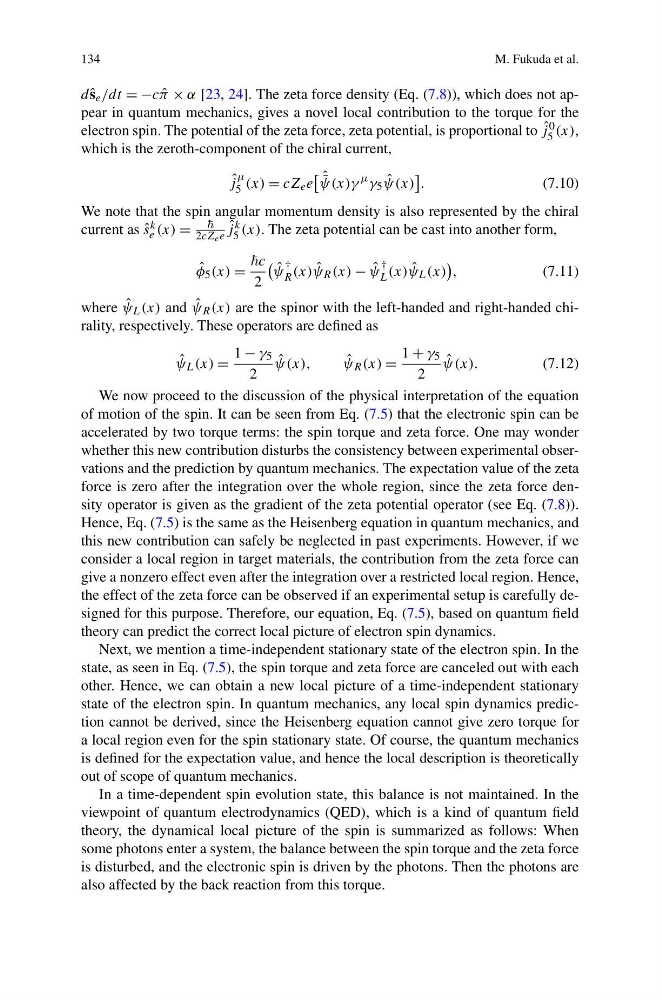
π × α [23, 24]. The zeta force density (Eq. (7.8)), which does not appear in quantum mechanics, gives a novel local contribution to the torque for the
electron spin. The potential of the zeta force, zeta potential, is proportional to ˆ
j 0
5 (x),
which is the zeroth-component of the chiral current,
ˆ
j
μ
5 (x) = cZ e e
ˆ ¯
ψ(x)γ
μ γ 5 ˆ
ψ(x)
.
(7.10)
We note that the spin angular momentum density is also represented by the chiral
current as ˆ
s k
e (x) =
2cZ e e
ˆ
j k
5 (x). The zeta potential can be cast into another form,
ˆ
φ 5 (x) =
c
2
ˆ
ψ
†
R (x) ˆ
ψ R (x) − ˆ
ψ
†
L (x) ˆ
ψ L (x)
,
(7.11)
where ˆ
ψ L (x) and ˆ
ψ R (x) are the spinor with the left-handed and right-handed chirality, respectively. These operators are defined as
ˆ
ψ L (x) =
1 − γ 5
2
ˆ
ψ(x),
ˆ
ψ R (x) =
1 + γ 5
2
ˆ
ψ(x).
(7.12)
We now proceed to the discussion of the physical interpretation of the equation
of motion of the spin. It can be seen from Eq. (7.5) that the electronic spin can be
accelerated by two torque terms: the spin torque and zeta force. One may wonder
whether this new contribution disturbs the consistency between experimental observations and the prediction by quantum mechanics. The expectation value of the zeta
force is zero after the integration over the whole region, since the zeta force density operator is given as the gradient of the zeta potential operator (see Eq. (7.8)).
Hence, Eq. (7.5) is the same as the Heisenberg equation in quantum mechanics, and
this new contribution can safely be neglected in past experiments. However, if we
consider a local region in target materials, the contribution from the zeta force can
give a nonzero effect even after the integration over a restricted local region. Hence,
the effect of the zeta force can be observed if an experimental setup is carefully designed for this purpose. Therefore, our equation, Eq. (7.5), based on quantum field
theory can predict the correct local picture of electron spin dynamics.
Next, we mention a time-independent stationary state of the electron spin. In the
state, as seen in Eq. (7.5), the spin torque and zeta force are canceled out with each
other. Hence, we can obtain a new local picture of a time-independent stationary
state of the electron spin. In quantum mechanics, any local spin dynamics prediction cannot be derived, since the Heisenberg equation cannot give zero torque for
a local region even for the spin stationary state. Of course, the quantum mechanics
is defined for the expectation value, and hence the local description is theoretically
out of scope of quantum mechanics.
In a time-dependent spin evolution state, this balance is not maintained. In the
viewpoint of quantum electrodynamics (QED), which is a kind of quantum field
theory, the dynamical local picture of the spin is summarized as follows: When
some photons enter a system, the balance between the spin torque and the zeta force
is disturbed, and the electronic spin is driven by the photons. Then the photons are
also affected by the back reaction from this torque.
M. Fukuda et al.
d ˆ
s e /dt = −c ˆ
π × α [23, 24]. The zeta force density (Eq. (7.8)), which does not appear in quantum mechanics, gives a novel local contribution to the torque for the
electron spin. The potential of the zeta force, zeta potential, is proportional to ˆ
j 0
5 (x),
which is the zeroth-component of the chiral current,
ˆ
j
μ
5 (x) = cZ e e
ˆ ¯
ψ(x)γ
μ γ 5 ˆ
ψ(x)
.
(7.10)
We note that the spin angular momentum density is also represented by the chiral
current as ˆ
s k
e (x) =
2cZ e e
ˆ
j k
5 (x). The zeta potential can be cast into another form,
ˆ
φ 5 (x) =
c
2
ˆ
ψ
†
R (x) ˆ
ψ R (x) − ˆ
ψ
†
L (x) ˆ
ψ L (x)
,
(7.11)
where ˆ
ψ L (x) and ˆ
ψ R (x) are the spinor with the left-handed and right-handed chirality, respectively. These operators are defined as
ˆ
ψ L (x) =
1 − γ 5
2
ˆ
ψ(x),
ˆ
ψ R (x) =
1 + γ 5
2
ˆ
ψ(x).
(7.12)
We now proceed to the discussion of the physical interpretation of the equation
of motion of the spin. It can be seen from Eq. (7.5) that the electronic spin can be
accelerated by two torque terms: the spin torque and zeta force. One may wonder
whether this new contribution disturbs the consistency between experimental observations and the prediction by quantum mechanics. The expectation value of the zeta
force is zero after the integration over the whole region, since the zeta force density operator is given as the gradient of the zeta potential operator (see Eq. (7.8)).
Hence, Eq. (7.5) is the same as the Heisenberg equation in quantum mechanics, and
this new contribution can safely be neglected in past experiments. However, if we
consider a local region in target materials, the contribution from the zeta force can
give a nonzero effect even after the integration over a restricted local region. Hence,
the effect of the zeta force can be observed if an experimental setup is carefully designed for this purpose. Therefore, our equation, Eq. (7.5), based on quantum field
theory can predict the correct local picture of electron spin dynamics.
Next, we mention a time-independent stationary state of the electron spin. In the
state, as seen in Eq. (7.5), the spin torque and zeta force are canceled out with each
other. Hence, we can obtain a new local picture of a time-independent stationary
state of the electron spin. In quantum mechanics, any local spin dynamics prediction cannot be derived, since the Heisenberg equation cannot give zero torque for
a local region even for the spin stationary state. Of course, the quantum mechanics
is defined for the expectation value, and hence the local description is theoretically
out of scope of quantum mechanics.
In a time-dependent spin evolution state, this balance is not maintained. In the
viewpoint of quantum electrodynamics (QED), which is a kind of quantum field
theory, the dynamical local picture of the spin is summarized as follows: When
some photons enter a system, the balance between the spin torque and the zeta force
is disturbed, and the electronic spin is driven by the photons. Then the photons are
also affected by the back reaction from this torque.