

14
large scale fisheries operations, shrimp boats in some countries use pots, traps and
gillnets for reasons such as bottom topography and troll use such as rocky bottoms
(Gillett 2008).
2.1.1.6 Nutritional Composition of Shrimps/Prawns
Shrimps are high in protein, low in saturated fat and calories, and have a neutral
flavour (Table 2.1). Due to these characteristics, shrimps form a natural additive in
salads, pastas, curry, soups, and stir-fried dishes. Shrimps have also been identified
as a rich source of vitamin B 12 , selenium, ω-3 highly unsaturated fatty acids (HUFA)
and astaxanthin, a potent natural antioxidant. Despite the several nutritional parameters of shrimp based on which it can be considered as a healthy food, there is
reluctance among dieticians and health professionals as well as consumers because
of its relatively higher cholesterol (Krzynowek and Panunzio 1989; Essien 1995;
Dayal et al. 2013).
Shrimp meat contains low levels of saturated fats and high levels of polyunsaturated fatty acids such as eicosapentaenoic (EPA) and docosahexaenoic (DHA) acids
(Krzeczkowski 1970; Bottino et al. 1979; King et al. 1990). Thirty-two percent of
shrimp lipid is composed of polyunsaturated fatty acids (PUFA) (Table 2.2). Within
this, about 64% is contributed by ω-3 PUFA and the remaining 33% by ω-6
PUFA. Eating 100 g edible portion of shrimp in a day will provide >180 mg of EPA
+ DHA (Dayal et al. 2013).
Species, habitat, season, and feed can influence the proximate composition, particularly the lipid profile. Bono et al. (2012) examined the shrimp caught by trawlers
from muddy bottoms at 500–700 m depth in five different fishing areas in the central
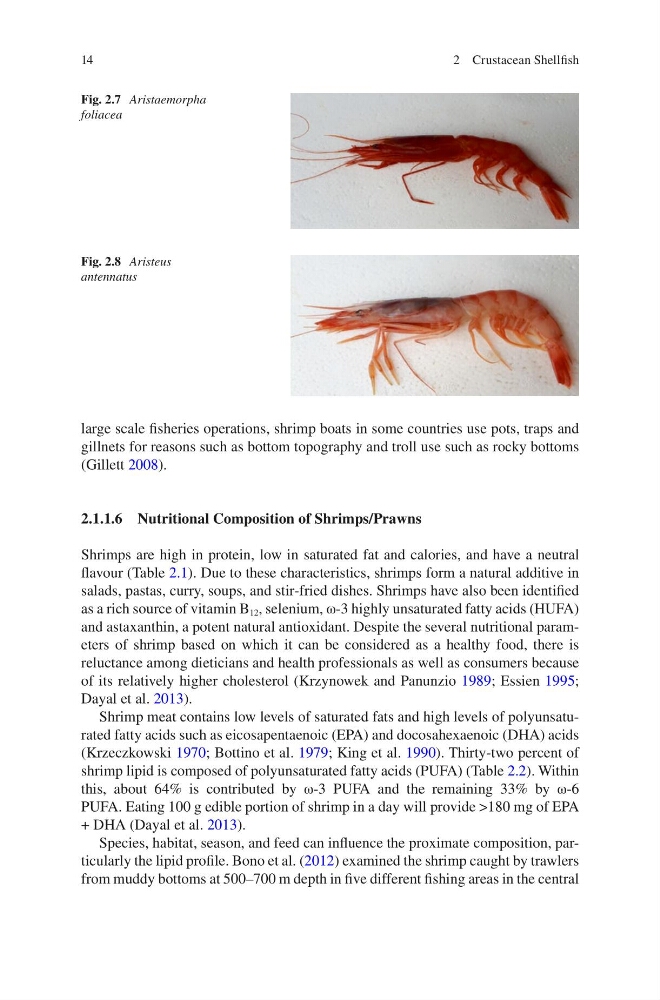
Fig. 2.7 Aristaemorpha
foliacea
Fig. 2.8 Aristeus
antennatus
2 Crustacean Shellfish
large scale fisheries operations, shrimp boats in some countries use pots, traps and
gillnets for reasons such as bottom topography and troll use such as rocky bottoms
(Gillett 2008).
2.1.1.6 Nutritional Composition of Shrimps/Prawns
Shrimps are high in protein, low in saturated fat and calories, and have a neutral
flavour (Table 2.1). Due to these characteristics, shrimps form a natural additive in
salads, pastas, curry, soups, and stir-fried dishes. Shrimps have also been identified
as a rich source of vitamin B 12 , selenium, ω-3 highly unsaturated fatty acids (HUFA)
and astaxanthin, a potent natural antioxidant. Despite the several nutritional parameters of shrimp based on which it can be considered as a healthy food, there is
reluctance among dieticians and health professionals as well as consumers because
of its relatively higher cholesterol (Krzynowek and Panunzio 1989; Essien 1995;
Dayal et al. 2013).
Shrimp meat contains low levels of saturated fats and high levels of polyunsaturated fatty acids such as eicosapentaenoic (EPA) and docosahexaenoic (DHA) acids
(Krzeczkowski 1970; Bottino et al. 1979; King et al. 1990). Thirty-two percent of
shrimp lipid is composed of polyunsaturated fatty acids (PUFA) (Table 2.2). Within
this, about 64% is contributed by ω-3 PUFA and the remaining 33% by ω-6
PUFA. Eating 100 g edible portion of shrimp in a day will provide >180 mg of EPA
+ DHA (Dayal et al. 2013).
Species, habitat, season, and feed can influence the proximate composition, particularly the lipid profile. Bono et al. (2012) examined the shrimp caught by trawlers
from muddy bottoms at 500–700 m depth in five different fishing areas in the central
Fig. 2.7 Aristaemorpha
foliacea
Fig. 2.8 Aristeus
antennatus
2 Crustacean Shellfish