

13
Aristaemorpha foliacea (Risso, 1827)
This species live in marine deep waters from 250 to 1300 m on the muddy bottoms.
Habitats are Mediterranean coasts of Spain, France, Italy, Algeria, and Israel
(Tavares 2002) (Fig. 2.7).
Aristeus antennatus (Risso, 1816)
Aristeus antennatus is an ecologically and economically important deep-water species in the Mediterranean Sea. This shrimp, known as red shrimp, live in a muddy
environment and at a depth of 200–250 m of the west of the Mediterranean. A. antennatus is widely distributed in the Central area of the East Atlantic, in the
Mediterranean Sea, apart from the North Adriatic Sea. It is caught by the bottom
trawl (Marra et al. 2015) (Fig. 2.8).
Crangon crangon (Linnaeus 1758)
Crangon crangon, also known as brown shrimp, is found in shallow waters from 0
to 12 m and grows to around 60 mm in size. It has greyish-brown colour. The
absence of a rostrum separates it from Pandalus shrimps. Brown shrimps are often
found in soft sandy and muddy bottoms, bays, and gulfs. They are resistant to water
temperature and salinity changes and their lives are 3–4 years (Anonymous 1972).
2.1.1.5 Fishing of Shrimps/Prawns
A major characteristic of most large-scale shrimp fishing is the use of trawl gear.
Many types of trawls are used to catch shrimp, but because the otter trawl is the
most important commercial gear in many countries, it deserves special mention.
Otter trawl gear is also used in many fisheries apart from shrimp fisheries. Although
the otter trawl is the most common form of shrimp trawl, several other similar types
of gear are used to catch shrimp on a large scale; two common types are the beam
trawl and the pair trawl. Most of the industrial shrimp fishing in the world is done
by trawling, yet there are some large-scale shrimp fisheries that use other gear. In
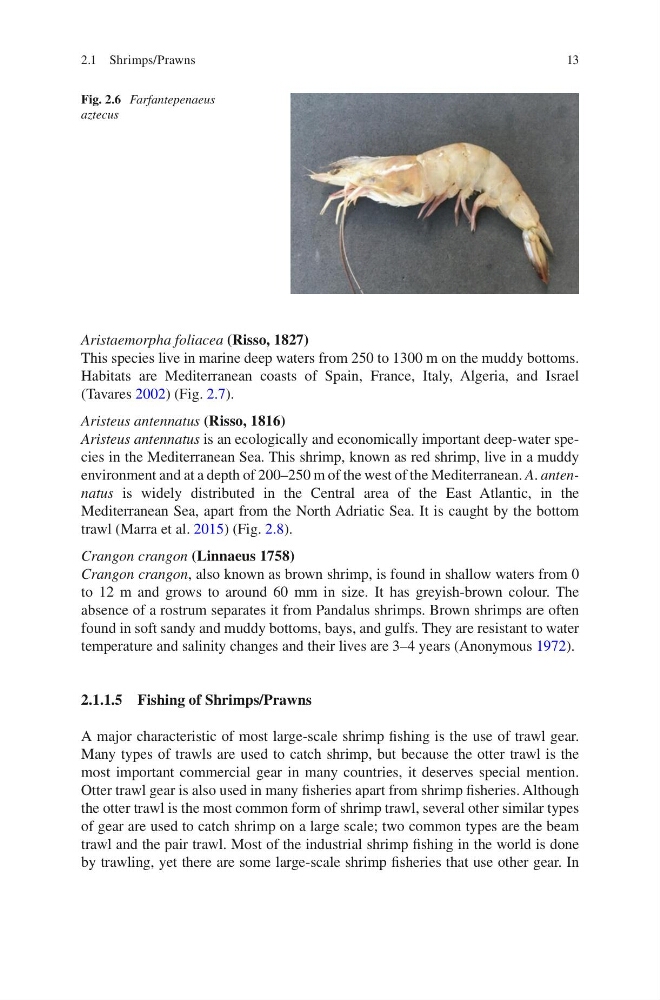
Fig. 2.6 Farfantepenaeus
aztecus
2.1 Shrimps/Prawns
Aristaemorpha foliacea (Risso, 1827)
This species live in marine deep waters from 250 to 1300 m on the muddy bottoms.
Habitats are Mediterranean coasts of Spain, France, Italy, Algeria, and Israel
(Tavares 2002) (Fig. 2.7).
Aristeus antennatus (Risso, 1816)
Aristeus antennatus is an ecologically and economically important deep-water species in the Mediterranean Sea. This shrimp, known as red shrimp, live in a muddy
environment and at a depth of 200–250 m of the west of the Mediterranean. A. antennatus is widely distributed in the Central area of the East Atlantic, in the
Mediterranean Sea, apart from the North Adriatic Sea. It is caught by the bottom
trawl (Marra et al. 2015) (Fig. 2.8).
Crangon crangon (Linnaeus 1758)
Crangon crangon, also known as brown shrimp, is found in shallow waters from 0
to 12 m and grows to around 60 mm in size. It has greyish-brown colour. The
absence of a rostrum separates it from Pandalus shrimps. Brown shrimps are often
found in soft sandy and muddy bottoms, bays, and gulfs. They are resistant to water
temperature and salinity changes and their lives are 3–4 years (Anonymous 1972).
2.1.1.5 Fishing of Shrimps/Prawns
A major characteristic of most large-scale shrimp fishing is the use of trawl gear.
Many types of trawls are used to catch shrimp, but because the otter trawl is the
most important commercial gear in many countries, it deserves special mention.
Otter trawl gear is also used in many fisheries apart from shrimp fisheries. Although
the otter trawl is the most common form of shrimp trawl, several other similar types
of gear are used to catch shrimp on a large scale; two common types are the beam
trawl and the pair trawl. Most of the industrial shrimp fishing in the world is done
by trawling, yet there are some large-scale shrimp fisheries that use other gear. In
Fig. 2.6 Farfantepenaeus
aztecus
2.1 Shrimps/Prawns