

212
higher levels of cholesterol, for example, about 140 mg of cholesterol/100 g in
European squid (Nunes et al. 2011) (Tables 3.8, 3.9, 3.10 and 3.11).
3.2.3.2 Quality Changes in Cephalopods
The cephalopods deteriorate very quickly because of endogenous and bacterial proteases. Protease plays an important role in protein breakdown, and the protease
activity of cephalopods has been reported to be higher than in various fish species
(Stanley and Hultin 1984; Hurtado et al. 1999). After death, cephalopods undergo
high protein degradation by both endogenous and bacterial enzymes. Such rapid
protein degradation results in high levels of nitrogen release from the muscle, which
promotes bacterial growth that leads to rapid degradation (Gómez-Guillén et al.
1996; Hurtado et al. 1999). In the mantle muscle of Squid (Ommastrephes loani
pacificus), autolytic activity was observed in the acidic pH range (Sakai and
Matsumoto 1981). It has been reported that for Illex illecebrosus and Loligo pealei,
proteolytic activity is mostly observed in the acidic pH range and minor activity in
the alkaline pH range (Lebanc and Gill 1982). Hurtado et al. (1999) observed proteolytic activity in octopus (O. vulgaris) muscle in an acid range at pH 2.5 and
temperature optimum at 40 °C.
As a result of enzymatic and bacterial activity, changes occur in the cephalopod
muscles, which reduce the sensory acceptability of the product. To protect these
products from deterioration, refrigeration or ice storage is applied. They are conserved until they maintain their sensory acceptability. Sensory rejection for octopus
was reported to be 6–7 days at 2.5 °C (Hurtado et al. 1999), 7 days at 1–2 °C (Civera
et al. 1999) and 8 days in ice (Barbosa and Vaz-Pires 2004) it was reported to be
9 days at 2 °C (Unal-Sengor et al. 2018) and 12 days in ice (Prafulla et al. 2000) for
cuttlefish (Sepia pharaonis) 9 days for Sepia officinalis (Vaz-Pires et al. 2008).
Panellists observed a loss of sensory quality with a decrease in the brightness of the
cuttlefish skin, an increase in eye opacity, intensification of the yellowish colour of
the mantle, unacceptable odour development, softening of flesh and loss of mucus
(Unal-Sengor et al. 2018). As storage progressed, instead of fresh sea weedy odour,
sheen and glossy appearance, characteristic white colour, sweet flavour, firm and
juicy texture; loss of bloom, flabby texture and discolouration were observed in the
cuttlefish (Sepia pharaonis) (Prafulla et al. 2000). According to the sensory quality
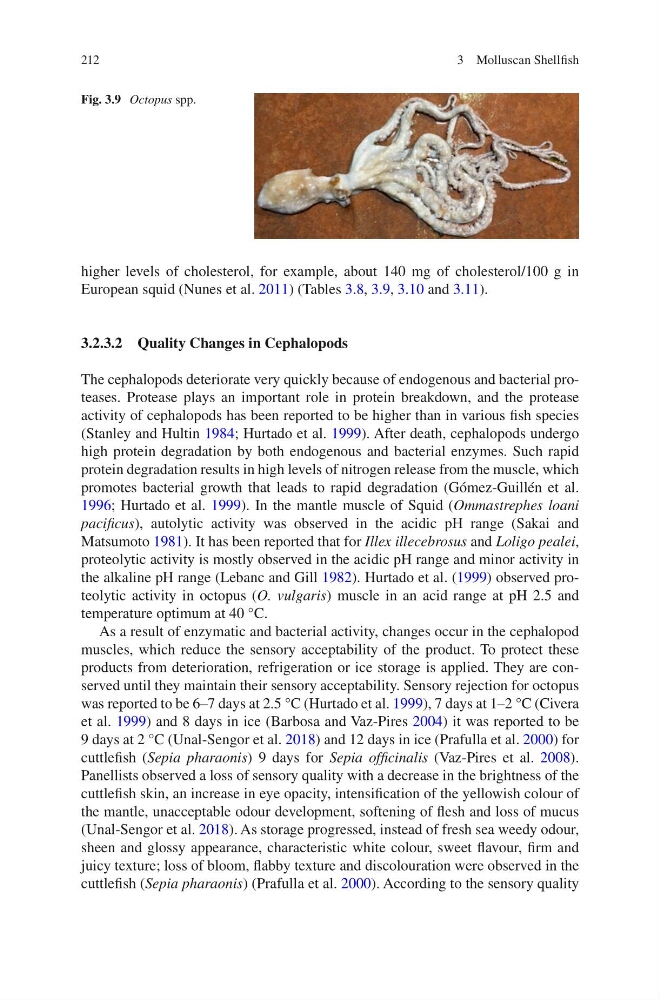
Fig. 3.9 Octopus spp.
3 Molluscan Shellfish
higher levels of cholesterol, for example, about 140 mg of cholesterol/100 g in
European squid (Nunes et al. 2011) (Tables 3.8, 3.9, 3.10 and 3.11).
3.2.3.2 Quality Changes in Cephalopods
The cephalopods deteriorate very quickly because of endogenous and bacterial proteases. Protease plays an important role in protein breakdown, and the protease
activity of cephalopods has been reported to be higher than in various fish species
(Stanley and Hultin 1984; Hurtado et al. 1999). After death, cephalopods undergo
high protein degradation by both endogenous and bacterial enzymes. Such rapid
protein degradation results in high levels of nitrogen release from the muscle, which
promotes bacterial growth that leads to rapid degradation (Gómez-Guillén et al.
1996; Hurtado et al. 1999). In the mantle muscle of Squid (Ommastrephes loani
pacificus), autolytic activity was observed in the acidic pH range (Sakai and
Matsumoto 1981). It has been reported that for Illex illecebrosus and Loligo pealei,
proteolytic activity is mostly observed in the acidic pH range and minor activity in
the alkaline pH range (Lebanc and Gill 1982). Hurtado et al. (1999) observed proteolytic activity in octopus (O. vulgaris) muscle in an acid range at pH 2.5 and
temperature optimum at 40 °C.
As a result of enzymatic and bacterial activity, changes occur in the cephalopod
muscles, which reduce the sensory acceptability of the product. To protect these
products from deterioration, refrigeration or ice storage is applied. They are conserved until they maintain their sensory acceptability. Sensory rejection for octopus
was reported to be 6–7 days at 2.5 °C (Hurtado et al. 1999), 7 days at 1–2 °C (Civera
et al. 1999) and 8 days in ice (Barbosa and Vaz-Pires 2004) it was reported to be
9 days at 2 °C (Unal-Sengor et al. 2018) and 12 days in ice (Prafulla et al. 2000) for
cuttlefish (Sepia pharaonis) 9 days for Sepia officinalis (Vaz-Pires et al. 2008).
Panellists observed a loss of sensory quality with a decrease in the brightness of the
cuttlefish skin, an increase in eye opacity, intensification of the yellowish colour of
the mantle, unacceptable odour development, softening of flesh and loss of mucus
(Unal-Sengor et al. 2018). As storage progressed, instead of fresh sea weedy odour,
sheen and glossy appearance, characteristic white colour, sweet flavour, firm and
juicy texture; loss of bloom, flabby texture and discolouration were observed in the
cuttlefish (Sepia pharaonis) (Prafulla et al. 2000). According to the sensory quality
Fig. 3.9 Octopus spp.
3 Molluscan Shellfish