

which was attributed to a kinked P-loop conformation in the former two kinases
positioning the cysteine in closer proximity of the warhead. Similar inhibitors were
designed from the scaffold of the c-SRC/BCR-ABL inhibitor dasatinib [118]. The
exemplary vinyl sulfonamide 61 is a potent inhibitor of the dasatinib-resistant c-SRC
T338M mutant (IC 50 ¼ 44 nM; k inact /K I ¼ 4.0 Â 10
4 M
À1 s
À1 ) with good cellular
potency and increased selectivity compared to the relatively promiscuous template
dasatinib.
2.6 Development of Inhibitors Targeting Cysteines
in the Hinge Region
2.6.1 Inhibitors Targeting the H1 Position and the H3 Subsite
Among the four FGF receptor tyrosine kinases, FGFR4 stands out as the only family
member harboring a cysteine at the H2 (GK + 2) position in the middle of the hinge
region. Equivalent cysteines have only been identified in four other kinases, namely
TTK, MAPKAPK2, MAPKAPK3, and p70S6Kβ. This cysteine (Cys552) was first
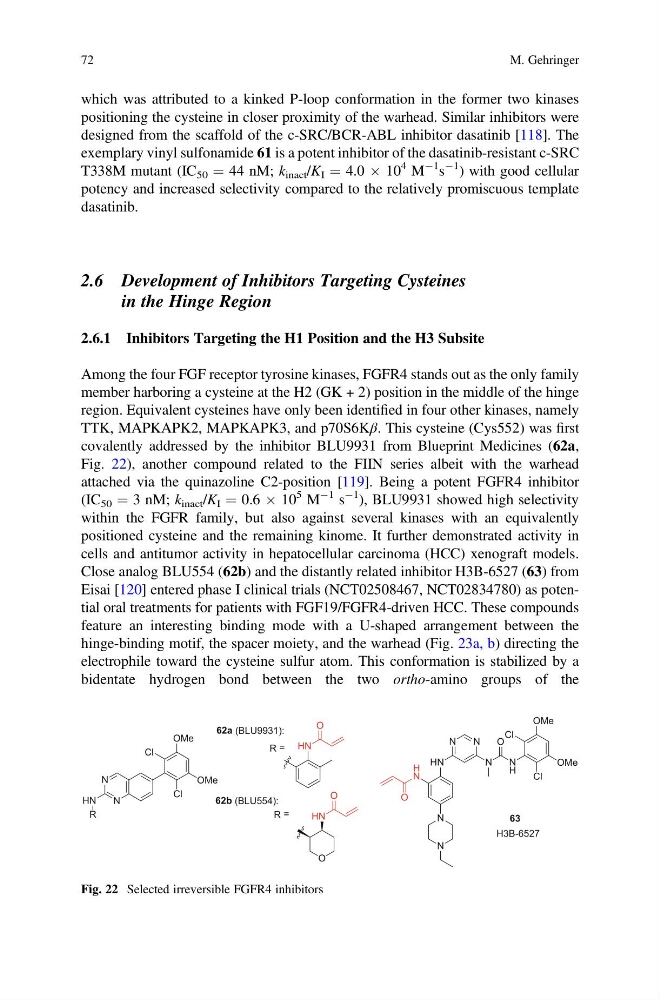
covalently addressed by the inhibitor BLU9931 from Blueprint Medicines (62a,
Fig. 22), another compound related to the FIIN series albeit with the warhead
attached via the quinazoline C2-position [119]. Being a potent FGFR4 inhibitor
(IC 50 ¼ 3 nM; k inact /K I ¼ 0.6 Â 10
5 M
À1 s
À1 ), BLU9931 showed high selectivity
within the FGFR family, but also against several kinases with an equivalently
positioned cysteine and the remaining kinome. It further demonstrated activity in
cells and antitumor activity in hepatocellular carcinoma (HCC) xenograft models.
Close analog BLU554 (62b) and the distantly related inhibitor H3B-6527 (63) from
Eisai [120] entered phase I clinical trials (NCT02508467, NCT02834780) as potential oral treatments for patients with FGF19/FGFR4-driven HCC. These compounds
feature an interesting binding mode with a U-shaped arrangement between the
hinge-binding motif, the spacer moiety, and the warhead (Fig. 23a, b) directing the
electrophile toward the cysteine sulfur atom. This conformation is stabilized by a
bidentate hydrogen bond between the two ortho-amino groups of the
Cl
OMe
OMe
Cl
N
N
62a (BLU9931):
HN
O
R =
62b (BLU554):
HN
R
O
HN
O
R =
H
N
N
N
HN
N
N
N
N
H
Cl
OMe
OMe
Cl
O
O
H3B-6527
63
Fig. 22 Selected irreversible FGFR4 inhibitors
72
M. Gehringer
positioning the cysteine in closer proximity of the warhead. Similar inhibitors were
designed from the scaffold of the c-SRC/BCR-ABL inhibitor dasatinib [118]. The
exemplary vinyl sulfonamide 61 is a potent inhibitor of the dasatinib-resistant c-SRC
T338M mutant (IC 50 ¼ 44 nM; k inact /K I ¼ 4.0 Â 10
4 M
À1 s
À1 ) with good cellular
potency and increased selectivity compared to the relatively promiscuous template
dasatinib.
2.6 Development of Inhibitors Targeting Cysteines
in the Hinge Region
2.6.1 Inhibitors Targeting the H1 Position and the H3 Subsite
Among the four FGF receptor tyrosine kinases, FGFR4 stands out as the only family
member harboring a cysteine at the H2 (GK + 2) position in the middle of the hinge
region. Equivalent cysteines have only been identified in four other kinases, namely
TTK, MAPKAPK2, MAPKAPK3, and p70S6Kβ. This cysteine (Cys552) was first
covalently addressed by the inhibitor BLU9931 from Blueprint Medicines (62a,
Fig. 22), another compound related to the FIIN series albeit with the warhead
attached via the quinazoline C2-position [119]. Being a potent FGFR4 inhibitor
(IC 50 ¼ 3 nM; k inact /K I ¼ 0.6 Â 10
5 M
À1 s
À1 ), BLU9931 showed high selectivity
within the FGFR family, but also against several kinases with an equivalently
positioned cysteine and the remaining kinome. It further demonstrated activity in
cells and antitumor activity in hepatocellular carcinoma (HCC) xenograft models.
Close analog BLU554 (62b) and the distantly related inhibitor H3B-6527 (63) from
Eisai [120] entered phase I clinical trials (NCT02508467, NCT02834780) as potential oral treatments for patients with FGF19/FGFR4-driven HCC. These compounds
feature an interesting binding mode with a U-shaped arrangement between the
hinge-binding motif, the spacer moiety, and the warhead (Fig. 23a, b) directing the
electrophile toward the cysteine sulfur atom. This conformation is stabilized by a
bidentate hydrogen bond between the two ortho-amino groups of the
Cl
OMe
OMe
Cl
N
N
62a (BLU9931):
HN
O
R =
62b (BLU554):
HN
R
O
HN
O
R =
H
N
N
N
HN
N
N
N
N
H
Cl
OMe
OMe
Cl
O
O
H3B-6527
63
Fig. 22 Selected irreversible FGFR4 inhibitors
72
M. Gehringer