

[117], which is currently in phase I/II clinical studies (NCT02052778), have been
reported.
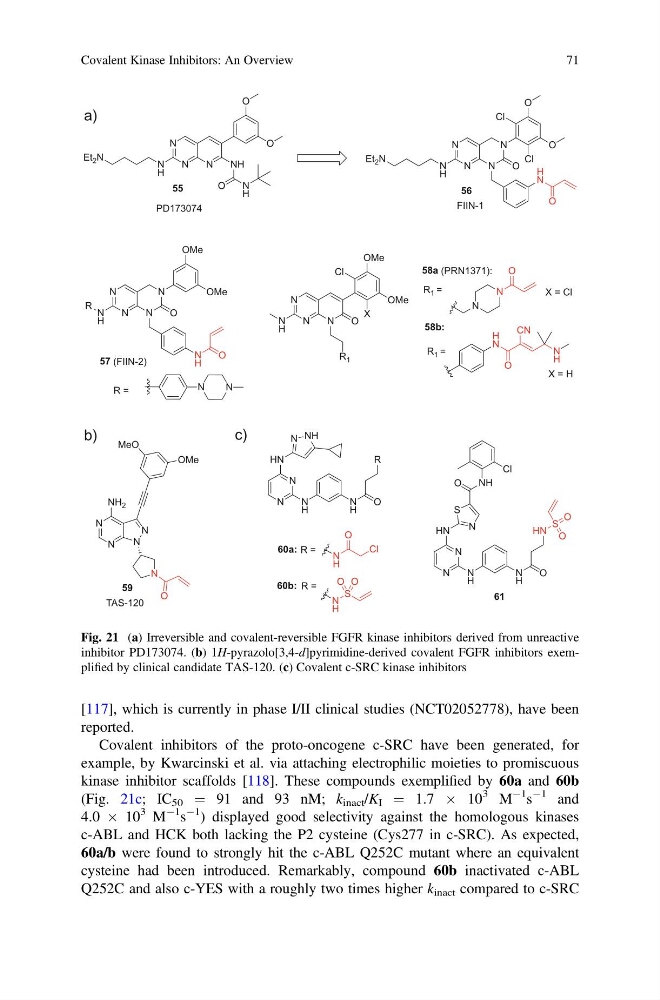
Covalent inhibitors of the proto-oncogene c-SRC have been generated, for
example, by Kwarcinski et al. via attaching electrophilic moieties to promiscuous
kinase inhibitor scaffolds [118]. These compounds exemplified by 60a and 60b
(Fig. 21c; IC 50 ¼ 91 and 93 nM; k inact /K I ¼ 1.7 Â 10
3 M
À1 s
À1 and
4.0 Â 10
3 M
À1 s
À1 ) displayed good selectivity against the homologous kinases
c-ABL and HCK both lacking the P2 cysteine (Cys277 in c-SRC). As expected,
60a/b were found to strongly hit the c-ABL Q252C mutant where an equivalent
cysteine had been introduced. Remarkably, compound 60b inactivated c-ABL
Q252C and also c-YES with a roughly two times higher k inact compared to c-SRC
a)
N
N
N
H
R
N
N
O
N
N
N
H
N
R 1
O
Cl
X
OMe
OMe
OMe
OMe
58a (PRN1371):
N
N
N
N
NH 2
OMe
MeO
N
O
TAS-120
59
R 1 =
N
N
O
X = Cl
R 1 =
58b:
H
N
O
CN
N
H
X = H
b)
c)
N
N
N
H
HN
N
S
NH
O
Cl
N
H
O
HN
S
O
O
61
N
N
N
H
HN
N
H
O
R
60a:
NH
N
R =
N
H
O
Cl
60b: R =
N
H
S
O O
N
H
O
R =
N
N
57 (FIIN-2)
N
N
N
NH
N
H
O
O
O
N
H
Et 2 N
PD173074
55
N
N
N
N
O
O
O
N
H
Et 2 N
56
H
N
O
FIIN-1
Cl
Cl
Fig. 21 (a) Irreversible and covalent-reversible FGFR kinase inhibitors derived from unreactive
inhibitor PD173074. (b) 1H-pyrazolo[3,4-d]pyrimidine-derived covalent FGFR inhibitors exemplified by clinical candidate TAS-120. (c) Covalent c-SRC kinase inhibitors
Covalent Kinase Inhibitors: An Overview
71
reported.
Covalent inhibitors of the proto-oncogene c-SRC have been generated, for
example, by Kwarcinski et al. via attaching electrophilic moieties to promiscuous
kinase inhibitor scaffolds [118]. These compounds exemplified by 60a and 60b
(Fig. 21c; IC 50 ¼ 91 and 93 nM; k inact /K I ¼ 1.7 Â 10
3 M
À1 s
À1 and
4.0 Â 10
3 M
À1 s
À1 ) displayed good selectivity against the homologous kinases
c-ABL and HCK both lacking the P2 cysteine (Cys277 in c-SRC). As expected,
60a/b were found to strongly hit the c-ABL Q252C mutant where an equivalent
cysteine had been introduced. Remarkably, compound 60b inactivated c-ABL
Q252C and also c-YES with a roughly two times higher k inact compared to c-SRC
a)
N
N
N
H
R
N
N
O
N
N
N
H
N
R 1
O
Cl
X
OMe
OMe
OMe
OMe
58a (PRN1371):
N
N
N
N
NH 2
OMe
MeO
N
O
TAS-120
59
R 1 =
N
N
O
X = Cl
R 1 =
58b:
H
N
O
CN
N
H
X = H
b)
c)
N
N
N
H
HN
N
S
NH
O
Cl
N
H
O
HN
S
O
O
61
N
N
N
H
HN
N
H
O
R
60a:
NH
N
R =
N
H
O
Cl
60b: R =
N
H
S
O O
N
H
O
R =
N
N
57 (FIIN-2)
N
N
N
NH
N
H
O
O
O
N
H
Et 2 N
PD173074
55
N
N
N
N
O
O
O
N
H
Et 2 N
56
H
N
O
FIIN-1
Cl
Cl
Fig. 21 (a) Irreversible and covalent-reversible FGFR kinase inhibitors derived from unreactive
inhibitor PD173074. (b) 1H-pyrazolo[3,4-d]pyrimidine-derived covalent FGFR inhibitors exemplified by clinical candidate TAS-120. (c) Covalent c-SRC kinase inhibitors
Covalent Kinase Inhibitors: An Overview
71