

kinase kinase ZAK [113]. As mentioned above, a very recent study proved the
accessibility of a cysteine one position further N-terminally on the β1-sheet
(A1) present in few kinases including the non-receptor tyrosine kinase FAK (focal
adhesion kinase). The A1 position has not been part of recent analyses presumably
due to its unfavorable orientation pointing from the top of the β1-sheet away from
the ATP binding site. Design started from the structure of known reversible FAK
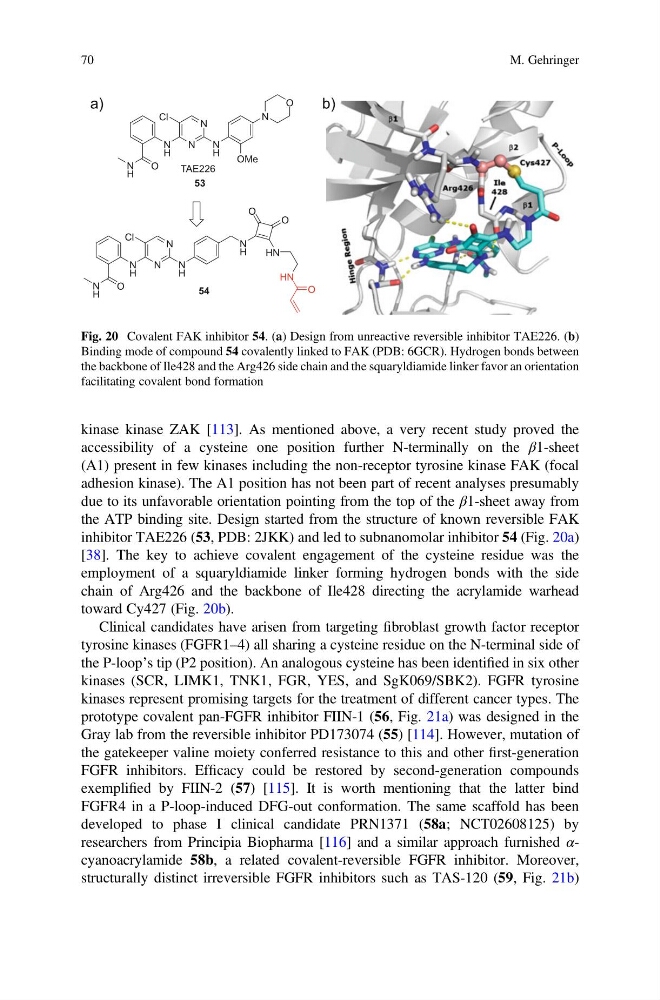
inhibitor TAE226 (53, PDB: 2JKK) and led to subnanomolar inhibitor 54 (Fig. 20a)
[38]. The key to achieve covalent engagement of the cysteine residue was the
employment of a squaryldiamide linker forming hydrogen bonds with the side
chain of Arg426 and the backbone of Ile428 directing the acrylamide warhead
toward Cy427 (Fig. 20b).
Clinical candidates have arisen from targeting fibroblast growth factor receptor
tyrosine kinases (FGFR1–4) all sharing a cysteine residue on the N-terminal side of
the P-loop’s tip (P2 position). An analogous cysteine has been identified in six other
kinases (SCR, LIMK1, TNK1, FGR, YES, and SgK069/SBK2). FGFR tyrosine
kinases represent promising targets for the treatment of different cancer types. The
prototype covalent pan-FGFR inhibitor FIIN-1 (56, Fig. 21a) was designed in the
Gray lab from the reversible inhibitor PD173074 (55) [114]. However, mutation of
the gatekeeper valine moiety conferred resistance to this and other first-generation
FGFR inhibitors. Efficacy could be restored by second-generation compounds
exemplified by FIIN-2 (57) [115]. It is worth mentioning that the latter bind
FGFR4 in a P-loop-induced DFG-out conformation. The same scaffold has been
developed to phase I clinical candidate PRN1371 (58a; NCT02608125) by
researchers from Principia Biopharma [116] and a similar approach furnished αcyanoacrylamide 58b, a related covalent-reversible FGFR inhibitor. Moreover,
structurally distinct irreversible FGFR inhibitors such as TAS-120 (59, Fig. 21b)
N
N
N
H
N
H
O
N
H
Cl
N
H
HN
O
O
O
HN
54
N
N
N
H
N
H
O
N
H
Cl
OMe
N
O
53
TAE226
a)
b)
Fig. 20 Covalent FAK inhibitor 54. (a) Design from unreactive reversible inhibitor TAE226. (b)
Binding mode of compound 54 covalently linked to FAK (PDB: 6GCR). Hydrogen bonds between
the backbone of Ile428 and the Arg426 side chain and the squaryldiamide linker favor an orientation
facilitating covalent bond formation
70
M. Gehringer
accessibility of a cysteine one position further N-terminally on the β1-sheet
(A1) present in few kinases including the non-receptor tyrosine kinase FAK (focal
adhesion kinase). The A1 position has not been part of recent analyses presumably
due to its unfavorable orientation pointing from the top of the β1-sheet away from
the ATP binding site. Design started from the structure of known reversible FAK
inhibitor TAE226 (53, PDB: 2JKK) and led to subnanomolar inhibitor 54 (Fig. 20a)
[38]. The key to achieve covalent engagement of the cysteine residue was the
employment of a squaryldiamide linker forming hydrogen bonds with the side
chain of Arg426 and the backbone of Ile428 directing the acrylamide warhead
toward Cy427 (Fig. 20b).
Clinical candidates have arisen from targeting fibroblast growth factor receptor
tyrosine kinases (FGFR1–4) all sharing a cysteine residue on the N-terminal side of
the P-loop’s tip (P2 position). An analogous cysteine has been identified in six other
kinases (SCR, LIMK1, TNK1, FGR, YES, and SgK069/SBK2). FGFR tyrosine
kinases represent promising targets for the treatment of different cancer types. The
prototype covalent pan-FGFR inhibitor FIIN-1 (56, Fig. 21a) was designed in the
Gray lab from the reversible inhibitor PD173074 (55) [114]. However, mutation of
the gatekeeper valine moiety conferred resistance to this and other first-generation
FGFR inhibitors. Efficacy could be restored by second-generation compounds
exemplified by FIIN-2 (57) [115]. It is worth mentioning that the latter bind
FGFR4 in a P-loop-induced DFG-out conformation. The same scaffold has been
developed to phase I clinical candidate PRN1371 (58a; NCT02608125) by
researchers from Principia Biopharma [116] and a similar approach furnished αcyanoacrylamide 58b, a related covalent-reversible FGFR inhibitor. Moreover,
structurally distinct irreversible FGFR inhibitors such as TAS-120 (59, Fig. 21b)
N
N
N
H
N
H
O
N
H
Cl
N
H
HN
O
O
O
HN
54
N
N
N
H
N
H
O
N
H
Cl
OMe
N
O
53
TAE226
a)
b)
Fig. 20 Covalent FAK inhibitor 54. (a) Design from unreactive reversible inhibitor TAE226. (b)
Binding mode of compound 54 covalently linked to FAK (PDB: 6GCR). Hydrogen bonds between
the backbone of Ile428 and the Arg426 side chain and the squaryldiamide linker favor an orientation
facilitating covalent bond formation
70
M. Gehringer