

used in Taunton’s seminal work on dually activated Michael acceptors as tunable
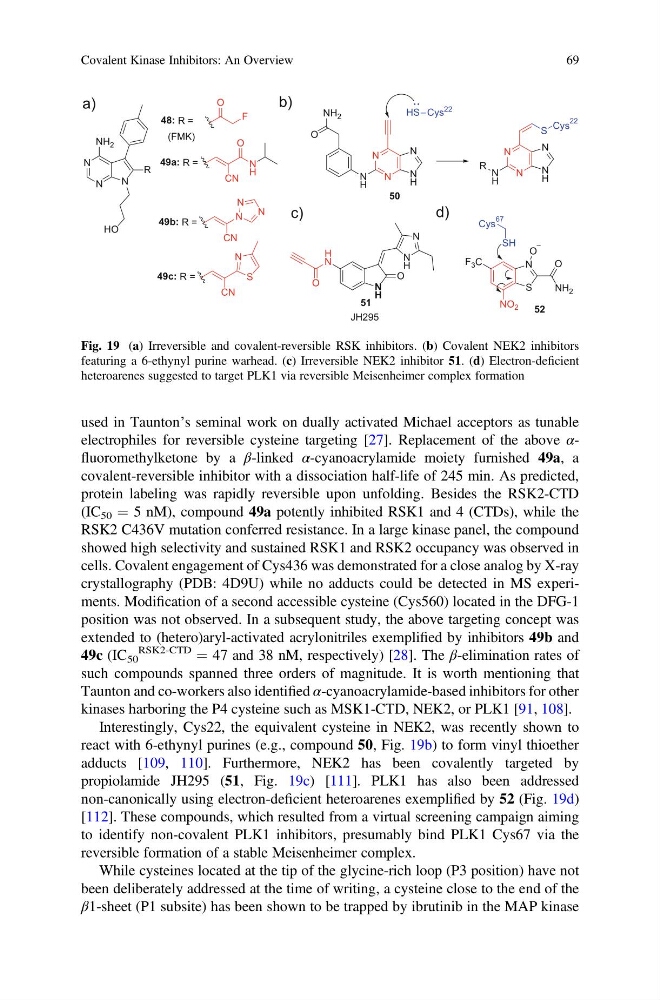
electrophiles for reversible cysteine targeting [27]. Replacement of the above αfluoromethylketone by a β-linked α-cyanoacrylamide moiety furnished 49a, a
covalent-reversible inhibitor with a dissociation half-life of 245 min. As predicted,
protein labeling was rapidly reversible upon unfolding. Besides the RSK2-CTD
(IC 50 ¼ 5 nM), compound 49a potently inhibited RSK1 and 4 (CTDs), while the
RSK2 C436V mutation conferred resistance. In a large kinase panel, the compound
showed high selectivity and sustained RSK1 and RSK2 occupancy was observed in
cells. Covalent engagement of Cys436 was demonstrated for a close analog by X-ray
crystallography (PDB: 4D9U) while no adducts could be detected in MS experiments. Modification of a second accessible cysteine (Cys560) located in the DFG-1
position was not observed. In a subsequent study, the above targeting concept was
extended to (hetero)aryl-activated acrylonitriles exemplified by inhibitors 49b and
49c (IC 50
RSK2-CTD
¼ 47 and 38 nM, respectively) [28]. The β-elimination rates of
such compounds spanned three orders of magnitude. It is worth mentioning that
Taunton and co-workers also identified α-cyanoacrylamide-based inhibitors for other
kinases harboring the P4 cysteine such as MSK1-CTD, NEK2, or PLK1 [91, 108].
Interestingly, Cys22, the equivalent cysteine in NEK2, was recently shown to
react with 6-ethynyl purines (e.g., compound 50, Fig. 19b) to form vinyl thioether
adducts [109, 110]. Furthermore, NEK2 has been covalently targeted by
propiolamide JH295 (51, Fig. 19c) [111]. PLK1 has also been addressed
non-canonically using electron-deficient heteroarenes exemplified by 52 (Fig. 19d)
[112]. These compounds, which resulted from a virtual screening campaign aiming
to identify non-covalent PLK1 inhibitors, presumably bind PLK1 Cys67 via the
reversible formation of a stable Meisenheimer complex.
While cysteines located at the tip of the glycine-rich loop (P3 position) have not
been deliberately addressed at the time of writing, a cysteine close to the end of the
β1-sheet (P1 subsite) has been shown to be trapped by ibrutinib in the MAP kinase
a)
N
N
N
NH 2
HO
R
F
O
CN
N
H
O
48: R =
(FMK)
49a: R =
N
CN
49b: R =
N
N
CN
49c: R =
S
N
N
H
O
N
N
H
H
N
O
b)
c)
N
N
N
H
N
N
H
NH 2
O
HS Cys
22
N
N
N
H
N
N
H
R
S
Cys
22
d)
S
N
O
NO 2
O
NH 2
F 3 C
SH
Cys
67
52
51
50
JH295
Fig. 19 (a) Irreversible and covalent-reversible RSK inhibitors. (b) Covalent NEK2 inhibitors
featuring a 6-ethynyl purine warhead. (c) Irreversible NEK2 inhibitor 51. (d) Electron-deficient
heteroarenes suggested to target PLK1 via reversible Meisenheimer complex formation
Covalent Kinase Inhibitors: An Overview
69
electrophiles for reversible cysteine targeting [27]. Replacement of the above αfluoromethylketone by a β-linked α-cyanoacrylamide moiety furnished 49a, a
covalent-reversible inhibitor with a dissociation half-life of 245 min. As predicted,
protein labeling was rapidly reversible upon unfolding. Besides the RSK2-CTD
(IC 50 ¼ 5 nM), compound 49a potently inhibited RSK1 and 4 (CTDs), while the
RSK2 C436V mutation conferred resistance. In a large kinase panel, the compound
showed high selectivity and sustained RSK1 and RSK2 occupancy was observed in
cells. Covalent engagement of Cys436 was demonstrated for a close analog by X-ray
crystallography (PDB: 4D9U) while no adducts could be detected in MS experiments. Modification of a second accessible cysteine (Cys560) located in the DFG-1
position was not observed. In a subsequent study, the above targeting concept was
extended to (hetero)aryl-activated acrylonitriles exemplified by inhibitors 49b and
49c (IC 50
RSK2-CTD
¼ 47 and 38 nM, respectively) [28]. The β-elimination rates of
such compounds spanned three orders of magnitude. It is worth mentioning that
Taunton and co-workers also identified α-cyanoacrylamide-based inhibitors for other
kinases harboring the P4 cysteine such as MSK1-CTD, NEK2, or PLK1 [91, 108].
Interestingly, Cys22, the equivalent cysteine in NEK2, was recently shown to
react with 6-ethynyl purines (e.g., compound 50, Fig. 19b) to form vinyl thioether
adducts [109, 110]. Furthermore, NEK2 has been covalently targeted by
propiolamide JH295 (51, Fig. 19c) [111]. PLK1 has also been addressed
non-canonically using electron-deficient heteroarenes exemplified by 52 (Fig. 19d)
[112]. These compounds, which resulted from a virtual screening campaign aiming
to identify non-covalent PLK1 inhibitors, presumably bind PLK1 Cys67 via the
reversible formation of a stable Meisenheimer complex.
While cysteines located at the tip of the glycine-rich loop (P3 position) have not
been deliberately addressed at the time of writing, a cysteine close to the end of the
β1-sheet (P1 subsite) has been shown to be trapped by ibrutinib in the MAP kinase
a)
N
N
N
NH 2
HO
R
F
O
CN
N
H
O
48: R =
(FMK)
49a: R =
N
CN
49b: R =
N
N
CN
49c: R =
S
N
N
H
O
N
N
H
H
N
O
b)
c)
N
N
N
H
N
N
H
NH 2
O
HS Cys
22
N
N
N
H
N
N
H
R
S
Cys
22
d)
S
N
O
NO 2
O
NH 2
F 3 C
SH
Cys
67
52
51
50
JH295
Fig. 19 (a) Irreversible and covalent-reversible RSK inhibitors. (b) Covalent NEK2 inhibitors
featuring a 6-ethynyl purine warhead. (c) Irreversible NEK2 inhibitor 51. (d) Electron-deficient
heteroarenes suggested to target PLK1 via reversible Meisenheimer complex formation
Covalent Kinase Inhibitors: An Overview
69