

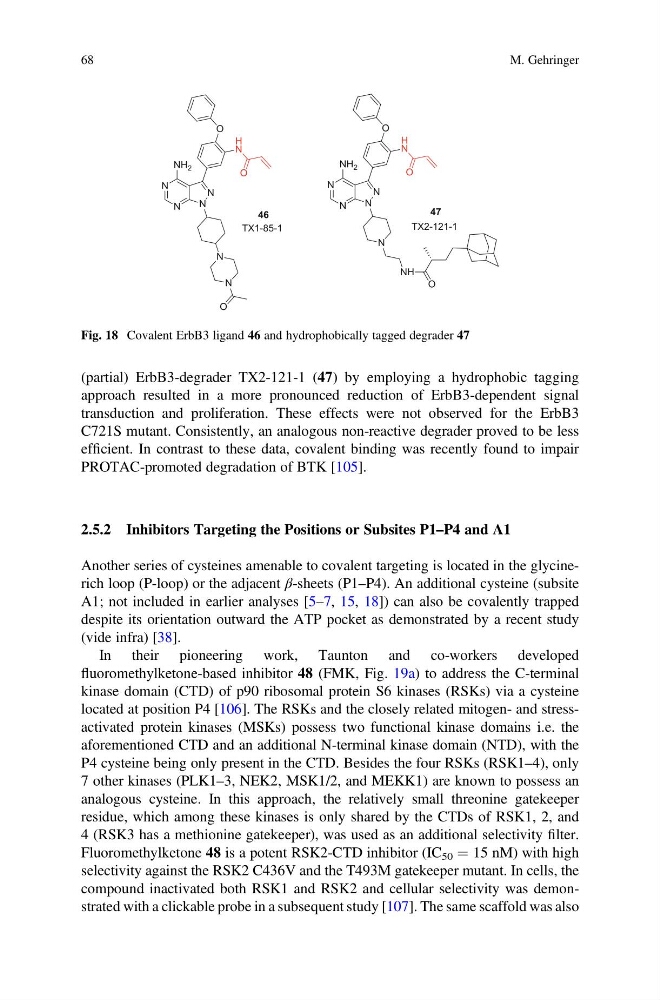
(partial) ErbB3-degrader TX2-121-1 (47) by employing a hydrophobic tagging
approach resulted in a more pronounced reduction of ErbB3-dependent signal
transduction and proliferation. These effects were not observed for the ErbB3
C721S mutant. Consistently, an analogous non-reactive degrader proved to be less
efficient. In contrast to these data, covalent binding was recently found to impair
PROTAC-promoted degradation of BTK [105].
2.5.2 Inhibitors Targeting the Positions or Subsites P1–P4 and A1
Another series of cysteines amenable to covalent targeting is located in the glycinerich loop (P-loop) or the adjacent β-sheets (P1–P4). An additional cysteine (subsite
A1; not included in earlier analyses [5–7, 15, 18]) can also be covalently trapped
despite its orientation outward the ATP pocket as demonstrated by a recent study
(vide infra) [38].
In their pioneering work, Taunton and co-workers developed
fluoromethylketone-based inhibitor 48 (FMK, Fig. 19a) to address the C-terminal
kinase domain (CTD) of p90 ribosomal protein S6 kinases (RSKs) via a cysteine
located at position P4 [106]. The RSKs and the closely related mitogen- and stressactivated protein kinases (MSKs) possess two functional kinase domains i.e. the
aforementioned CTD and an additional N-terminal kinase domain (NTD), with the
P4 cysteine being only present in the CTD. Besides the four RSKs (RSK1–4), only
7 other kinases (PLK1–3, NEK2, MSK1/2, and MEKK1) are known to possess an
analogous cysteine. In this approach, the relatively small threonine gatekeeper
residue, which among these kinases is only shared by the CTDs of RSK1, 2, and
4 (RSK3 has a methionine gatekeeper), was used as an additional selectivity filter.
Fluoromethylketone 48 is a potent RSK2-CTD inhibitor (IC 50 ¼ 15 nM) with high
selectivity against the RSK2 C436V and the T493M gatekeeper mutant. In cells, the
compound inactivated both RSK1 and RSK2 and cellular selectivity was demonstrated with a clickable probe in a subsequent study [107]. The same scaffold was also
NH 2
O
N
N
N
N
TX1-85-1
H
N
O
N
N
O
NH 2
O
N
N
N
N
H
N
O
N
NH
O
TX2-121-1
46
47
Fig. 18 Covalent ErbB3 ligand 46 and hydrophobically tagged degrader 47
68
M. Gehringer
approach resulted in a more pronounced reduction of ErbB3-dependent signal
transduction and proliferation. These effects were not observed for the ErbB3
C721S mutant. Consistently, an analogous non-reactive degrader proved to be less
efficient. In contrast to these data, covalent binding was recently found to impair
PROTAC-promoted degradation of BTK [105].
2.5.2 Inhibitors Targeting the Positions or Subsites P1–P4 and A1
Another series of cysteines amenable to covalent targeting is located in the glycinerich loop (P-loop) or the adjacent β-sheets (P1–P4). An additional cysteine (subsite
A1; not included in earlier analyses [5–7, 15, 18]) can also be covalently trapped
despite its orientation outward the ATP pocket as demonstrated by a recent study
(vide infra) [38].
In their pioneering work, Taunton and co-workers developed
fluoromethylketone-based inhibitor 48 (FMK, Fig. 19a) to address the C-terminal
kinase domain (CTD) of p90 ribosomal protein S6 kinases (RSKs) via a cysteine
located at position P4 [106]. The RSKs and the closely related mitogen- and stressactivated protein kinases (MSKs) possess two functional kinase domains i.e. the
aforementioned CTD and an additional N-terminal kinase domain (NTD), with the
P4 cysteine being only present in the CTD. Besides the four RSKs (RSK1–4), only
7 other kinases (PLK1–3, NEK2, MSK1/2, and MEKK1) are known to possess an
analogous cysteine. In this approach, the relatively small threonine gatekeeper
residue, which among these kinases is only shared by the CTDs of RSK1, 2, and
4 (RSK3 has a methionine gatekeeper), was used as an additional selectivity filter.
Fluoromethylketone 48 is a potent RSK2-CTD inhibitor (IC 50 ¼ 15 nM) with high
selectivity against the RSK2 C436V and the T493M gatekeeper mutant. In cells, the
compound inactivated both RSK1 and RSK2 and cellular selectivity was demonstrated with a clickable probe in a subsequent study [107]. The same scaffold was also
NH 2
O
N
N
N
N
TX1-85-1
H
N
O
N
N
O
NH 2
O
N
N
N
N
H
N
O
N
NH
O
TX2-121-1
46
47
Fig. 18 Covalent ErbB3 ligand 46 and hydrophobically tagged degrader 47
68
M. Gehringer