

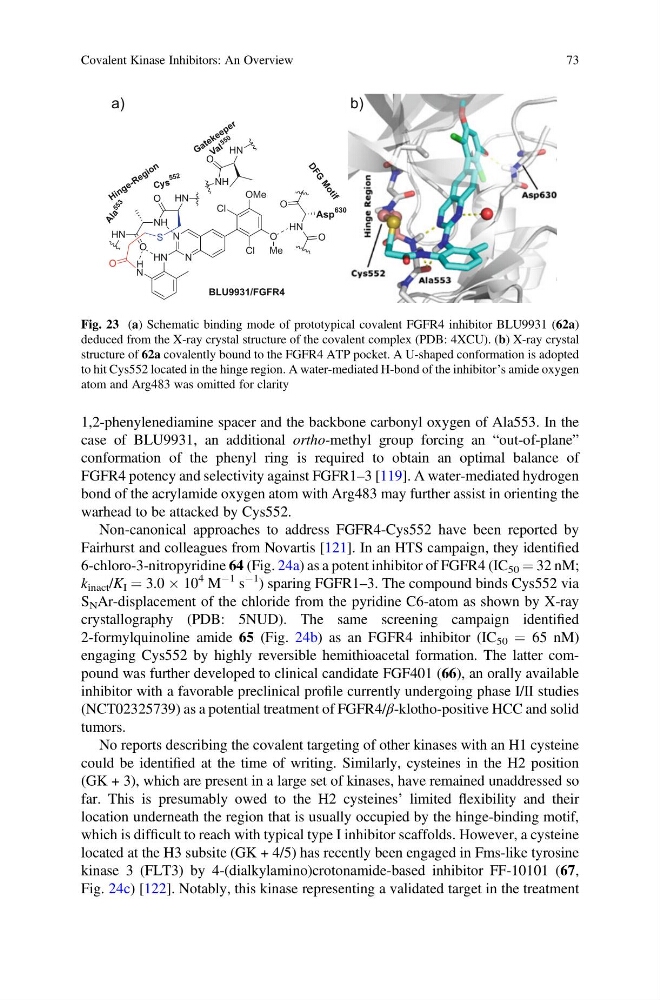
1,2-phenylenediamine spacer and the backbone carbonyl oxygen of Ala553. In the
case of BLU9931, an additional ortho-methyl group forcing an “out-of-plane”
conformation of the phenyl ring is required to obtain an optimal balance of
FGFR4 potency and selectivity against FGFR1–3 [119]. A water-mediated hydrogen
bond of the acrylamide oxygen atom with Arg483 may further assist in orienting the
warhead to be attacked by Cys552.
Non-canonical approaches to address FGFR4-Cys552 have been reported by
Fairhurst and colleagues from Novartis [121]. In an HTS campaign, they identified
6-chloro-3-nitropyridine 64 (Fig. 24a) as a potent inhibitor of FGFR4 (IC 50 ¼ 32 nM;
k inact /K I ¼ 3.0 Â 10
4 M
À1 s
À1 ) sparing FGFR1–3. The compound binds Cys552 via
S N Ar-displacement of the chloride from the pyridine C6-atom as shown by X-ray
crystallography (PDB: 5NUD). The same screening campaign identified
2-formylquinoline amide 65 (Fig. 24b) as an FGFR4 inhibitor (IC 50 ¼ 65 nM)
engaging Cys552 by highly reversible hemithioacetal formation. The latter compound was further developed to clinical candidate FGF401 (66), an orally available
inhibitor with a favorable preclinical profile currently undergoing phase I/II studies
(NCT02325739) as a potential treatment of FGFR4/β-klotho-positive HCC and solid
tumors.
No reports describing the covalent targeting of other kinases with an H1 cysteine
could be identified at the time of writing. Similarly, cysteines in the H2 position
(GK + 3), which are present in a large set of kinases, have remained unaddressed so
far. This is presumably owed to the H2 cysteines’ limited flexibility and their
location underneath the region that is usually occupied by the hinge-binding motif,
which is difficult to reach with typical type I inhibitor scaffolds. However, a cysteine
located at the H3 subsite (GK + 4/5) has recently been engaged in Fms-like tyrosine
kinase 3 (FLT3) by 4-(dialkylamino)crotonamide-based inhibitor FF-10101 (67,
Fig. 24c) [122]. Notably, this kinase representing a validated target in the treatment
N
N
BLU9931/FGFR4
HN
N
O
O
HN
NH
O HN
S
H
Cl
Cl
OMe
O
NH
O
HN
HN
O
Asp
630
O
Me
G a t e k e e p e r
V a l
5 5 0
Cy s
55 2
A l a 5 5 3
D F G
M
o t i f
H in
g e - R e g io
n
a)
b)
Fig. 23 (a) Schematic binding mode of prototypical covalent FGFR4 inhibitor BLU9931 (62a)
deduced from the X-ray crystal structure of the covalent complex (PDB: 4XCU). (b) X-ray crystal
structure of 62a covalently bound to the FGFR4 ATP pocket. A U-shaped conformation is adopted
to hit Cys552 located in the hinge region. A water-mediated H-bond of the inhibitor’s amide oxygen
atom and Arg483 was omitted for clarity
Covalent Kinase Inhibitors: An Overview
73
case of BLU9931, an additional ortho-methyl group forcing an “out-of-plane”
conformation of the phenyl ring is required to obtain an optimal balance of
FGFR4 potency and selectivity against FGFR1–3 [119]. A water-mediated hydrogen
bond of the acrylamide oxygen atom with Arg483 may further assist in orienting the
warhead to be attacked by Cys552.
Non-canonical approaches to address FGFR4-Cys552 have been reported by
Fairhurst and colleagues from Novartis [121]. In an HTS campaign, they identified
6-chloro-3-nitropyridine 64 (Fig. 24a) as a potent inhibitor of FGFR4 (IC 50 ¼ 32 nM;
k inact /K I ¼ 3.0 Â 10
4 M
À1 s
À1 ) sparing FGFR1–3. The compound binds Cys552 via
S N Ar-displacement of the chloride from the pyridine C6-atom as shown by X-ray
crystallography (PDB: 5NUD). The same screening campaign identified
2-formylquinoline amide 65 (Fig. 24b) as an FGFR4 inhibitor (IC 50 ¼ 65 nM)
engaging Cys552 by highly reversible hemithioacetal formation. The latter compound was further developed to clinical candidate FGF401 (66), an orally available
inhibitor with a favorable preclinical profile currently undergoing phase I/II studies
(NCT02325739) as a potential treatment of FGFR4/β-klotho-positive HCC and solid
tumors.
No reports describing the covalent targeting of other kinases with an H1 cysteine
could be identified at the time of writing. Similarly, cysteines in the H2 position
(GK + 3), which are present in a large set of kinases, have remained unaddressed so
far. This is presumably owed to the H2 cysteines’ limited flexibility and their
location underneath the region that is usually occupied by the hinge-binding motif,
which is difficult to reach with typical type I inhibitor scaffolds. However, a cysteine
located at the H3 subsite (GK + 4/5) has recently been engaged in Fms-like tyrosine
kinase 3 (FLT3) by 4-(dialkylamino)crotonamide-based inhibitor FF-10101 (67,
Fig. 24c) [122]. Notably, this kinase representing a validated target in the treatment
N
N
BLU9931/FGFR4
HN
N
O
O
HN
NH
O HN
S
H
Cl
Cl
OMe
O
NH
O
HN
HN
O
Asp
630
O
Me
G a t e k e e p e r
V a l
5 5 0
Cy s
55 2
A l a 5 5 3
D F G
M
o t i f
H in
g e - R e g io
n
a)
b)
Fig. 23 (a) Schematic binding mode of prototypical covalent FGFR4 inhibitor BLU9931 (62a)
deduced from the X-ray crystal structure of the covalent complex (PDB: 4XCU). (b) X-ray crystal
structure of 62a covalently bound to the FGFR4 ATP pocket. A U-shaped conformation is adopted
to hit Cys552 located in the hinge region. A water-mediated H-bond of the inhibitor’s amide oxygen
atom and Arg483 was omitted for clarity
Covalent Kinase Inhibitors: An Overview
73