

presumably also Cys803 in ErbB4). Improved efficacy of 16 compared to the
biochemically almost equipotent propionamide analog was observed in a xenograft
model highlighting the potential pharmacological advantages of covalent inhibitors.
Further development of analogous compounds led to canertinib (CI-1033, 17), the
first irreversible pan-ErbB inhibitor entering clinical trials [63]. The development of
canertinib, however, was recently discontinued. Afatinib (1), the first approved
covalent ErbB inhibitor features a very similar structure. Besides modifications at
the quinazoline’s C7 substituent, a key difference consists in the replacement of
canertinib’s acrylamide warhead by an analogous 4-(dialkylamino) crotonamide to
assist the deprotonation of the cysteine’s thiol group (see the mechanism in Fig. 9b).
Although afatinib showed high efficacy in the treatment of NSCLC with activating
EGFR mutations, the drug suffered from dose-limiting side effects hampering its use
for overcoming the T790M resistance. Approval of the structural analog dacomitinib
(2) was delayed until recently since early trails did not prove superiority compared to
first generation EGFR inhibitors.
On the basis of the related quinoline scaffold, compounds featuring a carbonitrile
group at the C3-position of the heterocyclic core were developed in order to increase
ErbB2 inhibitory activity, the latter being frequently overexpressed in breast cancer
[64]. These efforts culminated in the recent approval of neratinib (3).
Third-generation EGFR inhibitors were designed to target resistant/activating
EGFR-mutants (e.g., EGFR L858R/T790M) while sparing the wild-type kinase to
decrease dose-limiting side effects, which constitute a key liability of the secondgeneration drugs. The structure of such compounds does not rely on the prototypical
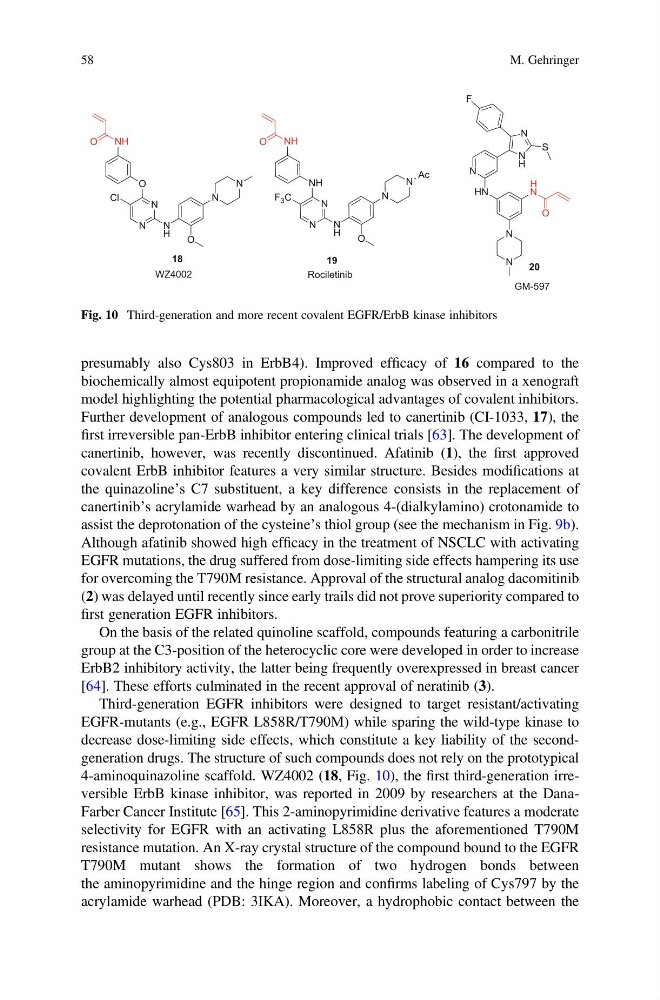
4-aminoquinazoline scaffold. WZ4002 (18, Fig. 10), the first third-generation irreversible ErbB kinase inhibitor, was reported in 2009 by researchers at the DanaFarber Cancer Institute [65]. This 2-aminopyrimidine derivative features a moderate
selectivity for EGFR with an activating L858R plus the aforementioned T790M
resistance mutation. An X-ray crystal structure of the compound bound to the EGFR
T790M mutant shows the formation of two hydrogen bonds between
the aminopyrimidine and the hinge region and confirms labeling of Cys797 by the
acrylamide warhead (PDB: 3IKA). Moreover, a hydrophobic contact between the
18
WZ4002
Cl
O
N
N
N
H
N
N
O
NH
O
N
H
N
S
N
HN
F
N
H
N
O
N
20
GM-597
F 3 C
N
NH
N
N
H
NH
O
O
N
N
Rociletinib
Ac
19
Fig. 10 Third-generation and more recent covalent EGFR/ErbB kinase inhibitors
58
M. Gehringer
biochemically almost equipotent propionamide analog was observed in a xenograft
model highlighting the potential pharmacological advantages of covalent inhibitors.
Further development of analogous compounds led to canertinib (CI-1033, 17), the
first irreversible pan-ErbB inhibitor entering clinical trials [63]. The development of
canertinib, however, was recently discontinued. Afatinib (1), the first approved
covalent ErbB inhibitor features a very similar structure. Besides modifications at
the quinazoline’s C7 substituent, a key difference consists in the replacement of
canertinib’s acrylamide warhead by an analogous 4-(dialkylamino) crotonamide to
assist the deprotonation of the cysteine’s thiol group (see the mechanism in Fig. 9b).
Although afatinib showed high efficacy in the treatment of NSCLC with activating
EGFR mutations, the drug suffered from dose-limiting side effects hampering its use
for overcoming the T790M resistance. Approval of the structural analog dacomitinib
(2) was delayed until recently since early trails did not prove superiority compared to
first generation EGFR inhibitors.
On the basis of the related quinoline scaffold, compounds featuring a carbonitrile
group at the C3-position of the heterocyclic core were developed in order to increase
ErbB2 inhibitory activity, the latter being frequently overexpressed in breast cancer
[64]. These efforts culminated in the recent approval of neratinib (3).
Third-generation EGFR inhibitors were designed to target resistant/activating
EGFR-mutants (e.g., EGFR L858R/T790M) while sparing the wild-type kinase to
decrease dose-limiting side effects, which constitute a key liability of the secondgeneration drugs. The structure of such compounds does not rely on the prototypical
4-aminoquinazoline scaffold. WZ4002 (18, Fig. 10), the first third-generation irreversible ErbB kinase inhibitor, was reported in 2009 by researchers at the DanaFarber Cancer Institute [65]. This 2-aminopyrimidine derivative features a moderate
selectivity for EGFR with an activating L858R plus the aforementioned T790M
resistance mutation. An X-ray crystal structure of the compound bound to the EGFR
T790M mutant shows the formation of two hydrogen bonds between
the aminopyrimidine and the hinge region and confirms labeling of Cys797 by the
acrylamide warhead (PDB: 3IKA). Moreover, a hydrophobic contact between the
18
WZ4002
Cl
O
N
N
N
H
N
N
O
NH
O
N
H
N
S
N
HN
F
N
H
N
O
N
20
GM-597
F 3 C
N
NH
N
N
H
NH
O
O
N
N
Rociletinib
Ac
19
Fig. 10 Third-generation and more recent covalent EGFR/ErbB kinase inhibitors
58
M. Gehringer