

pyrimidine’s 5-chloro substituent and the sulfur atom of the gatekeeper methionine
residue is observed. The latter interaction, which also can be interpreted within the
conceptual framework of halogen bonding [66, 67], is thought to contribute to the
observed selectivity for the T790M mutant. Rociletinib (CO1686, 19), a structurally
related inhibitor developed by Clovis Oncology and tested in clinical trials up to
phase III (NCT02322281) was dropped in May 2016 for several reasons including
lower response rates and a less favorable benefit–risk profile compared to
osimertinib [68], which was simultaneously developed by AstraZeneca. Osimertinib
successfully gained fast track approval in 2015/16 [69].
Besides escape pathways (e.g., HER2 and MET amplification or PI3K/AKT/
mTOR activation), resistance to third-generation EGFR inhibitors is frequently
driven by mutation of the reactive cysteine to serine. The common L858R/T790M/
C797S triple mutant, for example, precludes covalent binding and is resistant against
all EGFR inhibitor generations. A new EGFR inhibitor type (exemplified by
GM-597, 20) that covalently binds gefitinib-resistant double mutants while
maintaining nanomolar reversible activity against EGFR L858R/T790M/C797S
has recently been described by Günther et al. [70, 71].
The second class of clinically successful covalent kinase inhibitors addresses
Bruton’s tyrosine kinase (BTK), with two compounds being currently approved by
the FDA (vide supra). BTK is a cytoplasmic tyrosine kinase belonging to the TEC
family and plays a key role in B-cell receptor signaling. Due to its essential function
in B-cell development, BTK has been selected as a target not only for the treatment
of B-cell malignancies, but also for inflammatory and autoimmune disorders. Like
the aforementioned ErbB family kinases, BTK features a cysteine residue in the F2
position (Cys481). In 2006, the first covalent BTK inhibitors were reported by
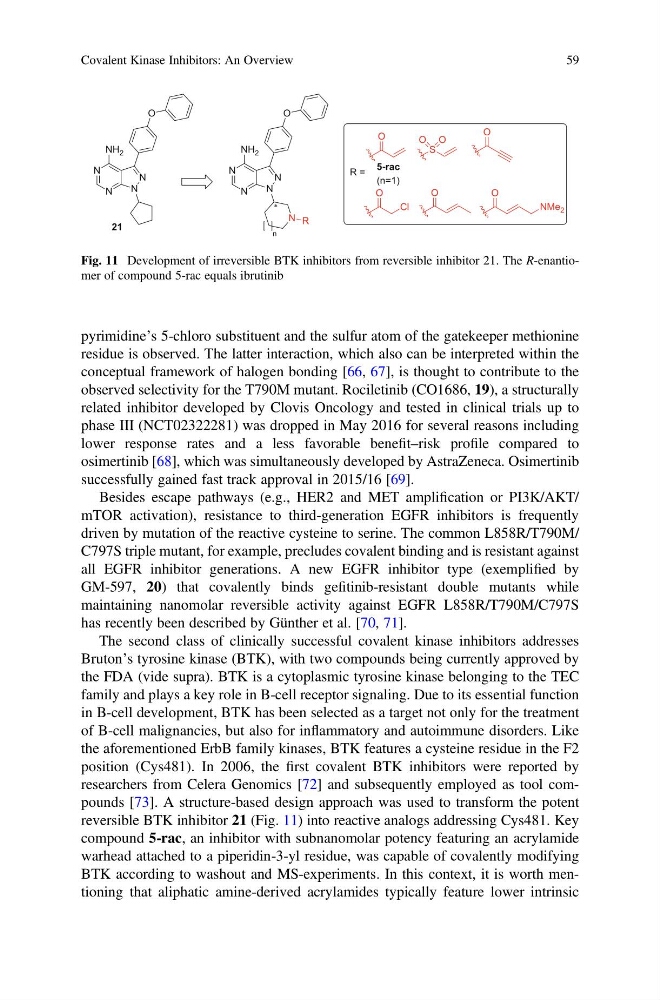
researchers from Celera Genomics [72] and subsequently employed as tool compounds [73]. A structure-based design approach was used to transform the potent
reversible BTK inhibitor 21 (Fig. 11) into reactive analogs addressing Cys481. Key
compound 5-rac, an inhibitor with subnanomolar potency featuring an acrylamide
warhead attached to a piperidin-3-yl residue, was capable of covalently modifying
BTK according to washout and MS-experiments. In this context, it is worth mentioning that aliphatic amine-derived acrylamides typically feature lower intrinsic
N
N
N
N
NH 2
21
N
N
N
N
NH 2
∗
N R
n
R =
S
O O
O
O
O
O
NMe 2
O
Cl
5-rac
(n=1)
O
O
Fig. 11 Development of irreversible BTK inhibitors from reversible inhibitor 21. The R-enantiomer of compound 5-rac equals ibrutinib
Covalent Kinase Inhibitors: An Overview
59
residue is observed. The latter interaction, which also can be interpreted within the
conceptual framework of halogen bonding [66, 67], is thought to contribute to the
observed selectivity for the T790M mutant. Rociletinib (CO1686, 19), a structurally
related inhibitor developed by Clovis Oncology and tested in clinical trials up to
phase III (NCT02322281) was dropped in May 2016 for several reasons including
lower response rates and a less favorable benefit–risk profile compared to
osimertinib [68], which was simultaneously developed by AstraZeneca. Osimertinib
successfully gained fast track approval in 2015/16 [69].
Besides escape pathways (e.g., HER2 and MET amplification or PI3K/AKT/
mTOR activation), resistance to third-generation EGFR inhibitors is frequently
driven by mutation of the reactive cysteine to serine. The common L858R/T790M/
C797S triple mutant, for example, precludes covalent binding and is resistant against
all EGFR inhibitor generations. A new EGFR inhibitor type (exemplified by
GM-597, 20) that covalently binds gefitinib-resistant double mutants while
maintaining nanomolar reversible activity against EGFR L858R/T790M/C797S
has recently been described by Günther et al. [70, 71].
The second class of clinically successful covalent kinase inhibitors addresses
Bruton’s tyrosine kinase (BTK), with two compounds being currently approved by
the FDA (vide supra). BTK is a cytoplasmic tyrosine kinase belonging to the TEC
family and plays a key role in B-cell receptor signaling. Due to its essential function
in B-cell development, BTK has been selected as a target not only for the treatment
of B-cell malignancies, but also for inflammatory and autoimmune disorders. Like
the aforementioned ErbB family kinases, BTK features a cysteine residue in the F2
position (Cys481). In 2006, the first covalent BTK inhibitors were reported by
researchers from Celera Genomics [72] and subsequently employed as tool compounds [73]. A structure-based design approach was used to transform the potent
reversible BTK inhibitor 21 (Fig. 11) into reactive analogs addressing Cys481. Key
compound 5-rac, an inhibitor with subnanomolar potency featuring an acrylamide
warhead attached to a piperidin-3-yl residue, was capable of covalently modifying
BTK according to washout and MS-experiments. In this context, it is worth mentioning that aliphatic amine-derived acrylamides typically feature lower intrinsic
N
N
N
N
NH 2
21
N
N
N
N
NH 2
∗
N R
n
R =
S
O O
O
O
O
O
NMe 2
O
Cl
5-rac
(n=1)
O
O
Fig. 11 Development of irreversible BTK inhibitors from reversible inhibitor 21. The R-enantiomer of compound 5-rac equals ibrutinib
Covalent Kinase Inhibitors: An Overview
59