

2.4 Development of Inhibitors Targeting Cysteines
in the Front Region
2.4.1 Inhibitors Targeting the F2 Position
So far, the most extensive research efforts have been directed toward kinases featuring
a cysteine residue at the F2 (αD À 1) position. Being located in the solvent-exposed
front region, F2 cysteines are common to 11 kinases, namely the ErbB family
members EGFR, ErbB2, and ErbB4 (but not the pseudokinase ErbB3), the TEC
family kinases (TEC, BTK, ITK, BMX, and TXK), the SRC kinase BLK, the Janus
kinase JAK3, and the MAP kinase kinase MKK7. The most considerable drug
discovery efforts have been aimed toward Cys797 of the EGFR receptor tyrosine
kinase. As a member of the ErbB family, EGFR (also referred to as HER1 or ErbB1)
transduces growth signals either as a homodimer or as a heterodimer with other ErbB
family members. Aberrant EGFR activity is a common driver of non-small cell lung
cancer (NSCLC) and patients with certain activating EGFR mutations (e.g., L858R
or exon 19 deletions) showed impressive response rates to first-generation (reversible) EGFR inhibitors such as gefitinib (see Fig. 5) or erlotinib. Unfortunately,
secondary resistance mutations, most notably the T790M mutation of the gatekeeper
residue, appeared rapidly and rendered first-generation EGFR inhibitors virtually
inactive in approximately half of the responder population. In this light, second- and
third-generation EGFR inhibitors were developed to exploit the nucleophilic nature
of Cys797.
Pioneering work was reported already in the late 1990s by Singh, Fry, and
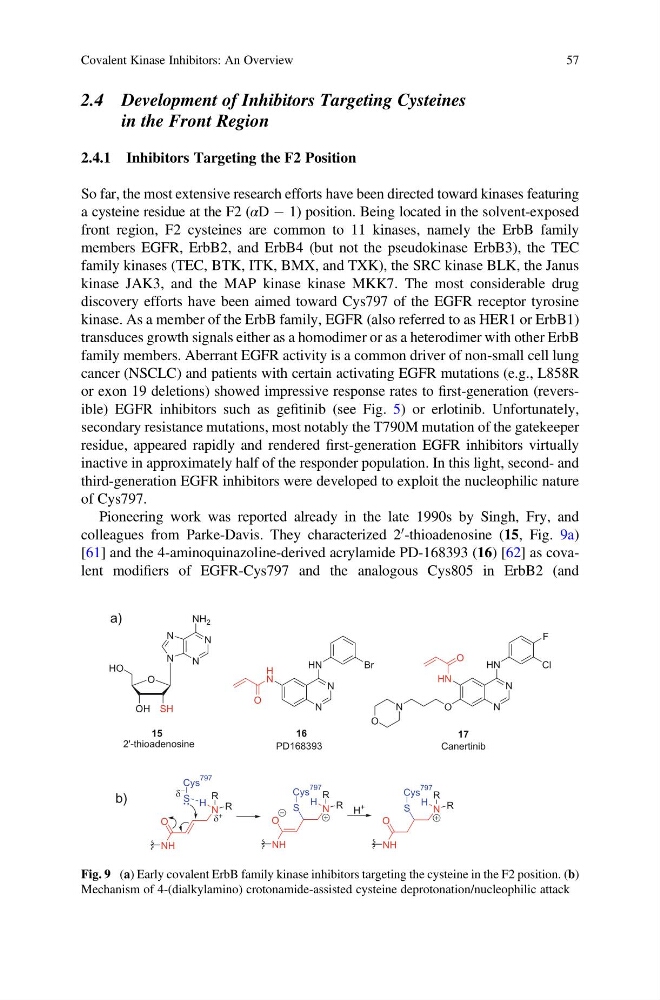
colleagues from Parke-Davis. They characterized 2
0 -thioadenosine (15, Fig. 9a)
[61] and the 4-aminoquinazoline-derived acrylamide PD-168393 (16) [62] as covalent modifiers of EGFR-Cys797 and the analogous Cys805 in ErbB2 (and
N
N
H
N
O
HN
Br
PD168393
N
N
N
N
NH 2
O
OH
HO
SH
2'-thioadenosine
15
16
17
Canertinib
HN
F
Cl
HN
O
N
N
N
O
O
a)
b)
R
N
R
H
S
Cys
797
δ
+
δ
−
NH
O
R
N
R
H
S
Cys
797
NH
O
H
+
R
N
R
H
S
Cys
797
NH
O
Fig. 9 (a) Early covalent ErbB family kinase inhibitors targeting the cysteine in the F2 position. (b)
Mechanism of 4-(dialkylamino) crotonamide-assisted cysteine deprotonation/nucleophilic attack
Covalent Kinase Inhibitors: An Overview
57
in the Front Region
2.4.1 Inhibitors Targeting the F2 Position
So far, the most extensive research efforts have been directed toward kinases featuring
a cysteine residue at the F2 (αD À 1) position. Being located in the solvent-exposed
front region, F2 cysteines are common to 11 kinases, namely the ErbB family
members EGFR, ErbB2, and ErbB4 (but not the pseudokinase ErbB3), the TEC
family kinases (TEC, BTK, ITK, BMX, and TXK), the SRC kinase BLK, the Janus
kinase JAK3, and the MAP kinase kinase MKK7. The most considerable drug
discovery efforts have been aimed toward Cys797 of the EGFR receptor tyrosine
kinase. As a member of the ErbB family, EGFR (also referred to as HER1 or ErbB1)
transduces growth signals either as a homodimer or as a heterodimer with other ErbB
family members. Aberrant EGFR activity is a common driver of non-small cell lung
cancer (NSCLC) and patients with certain activating EGFR mutations (e.g., L858R
or exon 19 deletions) showed impressive response rates to first-generation (reversible) EGFR inhibitors such as gefitinib (see Fig. 5) or erlotinib. Unfortunately,
secondary resistance mutations, most notably the T790M mutation of the gatekeeper
residue, appeared rapidly and rendered first-generation EGFR inhibitors virtually
inactive in approximately half of the responder population. In this light, second- and
third-generation EGFR inhibitors were developed to exploit the nucleophilic nature
of Cys797.
Pioneering work was reported already in the late 1990s by Singh, Fry, and
colleagues from Parke-Davis. They characterized 2
0 -thioadenosine (15, Fig. 9a)
[61] and the 4-aminoquinazoline-derived acrylamide PD-168393 (16) [62] as covalent modifiers of EGFR-Cys797 and the analogous Cys805 in ErbB2 (and
N
N
H
N
O
HN
Br
PD168393
N
N
N
N
NH 2
O
OH
HO
SH
2'-thioadenosine
15
16
17
Canertinib
HN
F
Cl
HN
O
N
N
N
O
O
a)
b)
R
N
R
H
S
Cys
797
δ
+
δ
−
NH
O
R
N
R
H
S
Cys
797
NH
O
H
+
R
N
R
H
S
Cys
797
NH
O
Fig. 9 (a) Early covalent ErbB family kinase inhibitors targeting the cysteine in the F2 position. (b)
Mechanism of 4-(dialkylamino) crotonamide-assisted cysteine deprotonation/nucleophilic attack
Covalent Kinase Inhibitors: An Overview
57