

hematologic malignancies with FLT3 and/or Ras mutations (NCT02418000, terminated), and recently for melanoma CNS metastases (NCT03332589). Further natural
products that are known to covalently engage protein kinases via cysteine adduction
include, for example, cyclopentenone prostaglandins (e.g., PGA 1 , 11) targeting the
activation loop cysteine (Cys178/179) in IKKα/β [57] or pyranonaphthoquinones
(e.g., lactoquinomycin, 12) targeting Cys296 and Cys310 (O2-position) in the
activation loop of AKT1 [58].
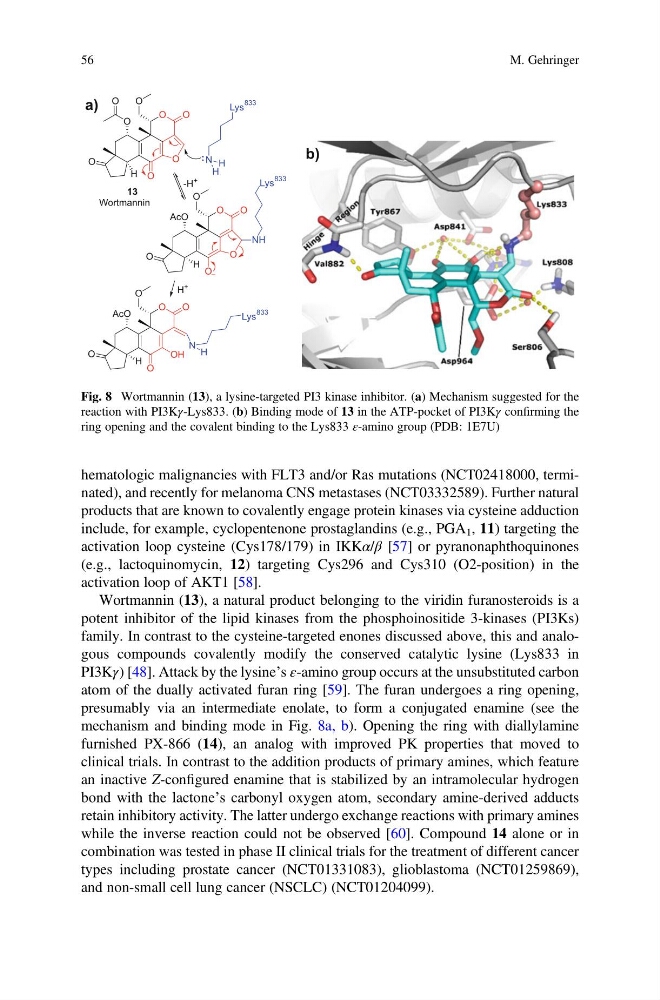
Wortmannin (13), a natural product belonging to the viridin furanosteroids is a
potent inhibitor of the lipid kinases from the phosphoinositide 3-kinases (PI3Ks)
family. In contrast to the cysteine-targeted enones discussed above, this and analogous compounds covalently modify the conserved catalytic lysine (Lys833 in
PI3Kγ) [48]. Attack by the lysine’s ε-amino group occurs at the unsubstituted carbon
atom of the dually activated furan ring [59]. The furan undergoes a ring opening,
presumably via an intermediate enolate, to form a conjugated enamine (see the
mechanism and binding mode in Fig. 8a, b). Opening the ring with diallylamine
furnished PX-866 (14), an analog with improved PK properties that moved to
clinical trials. In contrast to the addition products of primary amines, which feature
an inactive Z-configured enamine that is stabilized by an intramolecular hydrogen
bond with the lactone’s carbonyl oxygen atom, secondary amine-derived adducts
retain inhibitory activity. The latter undergo exchange reactions with primary amines
while the inverse reaction could not be observed [60]. Compound 14 alone or in
combination was tested in phase II clinical trials for the treatment of different cancer
types including prostate cancer (NCT01331083), glioblastoma (NCT01259869),
and non-small cell lung cancer (NSCLC) (NCT01204099).
O
O
O
H
O
O
O
O
O
Wortmannin
13
N
Lys
833
O
AcO
H
O
O
O
O
O
NH
Lys
833
O
AcO
H
O
O
O
OH
O
Lys
833
-H
+
H
+
N
H
H
H
a)
b)
Fig. 8 Wortmannin (13), a lysine-targeted PI3 kinase inhibitor. (a) Mechanism suggested for the
reaction with PI3Kγ-Lys833. (b) Binding mode of 13 in the ATP-pocket of PI3Kγ confirming the
ring opening and the covalent binding to the Lys833 ε-amino group (PDB: 1E7U)
56
M. Gehringer
products that are known to covalently engage protein kinases via cysteine adduction
include, for example, cyclopentenone prostaglandins (e.g., PGA 1 , 11) targeting the
activation loop cysteine (Cys178/179) in IKKα/β [57] or pyranonaphthoquinones
(e.g., lactoquinomycin, 12) targeting Cys296 and Cys310 (O2-position) in the
activation loop of AKT1 [58].
Wortmannin (13), a natural product belonging to the viridin furanosteroids is a
potent inhibitor of the lipid kinases from the phosphoinositide 3-kinases (PI3Ks)
family. In contrast to the cysteine-targeted enones discussed above, this and analogous compounds covalently modify the conserved catalytic lysine (Lys833 in
PI3Kγ) [48]. Attack by the lysine’s ε-amino group occurs at the unsubstituted carbon
atom of the dually activated furan ring [59]. The furan undergoes a ring opening,
presumably via an intermediate enolate, to form a conjugated enamine (see the
mechanism and binding mode in Fig. 8a, b). Opening the ring with diallylamine
furnished PX-866 (14), an analog with improved PK properties that moved to
clinical trials. In contrast to the addition products of primary amines, which feature
an inactive Z-configured enamine that is stabilized by an intramolecular hydrogen
bond with the lactone’s carbonyl oxygen atom, secondary amine-derived adducts
retain inhibitory activity. The latter undergo exchange reactions with primary amines
while the inverse reaction could not be observed [60]. Compound 14 alone or in
combination was tested in phase II clinical trials for the treatment of different cancer
types including prostate cancer (NCT01331083), glioblastoma (NCT01259869),
and non-small cell lung cancer (NSCLC) (NCT01204099).
O
O
O
H
O
O
O
O
O
Wortmannin
13
N
Lys
833
O
AcO
H
O
O
O
O
O
NH
Lys
833
O
AcO
H
O
O
O
OH
O
Lys
833
-H
+
H
+
N
H
H
H
a)
b)
Fig. 8 Wortmannin (13), a lysine-targeted PI3 kinase inhibitor. (a) Mechanism suggested for the
reaction with PI3Kγ-Lys833. (b) Binding mode of 13 in the ATP-pocket of PI3Kγ confirming the
ring opening and the covalent binding to the Lys833 ε-amino group (PDB: 1E7U)
56
M. Gehringer