

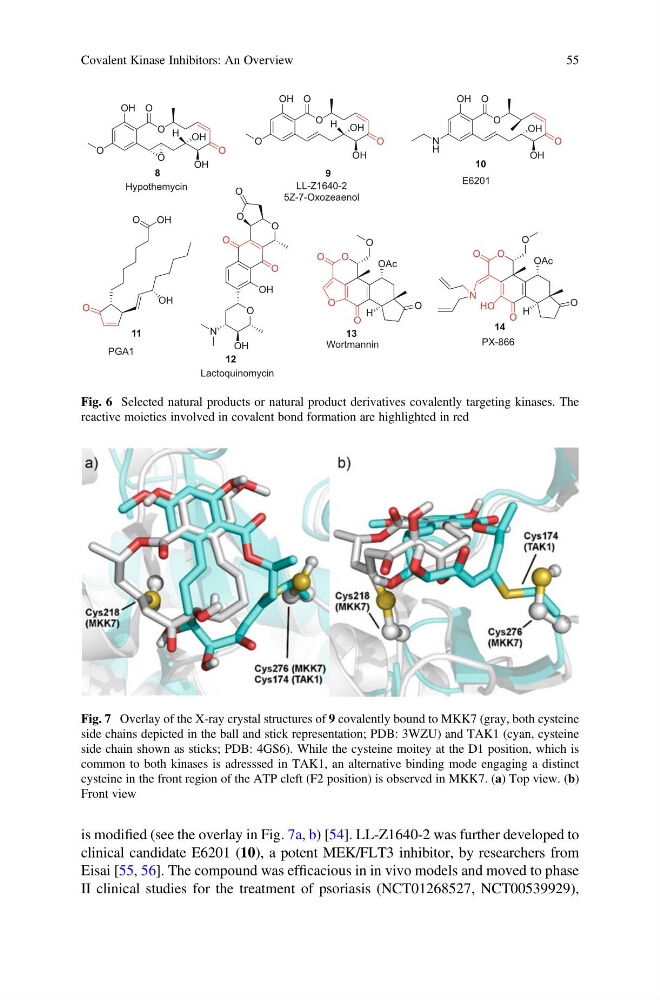
is modified (see the overlay in Fig. 7a, b) [54]. LL-Z1640-2 was further developed to
clinical candidate E6201 (10), a potent MEK/FLT3 inhibitor, by researchers from
Eisai [55, 56]. The compound was efficacious in in vivo models and moved to phase
II clinical studies for the treatment of psoriasis (NCT01268527, NCT00539929),
O
O
OH
OH
O
O
OH O
Hypothemycin
O
O
OH
O
O
OH
OH
LL-Z1640-2
5Z-7-Oxozeaenol
8
9
E6201
10
H
H
O
O
OH
N
H
O
OH
OH
O
OAc
H
O
O
O
O
O
Wortmannin
13
O
O
O
O
O
O
OH
N
OH
Lactoquinomycin
12
OH
O
OH
O
PGA1
11
OAc
O
O
O
O
H
PX-866
HO
N
O
14
Fig. 6 Selected natural products or natural product derivatives covalently targeting kinases. The
reactive moieties involved in covalent bond formation are highlighted in red
Fig. 7 Overlay of the X-ray crystal structures of 9 covalently bound to MKK7 (gray, both cysteine
side chains depicted in the ball and stick representation; PDB: 3WZU) and TAK1 (cyan, cysteine
side chain shown as sticks; PDB: 4GS6). While the cysteine moitey at the D1 position, which is
common to both kinases is adresssed in TAK1, an alternative binding mode engaging a distinct
cysteine in the front region of the ATP cleft (F2 position) is observed in MKK7. (a) Top view. (b)
Front view
Covalent Kinase Inhibitors: An Overview
55
clinical candidate E6201 (10), a potent MEK/FLT3 inhibitor, by researchers from
Eisai [55, 56]. The compound was efficacious in in vivo models and moved to phase
II clinical studies for the treatment of psoriasis (NCT01268527, NCT00539929),
O
O
OH
OH
O
O
OH O
Hypothemycin
O
O
OH
O
O
OH
OH
LL-Z1640-2
5Z-7-Oxozeaenol
8
9
E6201
10
H
H
O
O
OH
N
H
O
OH
OH
O
OAc
H
O
O
O
O
O
Wortmannin
13
O
O
O
O
O
O
OH
N
OH
Lactoquinomycin
12
OH
O
OH
O
PGA1
11
OAc
O
O
O
O
H
PX-866
HO
N
O
14
Fig. 6 Selected natural products or natural product derivatives covalently targeting kinases. The
reactive moieties involved in covalent bond formation are highlighted in red
Fig. 7 Overlay of the X-ray crystal structures of 9 covalently bound to MKK7 (gray, both cysteine
side chains depicted in the ball and stick representation; PDB: 3WZU) and TAK1 (cyan, cysteine
side chain shown as sticks; PDB: 4GS6). While the cysteine moitey at the D1 position, which is
common to both kinases is adresssed in TAK1, an alternative binding mode engaging a distinct
cysteine in the front region of the ATP cleft (F2 position) is observed in MKK7. (a) Top view. (b)
Front view
Covalent Kinase Inhibitors: An Overview
55