

2.3 Natural Products as Covalent Protein Kinase Inhibitors
Natural products have been a rich source of covalent ligands [47] and such compounds have been known as covalent kinase inhibitors for more than two decades
[48–50]. For example, hypothemycin (8, Fig. 6) and analogous resorcylic acid
lactones (RALs) incorporating an endocyclic cis-enone motif engage cysteine residues preceding the conserved DFG motif (D1 position, e.g., Cys166 in ERK2 or
Cys174 in TAK1). Equivalent cysteine residues are present in about 50 kinases from
several distinct families [5–7] many of which are covalently inhibited by
hypothemycin [51, 52]. Modification occurs via hypothemycin’s reactive enone
moiety while the epoxide, which is also present, behaves as a bystander electrophile
in this context. LL-Z1640-2 (FR148083, 5Z-7-oxozeaenol, 9), a close analog of
hypothemycin binds kinases such as ERK1/2 and TAK via the expected cysteine
residues in the D1 position [53]. Despite the presence of a D1 cysteine, a distinct
binding mode is observed for mitogen-activated protein kinase kinase MKK7
(MAP2K7). Here, a cysteine in the F2 position of the solvent-exposed front region
N
O
HN
O
O
N
N
HN
Cl
F
Afatinib
N
N
N
H
N
HN
O
N
N
O
Osimertinib
N
O
HN
O
N
HN
N
Cl
O
N
Neratinib
NH 2
O
N
N
N
O
N
N
Ibrutinib
O
H
N
N
NH 2
N
N
N
O
N
Acalabrutinib
1
3
4
5
6
Dacomitinib
O
HN
O
N
N
HN
Cl
F
2
N
N
O
HN
Cl
F
O
Gefitinib
7
N
O
N
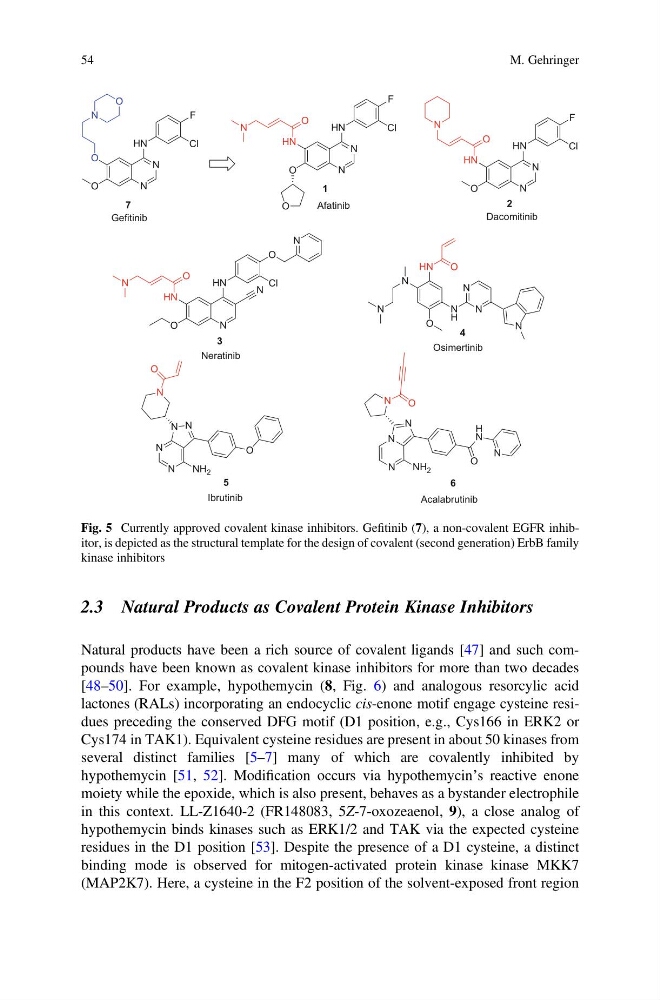
Fig. 5 Currently approved covalent kinase inhibitors. Gefitinib (7), a non-covalent EGFR inhibitor, is depicted as the structural template for the design of covalent (second generation) ErbB family
kinase inhibitors
54
M. Gehringer
Natural products have been a rich source of covalent ligands [47] and such compounds have been known as covalent kinase inhibitors for more than two decades
[48–50]. For example, hypothemycin (8, Fig. 6) and analogous resorcylic acid
lactones (RALs) incorporating an endocyclic cis-enone motif engage cysteine residues preceding the conserved DFG motif (D1 position, e.g., Cys166 in ERK2 or
Cys174 in TAK1). Equivalent cysteine residues are present in about 50 kinases from
several distinct families [5–7] many of which are covalently inhibited by
hypothemycin [51, 52]. Modification occurs via hypothemycin’s reactive enone
moiety while the epoxide, which is also present, behaves as a bystander electrophile
in this context. LL-Z1640-2 (FR148083, 5Z-7-oxozeaenol, 9), a close analog of
hypothemycin binds kinases such as ERK1/2 and TAK via the expected cysteine
residues in the D1 position [53]. Despite the presence of a D1 cysteine, a distinct
binding mode is observed for mitogen-activated protein kinase kinase MKK7
(MAP2K7). Here, a cysteine in the F2 position of the solvent-exposed front region
N
O
HN
O
O
N
N
HN
Cl
F
Afatinib
N
N
N
H
N
HN
O
N
N
O
Osimertinib
N
O
HN
O
N
HN
N
Cl
O
N
Neratinib
NH 2
O
N
N
N
O
N
N
Ibrutinib
O
H
N
N
NH 2
N
N
N
O
N
Acalabrutinib
1
3
4
5
6
Dacomitinib
O
HN
O
N
N
HN
Cl
F
2
N
N
O
HN
Cl
F
O
Gefitinib
7
N
O
N
Fig. 5 Currently approved covalent kinase inhibitors. Gefitinib (7), a non-covalent EGFR inhibitor, is depicted as the structural template for the design of covalent (second generation) ErbB family
kinase inhibitors
54
M. Gehringer