

been shown to react with cysteines to form products that can be readily hydrolyzed to
the corresponding (hydrated) glyoxamides [31].
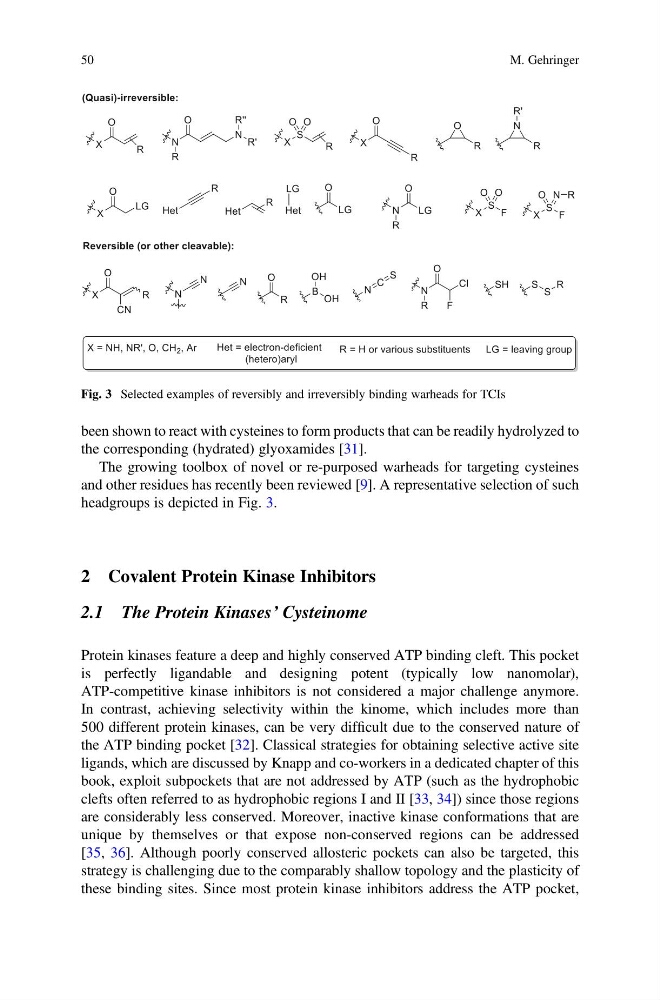
The growing toolbox of novel or re-purposed warheads for targeting cysteines
and other residues has recently been reviewed [9]. A representative selection of such
headgroups is depicted in Fig. 3.
2 Covalent Protein Kinase Inhibitors
2.1 The Protein Kinases’ Cysteinome
Protein kinases feature a deep and highly conserved ATP binding cleft. This pocket
is perfectly ligandable and designing potent (typically low nanomolar),
ATP-competitive kinase inhibitors is not considered a major challenge anymore.
In contrast, achieving selectivity within the kinome, which includes more than
500 different protein kinases, can be very difficult due to the conserved nature of
the ATP binding pocket [32]. Classical strategies for obtaining selective active site
ligands, which are discussed by Knapp and co-workers in a dedicated chapter of this
book, exploit subpockets that are not addressed by ATP (such as the hydrophobic
clefts often referred to as hydrophobic regions I and II [33, 34]) since those regions
are considerably less conserved. Moreover, inactive kinase conformations that are
unique by themselves or that expose non-conserved regions can be addressed
[35, 36]. Although poorly conserved allosteric pockets can also be targeted, this
strategy is challenging due to the comparably shallow topology and the plasticity of
these binding sites. Since most protein kinase inhibitors address the ATP pocket,
Fig. 3 Selected examples of reversibly and irreversibly binding warheads for TCIs
50
M. Gehringer
the corresponding (hydrated) glyoxamides [31].
The growing toolbox of novel or re-purposed warheads for targeting cysteines
and other residues has recently been reviewed [9]. A representative selection of such
headgroups is depicted in Fig. 3.
2 Covalent Protein Kinase Inhibitors
2.1 The Protein Kinases’ Cysteinome
Protein kinases feature a deep and highly conserved ATP binding cleft. This pocket
is perfectly ligandable and designing potent (typically low nanomolar),
ATP-competitive kinase inhibitors is not considered a major challenge anymore.
In contrast, achieving selectivity within the kinome, which includes more than
500 different protein kinases, can be very difficult due to the conserved nature of
the ATP binding pocket [32]. Classical strategies for obtaining selective active site
ligands, which are discussed by Knapp and co-workers in a dedicated chapter of this
book, exploit subpockets that are not addressed by ATP (such as the hydrophobic
clefts often referred to as hydrophobic regions I and II [33, 34]) since those regions
are considerably less conserved. Moreover, inactive kinase conformations that are
unique by themselves or that expose non-conserved regions can be addressed
[35, 36]. Although poorly conserved allosteric pockets can also be targeted, this
strategy is challenging due to the comparably shallow topology and the plasticity of
these binding sites. Since most protein kinase inhibitors address the ATP pocket,
Fig. 3 Selected examples of reversibly and irreversibly binding warheads for TCIs
50
M. Gehringer