

nucleophilic amino acids, e.g., lysine [9], if the latter are located nearby in the
binding pocket and possess sufficient nucleophilicity and conformational flexibility
to hit the electrophilic β-position via a favorable trajectory. Non-specific reaction
with ubiquitous thiols, e.g., in glutathione (GSH) or cysteines from other proteins
must be much slower to prevent premature inhibitor depletion and off-target-mediated side effects. Nucleophilic addition of the cysteines’ thiol group leads to βthioether adducts, which are generally stable with respect to the half-life of most
target proteins.
An interesting recent development are TCIs with reversibly binding warheads
[26]. For addressing cysteines transiently, α-cyanoacrylamides and analogous
“hyper-activated” Michael acceptors have proven suitable. Although the dual activation by two electron-withdrawing group increases the intrinsic reactivity of such
Michael acceptor systems, it also causes a thermodynamic destabilization of the
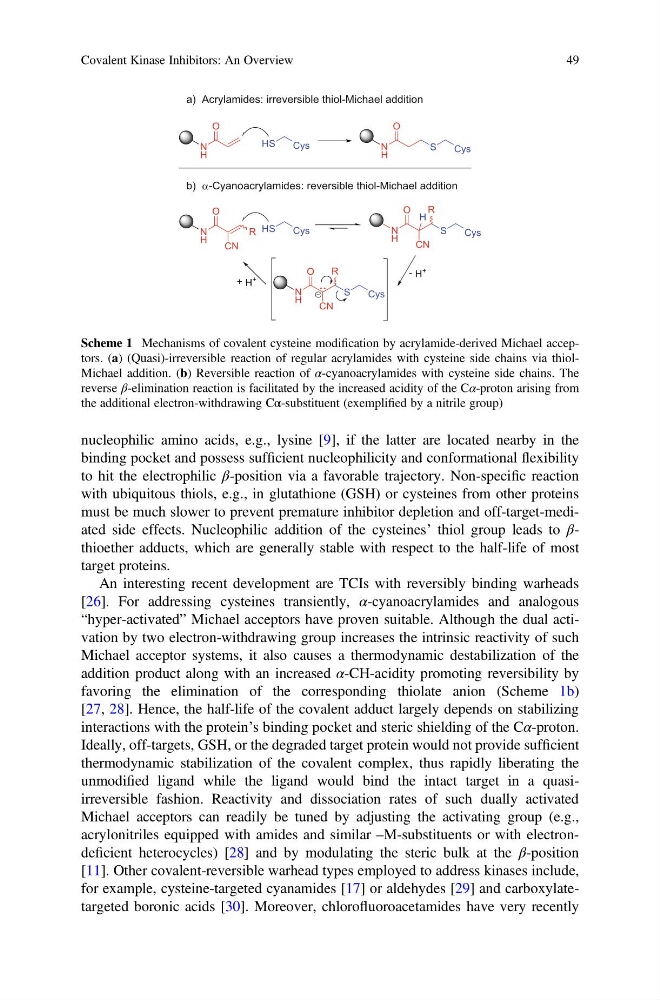
addition product along with an increased α-CH-acidity promoting reversibility by
favoring the elimination of the corresponding thiolate anion (Scheme 1b)
[27, 28]. Hence, the half-life of the covalent adduct largely depends on stabilizing
interactions with the protein’s binding pocket and steric shielding of the Cα-proton.
Ideally, off-targets, GSH, or the degraded target protein would not provide sufficient
thermodynamic stabilization of the covalent complex, thus rapidly liberating the
unmodified ligand while the ligand would bind the intact target in a quasiirreversible fashion. Reactivity and dissociation rates of such dually activated
Michael acceptors can readily be tuned by adjusting the activating group (e.g.,
acrylonitriles equipped with amides and similar –M-substituents or with electrondeficient heterocycles) [28] and by modulating the steric bulk at the β-position
[11]. Other covalent-reversible warhead types employed to address kinases include,
for example, cysteine-targeted cyanamides [17] or aldehydes [29] and carboxylatetargeted boronic acids [30]. Moreover, chlorofluoroacetamides have very recently
N
H
O
HS
Cys
N
H
O
S
Cys
a) Acrylamides: irreversible thiol-Michael addition
N
H
O
S
Cys
CN
- H
+
N
H
O
S
Cys
CN
+ H
+
H
N
H
O
HS
Cys
CN
b) α-Cyanoacrylamides: reversible thiol-Michael addition
R
R
R
Scheme 1 Mechanisms of covalent cysteine modification by acrylamide-derived Michael acceptors. (a) (Quasi)-irreversible reaction of regular acrylamides with cysteine side chains via thiolMichael addition. (b) Reversible reaction of α-cyanoacrylamides with cysteine side chains. The
reverse β-elimination reaction is facilitated by the increased acidity of the Cα-proton arising from
the additional electron-withdrawing Cα-substituent (exemplified by a nitrile group)
Covalent Kinase Inhibitors: An Overview
49
binding pocket and possess sufficient nucleophilicity and conformational flexibility
to hit the electrophilic β-position via a favorable trajectory. Non-specific reaction
with ubiquitous thiols, e.g., in glutathione (GSH) or cysteines from other proteins
must be much slower to prevent premature inhibitor depletion and off-target-mediated side effects. Nucleophilic addition of the cysteines’ thiol group leads to βthioether adducts, which are generally stable with respect to the half-life of most
target proteins.
An interesting recent development are TCIs with reversibly binding warheads
[26]. For addressing cysteines transiently, α-cyanoacrylamides and analogous
“hyper-activated” Michael acceptors have proven suitable. Although the dual activation by two electron-withdrawing group increases the intrinsic reactivity of such
Michael acceptor systems, it also causes a thermodynamic destabilization of the
addition product along with an increased α-CH-acidity promoting reversibility by
favoring the elimination of the corresponding thiolate anion (Scheme 1b)
[27, 28]. Hence, the half-life of the covalent adduct largely depends on stabilizing
interactions with the protein’s binding pocket and steric shielding of the Cα-proton.
Ideally, off-targets, GSH, or the degraded target protein would not provide sufficient
thermodynamic stabilization of the covalent complex, thus rapidly liberating the
unmodified ligand while the ligand would bind the intact target in a quasiirreversible fashion. Reactivity and dissociation rates of such dually activated
Michael acceptors can readily be tuned by adjusting the activating group (e.g.,
acrylonitriles equipped with amides and similar –M-substituents or with electrondeficient heterocycles) [28] and by modulating the steric bulk at the β-position
[11]. Other covalent-reversible warhead types employed to address kinases include,
for example, cysteine-targeted cyanamides [17] or aldehydes [29] and carboxylatetargeted boronic acids [30]. Moreover, chlorofluoroacetamides have very recently
N
H
O
HS
Cys
N
H
O
S
Cys
a) Acrylamides: irreversible thiol-Michael addition
N
H
O
S
Cys
CN
- H
+
N
H
O
S
Cys
CN
+ H
+
H
N
H
O
HS
Cys
CN
b) α-Cyanoacrylamides: reversible thiol-Michael addition
R
R
R
Scheme 1 Mechanisms of covalent cysteine modification by acrylamide-derived Michael acceptors. (a) (Quasi)-irreversible reaction of regular acrylamides with cysteine side chains via thiolMichael addition. (b) Reversible reaction of α-cyanoacrylamides with cysteine side chains. The
reverse β-elimination reaction is facilitated by the increased acidity of the Cα-proton arising from
the additional electron-withdrawing Cα-substituent (exemplified by a nitrile group)
Covalent Kinase Inhibitors: An Overview
49