

therapeutic targeting is complicated by the high intracellular ATP concentrations
(generally in the low millimolar range [37]) competing with the ligand. Covalent
inhibitors hold the potential to address the aforementioned challenges as they
combine the use of an additional selectivity filter with limited ATP-competitivity.
Protein kinases possess neither a catalytic cysteine residue nor any other highly
activated nucleophile in the active site. Instead, they feature only non-catalytic
cysteines that may have regulatory functions but are not directly involved in
phosphate transfer. Collectively, these cysteine residues have been denominated
the protein kinases’ cysteinome [5, 6]. Cysteine residues are distributed at various
locations inside and around the ATP pocket that could potentially be tackled by
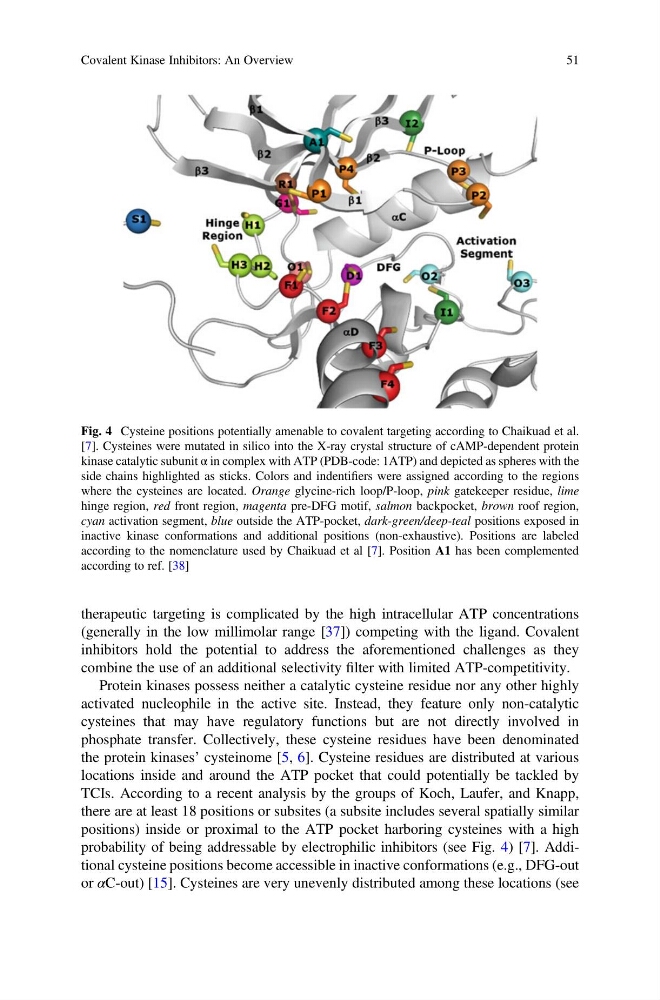
TCIs. According to a recent analysis by the groups of Koch, Laufer, and Knapp,
there are at least 18 positions or subsites (a subsite includes several spatially similar
positions) inside or proximal to the ATP pocket harboring cysteines with a high
probability of being addressable by electrophilic inhibitors (see Fig. 4) [7]. Additional cysteine positions become accessible in inactive conformations (e.g., DFG-out
or αC-out) [15]. Cysteines are very unevenly distributed among these locations (see
Fig. 4 Cysteine positions potentially amenable to covalent targeting according to Chaikuad et al.
[7]. Cysteines were mutated in silico into the X-ray crystal structure of cAMP-dependent protein
kinase catalytic subunit α in complex with ATP (PDB-code: 1ATP) and depicted as spheres with the
side chains highlighted as sticks. Colors and indentifiers were assigned according to the regions
where the cysteines are located. Orange glycine-rich loop/P-loop, pink gatekeeper residue, lime
hinge region, red front region, magenta pre-DFG motif, salmon backpocket, brown roof region,
cyan activation segment, blue outside the ATP-pocket, dark-green/deep-teal positions exposed in
inactive kinase conformations and additional positions (non-exhaustive). Positions are labeled
according to the nomenclature used by Chaikuad et al [7]. Position A1 has been complemented
according to ref. [38]
Covalent Kinase Inhibitors: An Overview
51
(generally in the low millimolar range [37]) competing with the ligand. Covalent
inhibitors hold the potential to address the aforementioned challenges as they
combine the use of an additional selectivity filter with limited ATP-competitivity.
Protein kinases possess neither a catalytic cysteine residue nor any other highly
activated nucleophile in the active site. Instead, they feature only non-catalytic
cysteines that may have regulatory functions but are not directly involved in
phosphate transfer. Collectively, these cysteine residues have been denominated
the protein kinases’ cysteinome [5, 6]. Cysteine residues are distributed at various
locations inside and around the ATP pocket that could potentially be tackled by
TCIs. According to a recent analysis by the groups of Koch, Laufer, and Knapp,
there are at least 18 positions or subsites (a subsite includes several spatially similar
positions) inside or proximal to the ATP pocket harboring cysteines with a high
probability of being addressable by electrophilic inhibitors (see Fig. 4) [7]. Additional cysteine positions become accessible in inactive conformations (e.g., DFG-out
or αC-out) [15]. Cysteines are very unevenly distributed among these locations (see
Fig. 4 Cysteine positions potentially amenable to covalent targeting according to Chaikuad et al.
[7]. Cysteines were mutated in silico into the X-ray crystal structure of cAMP-dependent protein
kinase catalytic subunit α in complex with ATP (PDB-code: 1ATP) and depicted as spheres with the
side chains highlighted as sticks. Colors and indentifiers were assigned according to the regions
where the cysteines are located. Orange glycine-rich loop/P-loop, pink gatekeeper residue, lime
hinge region, red front region, magenta pre-DFG motif, salmon backpocket, brown roof region,
cyan activation segment, blue outside the ATP-pocket, dark-green/deep-teal positions exposed in
inactive kinase conformations and additional positions (non-exhaustive). Positions are labeled
according to the nomenclature used by Chaikuad et al [7]. Position A1 has been complemented
according to ref. [38]
Covalent Kinase Inhibitors: An Overview
51