

showed some capacity to decrease Th1 and Th17 cell proliferation while increasing
T reg cell counts as shown by flow cytometry.
In another recent publication from Chen and co-workers, structure–activity
relationships of analogs of compound 58 from Pfizer/MSD (vide supra) were
reported [60]. In this study, the hinge-binding motif was varied, and a series of
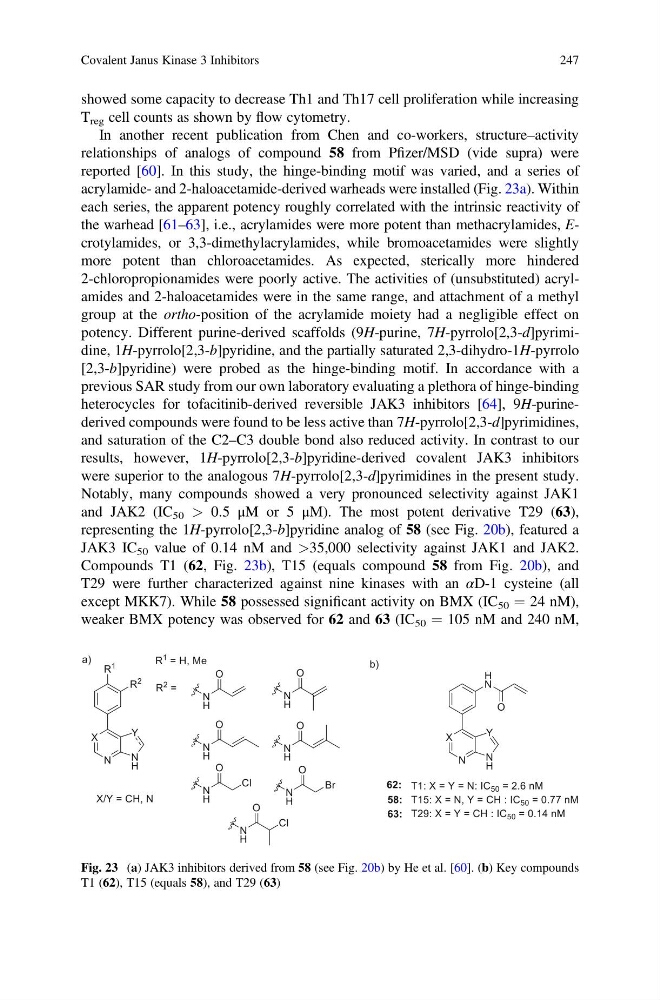
acrylamide- and 2-haloacetamide-derived warheads were installed (Fig. 23a). Within
each series, the apparent potency roughly correlated with the intrinsic reactivity of
the warhead [61–63], i.e., acrylamides were more potent than methacrylamides, Ecrotylamides, or 3,3-dimethylacrylamides, while bromoacetamides were slightly
more potent than chloroacetamides. As expected, sterically more hindered
2-chloropropionamides were poorly active. The activities of (unsubstituted) acrylamides and 2-haloacetamides were in the same range, and attachment of a methyl
group at the ortho-position of the acrylamide moiety had a negligible effect on
potency. Different purine-derived scaffolds (9H-purine, 7H-pyrrolo[2,3-d]pyrimidine, 1H-pyrrolo[2,3-b]pyridine, and the partially saturated 2,3-dihydro-1H-pyrrolo
[2,3-b]pyridine) were probed as the hinge-binding motif. In accordance with a
previous SAR study from our own laboratory evaluating a plethora of hinge-binding
heterocycles for tofacitinib-derived reversible JAK3 inhibitors [64], 9H-purinederived compounds were found to be less active than 7H-pyrrolo[2,3-d]pyrimidines,
and saturation of the C2–C3 double bond also reduced activity. In contrast to our
results, however, 1H-pyrrolo[2,3-b]pyridine-derived covalent JAK3 inhibitors
were superior to the analogous 7H-pyrrolo[2,3-d]pyrimidines in the present study.
Notably, many compounds showed a very pronounced selectivity against JAK1
and JAK2 (IC 50 > 0.5 μM or 5 μM). The most potent derivative T29 (63),
representing the 1H-pyrrolo[2,3-b]pyridine analog of 58 (see Fig. 20b), featured a
JAK3 IC 50 value of 0.14 nM and >35,000 selectivity against JAK1 and JAK2.
Compounds T1 (62, Fig. 23b), T15 (equals compound 58 from Fig. 20b), and
T29 were further characterized against nine kinases with an αD-1 cysteine (all
except MKK7). While 58 possessed significant activity on BMX (IC 50 ¼ 24 nM),
weaker BMX potency was observed for 62 and 63 (IC 50 ¼ 105 nM and 240 nM,
Fig. 23 (a) JAK3 inhibitors derived from 58 (see Fig. 20b) by He et al. [60]. (b) Key compounds
T1 (62), T15 (equals 58), and T29 (63)
Covalent Janus Kinase 3 Inhibitors
247
T reg cell counts as shown by flow cytometry.
In another recent publication from Chen and co-workers, structure–activity
relationships of analogs of compound 58 from Pfizer/MSD (vide supra) were
reported [60]. In this study, the hinge-binding motif was varied, and a series of
acrylamide- and 2-haloacetamide-derived warheads were installed (Fig. 23a). Within
each series, the apparent potency roughly correlated with the intrinsic reactivity of
the warhead [61–63], i.e., acrylamides were more potent than methacrylamides, Ecrotylamides, or 3,3-dimethylacrylamides, while bromoacetamides were slightly
more potent than chloroacetamides. As expected, sterically more hindered
2-chloropropionamides were poorly active. The activities of (unsubstituted) acrylamides and 2-haloacetamides were in the same range, and attachment of a methyl
group at the ortho-position of the acrylamide moiety had a negligible effect on
potency. Different purine-derived scaffolds (9H-purine, 7H-pyrrolo[2,3-d]pyrimidine, 1H-pyrrolo[2,3-b]pyridine, and the partially saturated 2,3-dihydro-1H-pyrrolo
[2,3-b]pyridine) were probed as the hinge-binding motif. In accordance with a
previous SAR study from our own laboratory evaluating a plethora of hinge-binding
heterocycles for tofacitinib-derived reversible JAK3 inhibitors [64], 9H-purinederived compounds were found to be less active than 7H-pyrrolo[2,3-d]pyrimidines,
and saturation of the C2–C3 double bond also reduced activity. In contrast to our
results, however, 1H-pyrrolo[2,3-b]pyridine-derived covalent JAK3 inhibitors
were superior to the analogous 7H-pyrrolo[2,3-d]pyrimidines in the present study.
Notably, many compounds showed a very pronounced selectivity against JAK1
and JAK2 (IC 50 > 0.5 μM or 5 μM). The most potent derivative T29 (63),
representing the 1H-pyrrolo[2,3-b]pyridine analog of 58 (see Fig. 20b), featured a
JAK3 IC 50 value of 0.14 nM and >35,000 selectivity against JAK1 and JAK2.
Compounds T1 (62, Fig. 23b), T15 (equals compound 58 from Fig. 20b), and
T29 were further characterized against nine kinases with an αD-1 cysteine (all
except MKK7). While 58 possessed significant activity on BMX (IC 50 ¼ 24 nM),
weaker BMX potency was observed for 62 and 63 (IC 50 ¼ 105 nM and 240 nM,
Fig. 23 (a) JAK3 inhibitors derived from 58 (see Fig. 20b) by He et al. [60]. (b) Key compounds
T1 (62), T15 (equals 58), and T29 (63)
Covalent Janus Kinase 3 Inhibitors
247