

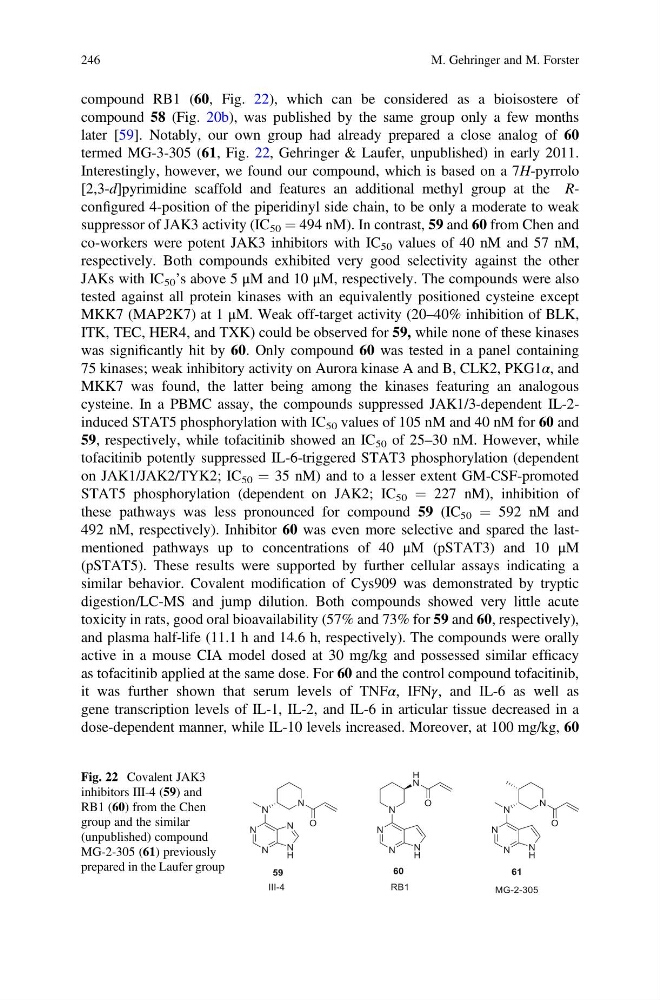
compound RB1 (60, Fig. 22), which can be considered as a bioisostere of
compound 58 (Fig. 20b), was published by the same group only a few months
later [59]. Notably, our own group had already prepared a close analog of 60
termed MG-3-305 (61, Fig. 22, Gehringer & Laufer, unpublished) in early 2011.
Interestingly, however, we found our compound, which is based on a 7H-pyrrolo
[2,3-d]pyrimidine scaffold and features an additional methyl group at the Rconfigured 4-position of the piperidinyl side chain, to be only a moderate to weak
suppressor of JAK3 activity (IC 50 ¼ 494 nM). In contrast, 59 and 60 from Chen and
co-workers were potent JAK3 inhibitors with IC 50 values of 40 nM and 57 nM,
respectively. Both compounds exhibited very good selectivity against the other
JAKs with IC 50 ’s above 5 μM and 10 μM, respectively. The compounds were also
tested against all protein kinases with an equivalently positioned cysteine except
MKK7 (MAP2K7) at 1 μM. Weak off-target activity (20–40% inhibition of BLK,
ITK, TEC, HER4, and TXK) could be observed for 59, while none of these kinases
was significantly hit by 60. Only compound 60 was tested in a panel containing
75 kinases; weak inhibitory activity on Aurora kinase A and B, CLK2, PKG1α, and
MKK7 was found, the latter being among the kinases featuring an analogous
cysteine. In a PBMC assay, the compounds suppressed JAK1/3-dependent IL-2induced STAT5 phosphorylation with IC 50 values of 105 nM and 40 nM for 60 and
59, respectively, while tofacitinib showed an IC 50 of 25–30 nM. However, while
tofacitinib potently suppressed IL-6-triggered STAT3 phosphorylation (dependent
on JAK1/JAK2/TYK2; IC 50 ¼ 35 nM) and to a lesser extent GM-CSF-promoted
STAT5 phosphorylation (dependent on JAK2; IC 50 ¼ 227 nM), inhibition of
these pathways was less pronounced for compound 59 (IC 50 ¼ 592 nM and
492 nM, respectively). Inhibitor 60 was even more selective and spared the lastmentioned pathways up to concentrations of 40 μM (pSTAT3) and 10 μM
(pSTAT5). These results were supported by further cellular assays indicating a
similar behavior. Covalent modification of Cys909 was demonstrated by tryptic
digestion/LC-MS and jump dilution. Both compounds showed very little acute
toxicity in rats, good oral bioavailability (57% and 73% for 59 and 60, respectively),
and plasma half-life (11.1 h and 14.6 h, respectively). The compounds were orally
active in a mouse CIA model dosed at 30 mg/kg and possessed similar efficacy
as tofacitinib applied at the same dose. For 60 and the control compound tofacitinib,
it was further shown that serum levels of TNFα, IFNγ, and IL-6 as well as
gene transcription levels of IL-1, IL-2, and IL-6 in articular tissue decreased in a
dose-dependent manner, while IL-10 levels increased. Moreover, at 100 mg/kg, 60
Fig. 22 Covalent JAK3
inhibitors III-4 (59) and
RB1 (60) from the Chen
group and the similar
(unpublished) compound
MG-2-305 (61) previously
prepared in the Laufer group
246
M. Gehringer and M. Forster
compound 58 (Fig. 20b), was published by the same group only a few months
later [59]. Notably, our own group had already prepared a close analog of 60
termed MG-3-305 (61, Fig. 22, Gehringer & Laufer, unpublished) in early 2011.
Interestingly, however, we found our compound, which is based on a 7H-pyrrolo
[2,3-d]pyrimidine scaffold and features an additional methyl group at the Rconfigured 4-position of the piperidinyl side chain, to be only a moderate to weak
suppressor of JAK3 activity (IC 50 ¼ 494 nM). In contrast, 59 and 60 from Chen and
co-workers were potent JAK3 inhibitors with IC 50 values of 40 nM and 57 nM,
respectively. Both compounds exhibited very good selectivity against the other
JAKs with IC 50 ’s above 5 μM and 10 μM, respectively. The compounds were also
tested against all protein kinases with an equivalently positioned cysteine except
MKK7 (MAP2K7) at 1 μM. Weak off-target activity (20–40% inhibition of BLK,
ITK, TEC, HER4, and TXK) could be observed for 59, while none of these kinases
was significantly hit by 60. Only compound 60 was tested in a panel containing
75 kinases; weak inhibitory activity on Aurora kinase A and B, CLK2, PKG1α, and
MKK7 was found, the latter being among the kinases featuring an analogous
cysteine. In a PBMC assay, the compounds suppressed JAK1/3-dependent IL-2induced STAT5 phosphorylation with IC 50 values of 105 nM and 40 nM for 60 and
59, respectively, while tofacitinib showed an IC 50 of 25–30 nM. However, while
tofacitinib potently suppressed IL-6-triggered STAT3 phosphorylation (dependent
on JAK1/JAK2/TYK2; IC 50 ¼ 35 nM) and to a lesser extent GM-CSF-promoted
STAT5 phosphorylation (dependent on JAK2; IC 50 ¼ 227 nM), inhibition of
these pathways was less pronounced for compound 59 (IC 50 ¼ 592 nM and
492 nM, respectively). Inhibitor 60 was even more selective and spared the lastmentioned pathways up to concentrations of 40 μM (pSTAT3) and 10 μM
(pSTAT5). These results were supported by further cellular assays indicating a
similar behavior. Covalent modification of Cys909 was demonstrated by tryptic
digestion/LC-MS and jump dilution. Both compounds showed very little acute
toxicity in rats, good oral bioavailability (57% and 73% for 59 and 60, respectively),
and plasma half-life (11.1 h and 14.6 h, respectively). The compounds were orally
active in a mouse CIA model dosed at 30 mg/kg and possessed similar efficacy
as tofacitinib applied at the same dose. For 60 and the control compound tofacitinib,
it was further shown that serum levels of TNFα, IFNγ, and IL-6 as well as
gene transcription levels of IL-1, IL-2, and IL-6 in articular tissue decreased in a
dose-dependent manner, while IL-10 levels increased. Moreover, at 100 mg/kg, 60
Fig. 22 Covalent JAK3
inhibitors III-4 (59) and
RB1 (60) from the Chen
group and the similar
(unpublished) compound
MG-2-305 (61) previously
prepared in the Laufer group
246
M. Gehringer and M. Forster