

respectively). The inhibitory activity of these compounds on other kinases in
this set was less pronounced (IC 50 > 450 nM). All three inhibitors orally dosed
at 30 mg/kg inhibited carrageenan-induced paw edema in mice, compound 63
being more effective than the positive control compound tofacitinib (30 mg/kg).
Irreversible binding was further supported by a jump dilution assay, and covalent
docking recapitulated a similar binding mode as previously shown for compound 58
(see Fig. 21a) by researchers from Pfizer.
In early 2017, researchers from MSD published a comprehensive study of JAK3
biology where they focused on the aforementioned selectivity shift, which can be
observed when comparing enzymatic assays at Km ATP to cellular systems [52]. In
good agreement with previously reported data from Thorarensen et al. [30], they
showed that compared to JAK1, JAK3 possesses an about tenfold higher ATP
affinity. The latter results in a more pronounced loss of JAK3 inhibitory activity
relative to JAK1 when running assays at an invariable and high ATP concentration
mimicking a cellular environment. A screening of a large collection of JAK inhibitors with various selectivity profiles in cellular assays and the comparison of the
obtained data with results from enzymatic assays conducted at K m ATP uncovered
an average 44-fold loss in selectivity (JAK3 over JAK1). A decreased selectivity
against JAK2 was observed as well but was less pronounced (approx. eightfold). In
the light of these results, the researchers at MSD concluded that via elimination
of the ATP competitivity by using an irreversible inhibitor, much better JAK3
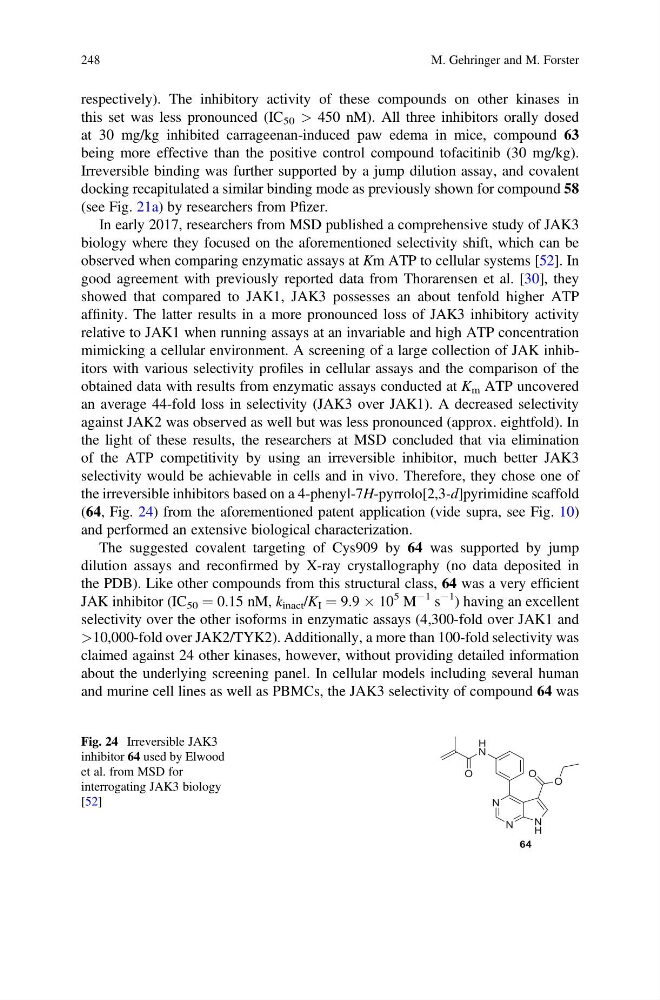
selectivity would be achievable in cells and in vivo. Therefore, they chose one of
the irreversible inhibitors based on a 4-phenyl-7H-pyrrolo[2,3-d]pyrimidine scaffold
(64, Fig. 24) from the aforementioned patent application (vide supra, see Fig. 10)
and performed an extensive biological characterization.
The suggested covalent targeting of Cys909 by 64 was supported by jump
dilution assays and reconfirmed by X-ray crystallography (no data deposited in
the PDB). Like other compounds from this structural class, 64 was a very efficient
JAK inhibitor (IC 50 ¼ 0.15 nM, k inact /K I ¼ 9.9 Â 10
5 M
À1 s
À1 ) having an excellent
selectivity over the other isoforms in enzymatic assays (4,300-fold over JAK1 and
>10,000-fold over JAK2/TYK2). Additionally, a more than 100-fold selectivity was
claimed against 24 other kinases, however, without providing detailed information
about the underlying screening panel. In cellular models including several human
and murine cell lines as well as PBMCs, the JAK3 selectivity of compound 64 was
Fig. 24 Irreversible JAK3
inhibitor 64 used by Elwood
et al. from MSD for
interrogating JAK3 biology
[52]
248
M. Gehringer and M. Forster
this set was less pronounced (IC 50 > 450 nM). All three inhibitors orally dosed
at 30 mg/kg inhibited carrageenan-induced paw edema in mice, compound 63
being more effective than the positive control compound tofacitinib (30 mg/kg).
Irreversible binding was further supported by a jump dilution assay, and covalent
docking recapitulated a similar binding mode as previously shown for compound 58
(see Fig. 21a) by researchers from Pfizer.
In early 2017, researchers from MSD published a comprehensive study of JAK3
biology where they focused on the aforementioned selectivity shift, which can be
observed when comparing enzymatic assays at Km ATP to cellular systems [52]. In
good agreement with previously reported data from Thorarensen et al. [30], they
showed that compared to JAK1, JAK3 possesses an about tenfold higher ATP
affinity. The latter results in a more pronounced loss of JAK3 inhibitory activity
relative to JAK1 when running assays at an invariable and high ATP concentration
mimicking a cellular environment. A screening of a large collection of JAK inhibitors with various selectivity profiles in cellular assays and the comparison of the
obtained data with results from enzymatic assays conducted at K m ATP uncovered
an average 44-fold loss in selectivity (JAK3 over JAK1). A decreased selectivity
against JAK2 was observed as well but was less pronounced (approx. eightfold). In
the light of these results, the researchers at MSD concluded that via elimination
of the ATP competitivity by using an irreversible inhibitor, much better JAK3
selectivity would be achievable in cells and in vivo. Therefore, they chose one of
the irreversible inhibitors based on a 4-phenyl-7H-pyrrolo[2,3-d]pyrimidine scaffold
(64, Fig. 24) from the aforementioned patent application (vide supra, see Fig. 10)
and performed an extensive biological characterization.
The suggested covalent targeting of Cys909 by 64 was supported by jump
dilution assays and reconfirmed by X-ray crystallography (no data deposited in
the PDB). Like other compounds from this structural class, 64 was a very efficient
JAK inhibitor (IC 50 ¼ 0.15 nM, k inact /K I ¼ 9.9 Â 10
5 M
À1 s
À1 ) having an excellent
selectivity over the other isoforms in enzymatic assays (4,300-fold over JAK1 and
>10,000-fold over JAK2/TYK2). Additionally, a more than 100-fold selectivity was
claimed against 24 other kinases, however, without providing detailed information
about the underlying screening panel. In cellular models including several human
and murine cell lines as well as PBMCs, the JAK3 selectivity of compound 64 was
Fig. 24 Irreversible JAK3
inhibitor 64 used by Elwood
et al. from MSD for
interrogating JAK3 biology
[52]
248
M. Gehringer and M. Forster