

engagement of the Cys909 thiol with an acrylamide attached to the piperidine
nitrogen atom (Fig. 20a).
One key modification to favor the anti-orientation was the removal of the
N-methyl group to facilitate the rotation around the C–N bond, which is linking
the aliphatic side chain to the heterocyclic hinge-binding motif. Simultaneously,
the exocyclic 4-methyl group at the piperidine moiety was truncated as it
was suspected to clash with the “roof” of the binding pocket in this inverted
conformation. The optimization process aimed to increase the rate of inactivation
(described by k inact ) by stabilizing the reactive conformation while decreasing the
intrinsic chemical reactivity of the warhead to a necessary minimum. These efforts
furnished two compound series represented by inhibitors 57 and 58 (Fig. 20b), the
latter being related to the MSD compounds discussed above (see Fig. 10). Both
inhibitors showed high JAK3 potency as well as excellent isoform selectivity, and
their covalent binding mode was confirmed by X-ray crystallography (exemplified
for compound 58 in Fig. 21a). However, the high intrinsic reactivity of the anilinederived acrylamides such as 58 led to a poor correlation between data from enzymatic assays, cellular models, and human whole blood justifying the discontinuation
of this series.
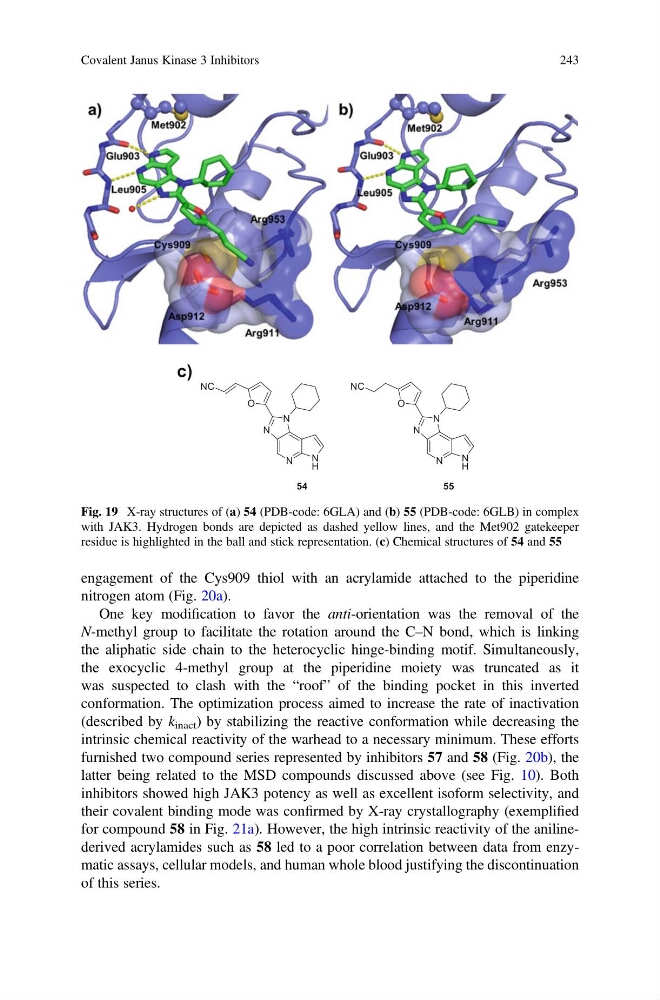
Fig. 19 X-ray structures of (a) 54 (PDB-code: 6GLA) and (b) 55 (PDB-code: 6GLB) in complex
with JAK3. Hydrogen bonds are depicted as dashed yellow lines, and the Met902 gatekeeper
residue is highlighted in the ball and stick representation. (c) Chemical structures of 54 and 55
Covalent Janus Kinase 3 Inhibitors
243
nitrogen atom (Fig. 20a).
One key modification to favor the anti-orientation was the removal of the
N-methyl group to facilitate the rotation around the C–N bond, which is linking
the aliphatic side chain to the heterocyclic hinge-binding motif. Simultaneously,
the exocyclic 4-methyl group at the piperidine moiety was truncated as it
was suspected to clash with the “roof” of the binding pocket in this inverted
conformation. The optimization process aimed to increase the rate of inactivation
(described by k inact ) by stabilizing the reactive conformation while decreasing the
intrinsic chemical reactivity of the warhead to a necessary minimum. These efforts
furnished two compound series represented by inhibitors 57 and 58 (Fig. 20b), the
latter being related to the MSD compounds discussed above (see Fig. 10). Both
inhibitors showed high JAK3 potency as well as excellent isoform selectivity, and
their covalent binding mode was confirmed by X-ray crystallography (exemplified
for compound 58 in Fig. 21a). However, the high intrinsic reactivity of the anilinederived acrylamides such as 58 led to a poor correlation between data from enzymatic assays, cellular models, and human whole blood justifying the discontinuation
of this series.
Fig. 19 X-ray structures of (a) 54 (PDB-code: 6GLA) and (b) 55 (PDB-code: 6GLB) in complex
with JAK3. Hydrogen bonds are depicted as dashed yellow lines, and the Met902 gatekeeper
residue is highlighted in the ball and stick representation. (c) Chemical structures of 54 and 55
Covalent Janus Kinase 3 Inhibitors
243