

Further optimization of the other series focused on metabolic stability with
special emphasis on decreasing GST-mediated clearance. Ultimately, an (S)-methyl
group in the 2-position of the piperidine ring was identified as the key feature to
achieve favorable PK properties enabling the development of clinical candidate
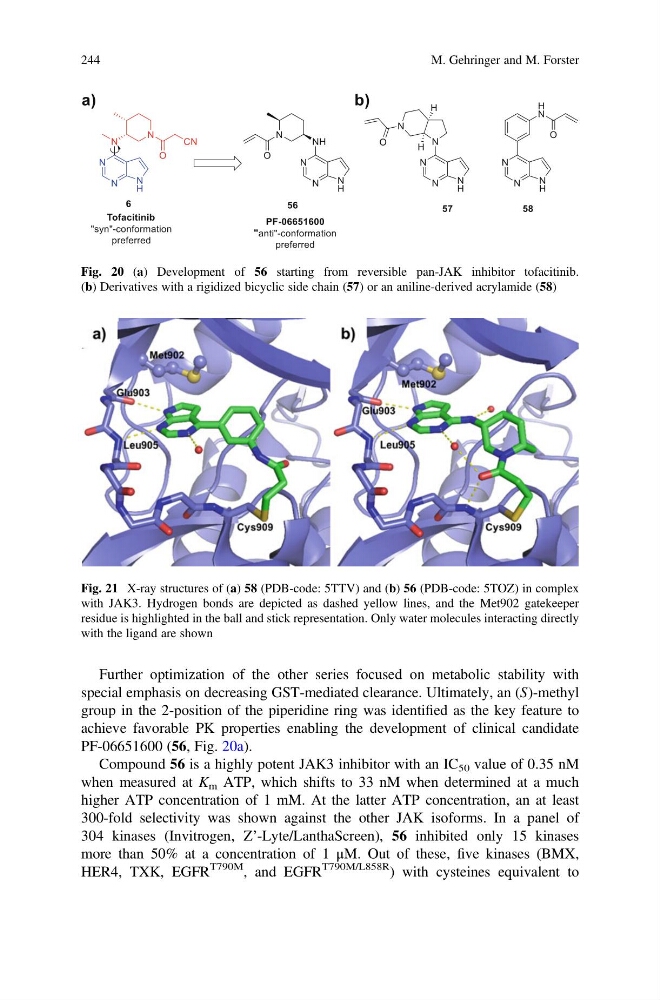
PF-06651600 (56, Fig. 20a).
Compound 56 is a highly potent JAK3 inhibitor with an IC 50 value of 0.35 nM
when measured at K m ATP, which shifts to 33 nM when determined at a much
higher ATP concentration of 1 mM. At the latter ATP concentration, an at least
300-fold selectivity was shown against the other JAK isoforms. In a panel of
304 kinases (Invitrogen, Z’-Lyte/LanthaScreen), 56 inhibited only 15 kinases
more than 50% at a concentration of 1 μM. Out of these, five kinases (BMX,
HER4, TXK, EGFR
T790M , and EGFR
T790M/L858R ) with cysteines equivalent to
Fig. 21 X-ray structures of (a) 58 (PDB-code: 5TTV) and (b) 56 (PDB-code: 5TOZ) in complex
with JAK3. Hydrogen bonds are depicted as dashed yellow lines, and the Met902 gatekeeper
residue is highlighted in the ball and stick representation. Only water molecules interacting directly
with the ligand are shown
Fig. 20 (a) Development of 56 starting from reversible pan-JAK inhibitor tofacitinib.
(b) Derivatives with a rigidized bicyclic side chain (57) or an aniline-derived acrylamide (58)
244
M. Gehringer and M. Forster
special emphasis on decreasing GST-mediated clearance. Ultimately, an (S)-methyl
group in the 2-position of the piperidine ring was identified as the key feature to
achieve favorable PK properties enabling the development of clinical candidate
PF-06651600 (56, Fig. 20a).
Compound 56 is a highly potent JAK3 inhibitor with an IC 50 value of 0.35 nM
when measured at K m ATP, which shifts to 33 nM when determined at a much
higher ATP concentration of 1 mM. At the latter ATP concentration, an at least
300-fold selectivity was shown against the other JAK isoforms. In a panel of
304 kinases (Invitrogen, Z’-Lyte/LanthaScreen), 56 inhibited only 15 kinases
more than 50% at a concentration of 1 μM. Out of these, five kinases (BMX,
HER4, TXK, EGFR
T790M , and EGFR
T790M/L858R ) with cysteines equivalent to
Fig. 21 X-ray structures of (a) 58 (PDB-code: 5TTV) and (b) 56 (PDB-code: 5TOZ) in complex
with JAK3. Hydrogen bonds are depicted as dashed yellow lines, and the Met902 gatekeeper
residue is highlighted in the ball and stick representation. Only water molecules interacting directly
with the ligand are shown
Fig. 20 (a) Development of 56 starting from reversible pan-JAK inhibitor tofacitinib.
(b) Derivatives with a rigidized bicyclic side chain (57) or an aniline-derived acrylamide (58)
244
M. Gehringer and M. Forster