

Another key feature of both, compound 52 and 53, is the induction of a novel
binding cleft through the reorientation of the side chains of Arg911, Asp912, and
Arg953 by interactions with the inhibitor’s nitrile group. We further investigated
the SAR of the underlying compound class with a special emphasis on the induction
of this “arginine pocket” to deduce its function in conferring activity and selectivity
[53]. After iteratively modifying the linker moiety and the headgroup, we
were able to show by X-ray crystallography that a relatively rigid α,β-unsaturated
acrylonitrile moiety (exemplified by compound 54, Fig. 19c) is necessary to
induce this cavity, while the pocket is not formed by the corresponding propionitriles
(e.g., compound 55). As depicted in Fig. 19a, the formation of the arginine pocket
was observed in the X-ray structure of acrylonitrile 54 in (non-covalent) complex
with JAK3. Contrastingly, the complex with saturated analog 55 (Fig. 19b) showed
the side chains of Arg911, Asp912, and Arg953 to adopt the typical conserved
conformation known from other JAK crystal structures.
Accordingly, these inhibitors showed distinct biochemical profiles. Compound
55 exhibited only a moderate JAK3 potency (IC 50 ¼ 129 nM) and no evident
isoform selectivity, while 54 was five times more potent on JAK3 (IC 50 ¼ 27 nM)
and showed a 60-fold to 210-fold selectivity over the other isoforms. It is noteworthy
that a covalent interaction with Cys909 was not detected in any of these structures,
suggesting that a moderate JAK3 selectivity can be achieved solely by the induction
of the arginine pocket without the need of establishing a covalent bond with Cys909.
Researchers from Pfizer have recently published two studies in which
they modified the non-covalent pan-JAK inhibitor tofacitinib (6) with the aim of
turning it into a covalent inhibitor [35, 57]. The key hypothesis of their effort was
that the piperidinyl side chain of 6 could be modified to prefer an “anti-conformation” with respect to the heterocyclic hinge-binding motif enabling the covalent
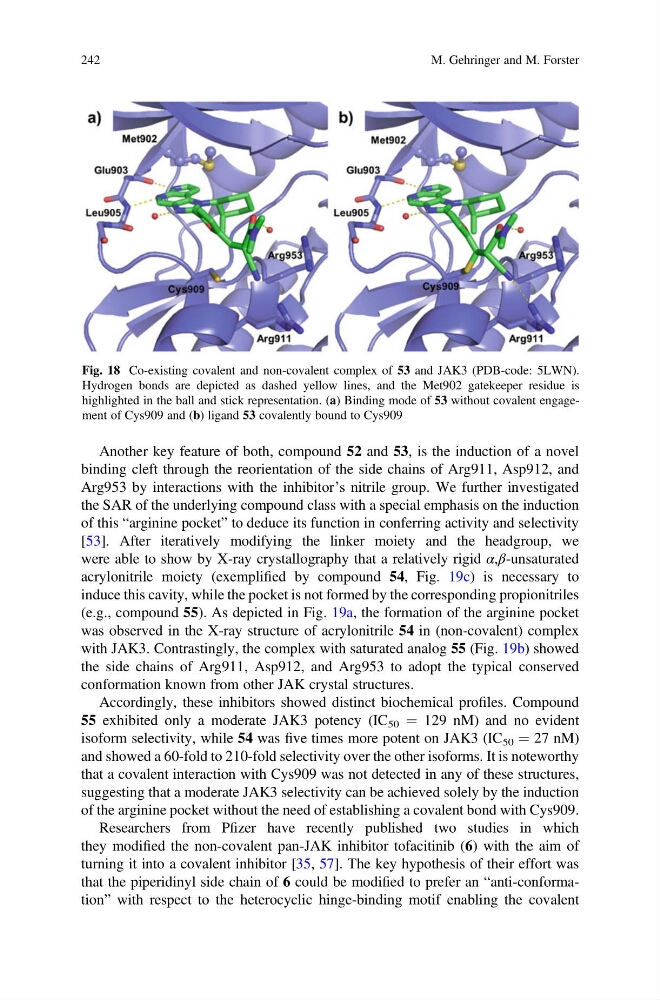
Fig. 18 Co-existing covalent and non-covalent complex of 53 and JAK3 (PDB-code: 5LWN).
Hydrogen bonds are depicted as dashed yellow lines, and the Met902 gatekeeper residue is
highlighted in the ball and stick representation. (a) Binding mode of 53 without covalent engagement of Cys909 and (b) ligand 53 covalently bound to Cys909
242
M. Gehringer and M. Forster
binding cleft through the reorientation of the side chains of Arg911, Asp912, and
Arg953 by interactions with the inhibitor’s nitrile group. We further investigated
the SAR of the underlying compound class with a special emphasis on the induction
of this “arginine pocket” to deduce its function in conferring activity and selectivity
[53]. After iteratively modifying the linker moiety and the headgroup, we
were able to show by X-ray crystallography that a relatively rigid α,β-unsaturated
acrylonitrile moiety (exemplified by compound 54, Fig. 19c) is necessary to
induce this cavity, while the pocket is not formed by the corresponding propionitriles
(e.g., compound 55). As depicted in Fig. 19a, the formation of the arginine pocket
was observed in the X-ray structure of acrylonitrile 54 in (non-covalent) complex
with JAK3. Contrastingly, the complex with saturated analog 55 (Fig. 19b) showed
the side chains of Arg911, Asp912, and Arg953 to adopt the typical conserved
conformation known from other JAK crystal structures.
Accordingly, these inhibitors showed distinct biochemical profiles. Compound
55 exhibited only a moderate JAK3 potency (IC 50 ¼ 129 nM) and no evident
isoform selectivity, while 54 was five times more potent on JAK3 (IC 50 ¼ 27 nM)
and showed a 60-fold to 210-fold selectivity over the other isoforms. It is noteworthy
that a covalent interaction with Cys909 was not detected in any of these structures,
suggesting that a moderate JAK3 selectivity can be achieved solely by the induction
of the arginine pocket without the need of establishing a covalent bond with Cys909.
Researchers from Pfizer have recently published two studies in which
they modified the non-covalent pan-JAK inhibitor tofacitinib (6) with the aim of
turning it into a covalent inhibitor [35, 57]. The key hypothesis of their effort was
that the piperidinyl side chain of 6 could be modified to prefer an “anti-conformation” with respect to the heterocyclic hinge-binding motif enabling the covalent
Fig. 18 Co-existing covalent and non-covalent complex of 53 and JAK3 (PDB-code: 5LWN).
Hydrogen bonds are depicted as dashed yellow lines, and the Met902 gatekeeper residue is
highlighted in the ball and stick representation. (a) Binding mode of 53 without covalent engagement of Cys909 and (b) ligand 53 covalently bound to Cys909
242
M. Gehringer and M. Forster