

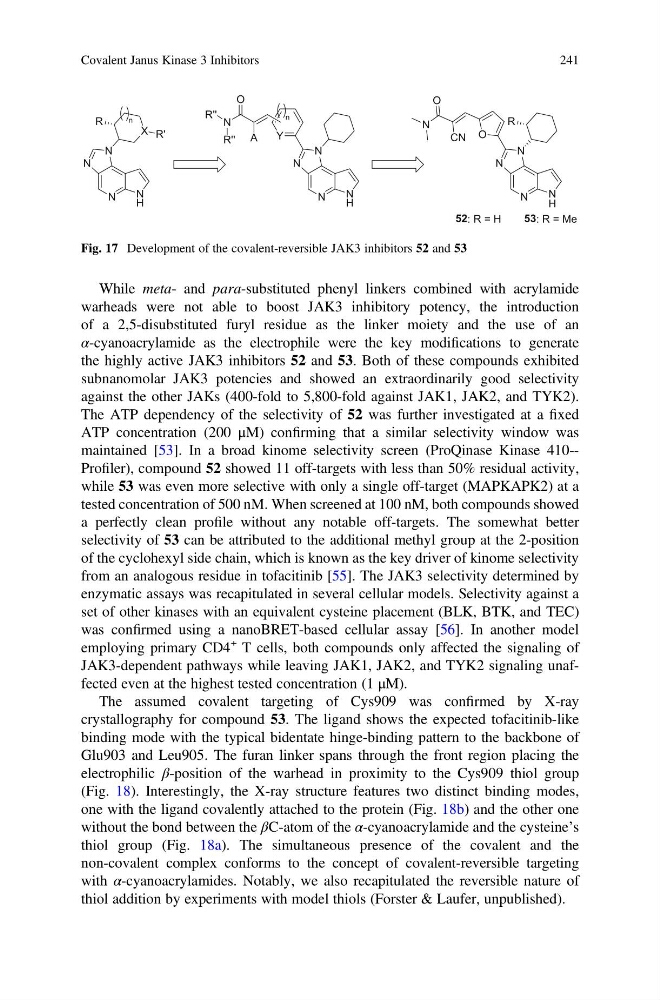
While meta- and para-substituted phenyl linkers combined with acrylamide
warheads were not able to boost JAK3 inhibitory potency, the introduction
of a 2,5-disubstituted furyl residue as the linker moiety and the use of an
α-cyanoacrylamide as the electrophile were the key modifications to generate
the highly active JAK3 inhibitors 52 and 53. Both of these compounds exhibited
subnanomolar JAK3 potencies and showed an extraordinarily good selectivity
against the other JAKs (400-fold to 5,800-fold against JAK1, JAK2, and TYK2).
The ATP dependency of the selectivity of 52 was further investigated at a fixed
ATP concentration (200 μM) confirming that a similar selectivity window was
maintained [53]. In a broad kinome selectivity screen (ProQinase Kinase 410-Profiler), compound 52 showed 11 off-targets with less than 50% residual activity,
while 53 was even more selective with only a single off-target (MAPKAPK2) at a
tested concentration of 500 nM. When screened at 100 nM, both compounds showed
a perfectly clean profile without any notable off-targets. The somewhat better
selectivity of 53 can be attributed to the additional methyl group at the 2-position
of the cyclohexyl side chain, which is known as the key driver of kinome selectivity
from an analogous residue in tofacitinib [55]. The JAK3 selectivity determined by
enzymatic assays was recapitulated in several cellular models. Selectivity against a
set of other kinases with an equivalent cysteine placement (BLK, BTK, and TEC)
was confirmed using a nanoBRET-based cellular assay [56]. In another model
employing primary CD4
+ T cells, both compounds only affected the signaling of
JAK3-dependent pathways while leaving JAK1, JAK2, and TYK2 signaling unaffected even at the highest tested concentration (1 μM).
The assumed covalent targeting of Cys909 was confirmed by X-ray
crystallography for compound 53. The ligand shows the expected tofacitinib-like
binding mode with the typical bidentate hinge-binding pattern to the backbone of
Glu903 and Leu905. The furan linker spans through the front region placing the
electrophilic β-position of the warhead in proximity to the Cys909 thiol group
(Fig. 18). Interestingly, the X-ray structure features two distinct binding modes,
one with the ligand covalently attached to the protein (Fig. 18b) and the other one
without the bond between the βC-atom of the α-cyanoacrylamide and the cysteine’s
thiol group (Fig. 18a). The simultaneous presence of the covalent and the
non-covalent complex conforms to the concept of covalent-reversible targeting
with α-cyanoacrylamides. Notably, we also recapitulated the reversible nature of
thiol addition by experiments with model thiols (Forster & Laufer, unpublished).
52: R = H
53: R = Me
N
N
H
N
N
X R'
n
N
N
H
N
N
Y
N
O
n
A
N
N
H
N
N
O
N
O
CN
R
R
R''
R''
Fig. 17 Development of the covalent-reversible JAK3 inhibitors 52 and 53
Covalent Janus Kinase 3 Inhibitors
241
warheads were not able to boost JAK3 inhibitory potency, the introduction
of a 2,5-disubstituted furyl residue as the linker moiety and the use of an
α-cyanoacrylamide as the electrophile were the key modifications to generate
the highly active JAK3 inhibitors 52 and 53. Both of these compounds exhibited
subnanomolar JAK3 potencies and showed an extraordinarily good selectivity
against the other JAKs (400-fold to 5,800-fold against JAK1, JAK2, and TYK2).
The ATP dependency of the selectivity of 52 was further investigated at a fixed
ATP concentration (200 μM) confirming that a similar selectivity window was
maintained [53]. In a broad kinome selectivity screen (ProQinase Kinase 410-Profiler), compound 52 showed 11 off-targets with less than 50% residual activity,
while 53 was even more selective with only a single off-target (MAPKAPK2) at a
tested concentration of 500 nM. When screened at 100 nM, both compounds showed
a perfectly clean profile without any notable off-targets. The somewhat better
selectivity of 53 can be attributed to the additional methyl group at the 2-position
of the cyclohexyl side chain, which is known as the key driver of kinome selectivity
from an analogous residue in tofacitinib [55]. The JAK3 selectivity determined by
enzymatic assays was recapitulated in several cellular models. Selectivity against a
set of other kinases with an equivalent cysteine placement (BLK, BTK, and TEC)
was confirmed using a nanoBRET-based cellular assay [56]. In another model
employing primary CD4
+ T cells, both compounds only affected the signaling of
JAK3-dependent pathways while leaving JAK1, JAK2, and TYK2 signaling unaffected even at the highest tested concentration (1 μM).
The assumed covalent targeting of Cys909 was confirmed by X-ray
crystallography for compound 53. The ligand shows the expected tofacitinib-like
binding mode with the typical bidentate hinge-binding pattern to the backbone of
Glu903 and Leu905. The furan linker spans through the front region placing the
electrophilic β-position of the warhead in proximity to the Cys909 thiol group
(Fig. 18). Interestingly, the X-ray structure features two distinct binding modes,
one with the ligand covalently attached to the protein (Fig. 18b) and the other one
without the bond between the βC-atom of the α-cyanoacrylamide and the cysteine’s
thiol group (Fig. 18a). The simultaneous presence of the covalent and the
non-covalent complex conforms to the concept of covalent-reversible targeting
with α-cyanoacrylamides. Notably, we also recapitulated the reversible nature of
thiol addition by experiments with model thiols (Forster & Laufer, unpublished).
52: R = H
53: R = Me
N
N
H
N
N
X R'
n
N
N
H
N
N
Y
N
O
n
A
N
N
H
N
N
O
N
O
CN
R
R
R''
R''
Fig. 17 Development of the covalent-reversible JAK3 inhibitors 52 and 53
Covalent Janus Kinase 3 Inhibitors
241