

p.o., QD). Due to the relatively poor characterization of these compounds, it remains
unclear, however, to what extent the observed cellular and in vivo effects arise
from specific inhibition of JAK3 and BTK.
In 2016, the Taunton group utilized JAK3i (39, Fig. 10), an acrylamide-based
inhibitor from the aforementioned patent application by Merck Sharp & Dome,
for the investigation of the time dependency of STAT5 phosphorylation in IL-2
stimulated CD4
+ T cells [45]. In accordance with the data provided by MSD, the
compound exhibited excellent JAK3 potency in an enzymatic assay (IC 50 ¼ 0.43 nM).
Moreover, >3,000-fold selectivity over the other JAK family members at a fixed
ATP concentration of 100 μM was demonstrated. Kinome selectivity, however,
was not determined in this study, but a promising selectivity against three kinases
with an equivalently positioned cysteine was shown at 1 mM ATP (EGFR, ITK,
and BTK with a 1,300-fold, 600-fold, and 50-fold selectivity, respectively). A final
confirmation of the covalent engagement of Cys909 by 39 via X-ray crystallography
was not part of this work, but other groups later reported such data for closely related
molecules of the same structural class (vide infra) [35, 52]. Instead, Taunton and
co-workers proved the involvement of Cys909 using murine CD4
+ T cells, where
overexpression of the JAK3
C909S mutant was protective against JAK3i-dependent
effects. By using JAK3i as a chemical probe, they found that IL-2-induced STAT5
phosphorylation occurs in two independent waves, one after 15 min and a second
one peaking approx. 2 h after stimulation. In contrast to the pan-JAK inhibitor
tofacitinib, which blocked both waves, compound 39 preferentially affected the
second wave of IL-2/pSTAT5 signaling. Blockage of the delayed STAT5 phosphorylation event was sufficient to prevent the cells from entering the S phase, and
compound 39 (40 mg/kg, i.p., BID) inhibited proliferation of T cell blasts in mice.
Our own group published a small set of tricyclic covalent-reversible JAK3 inhibitors
as chemical probes at the end of 2016 [48] and subsequently reported a detailed SAR
study of the underlying compound class in 2018 [53]. Within this project, rational
design started from tricyclic tofacitinib analogs [54] enabling the introduction of
different aromatic linkers at the imidazole’s C2-position, which were then decorated
with a variety of Michael acceptor-derived warheads. Our optimization efforts
culminated in the discovery of the key compounds 52 and 53 (Fig. 17).
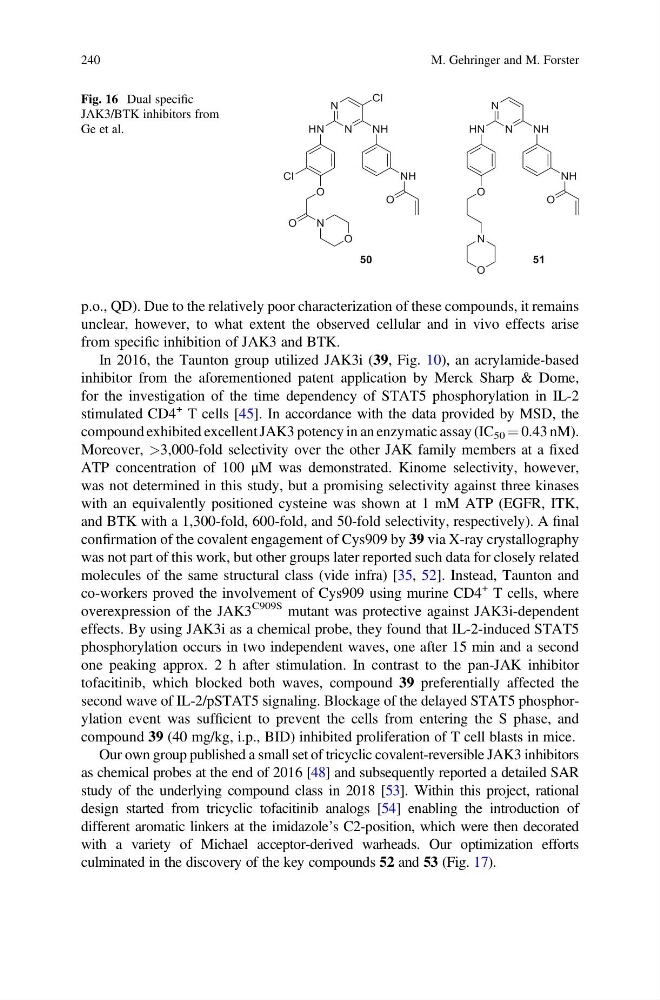
Fig. 16 Dual specific
JAK3/BTK inhibitors from
Ge et al.
240
M. Gehringer and M. Forster
unclear, however, to what extent the observed cellular and in vivo effects arise
from specific inhibition of JAK3 and BTK.
In 2016, the Taunton group utilized JAK3i (39, Fig. 10), an acrylamide-based
inhibitor from the aforementioned patent application by Merck Sharp & Dome,
for the investigation of the time dependency of STAT5 phosphorylation in IL-2
stimulated CD4
+ T cells [45]. In accordance with the data provided by MSD, the
compound exhibited excellent JAK3 potency in an enzymatic assay (IC 50 ¼ 0.43 nM).
Moreover, >3,000-fold selectivity over the other JAK family members at a fixed
ATP concentration of 100 μM was demonstrated. Kinome selectivity, however,
was not determined in this study, but a promising selectivity against three kinases
with an equivalently positioned cysteine was shown at 1 mM ATP (EGFR, ITK,
and BTK with a 1,300-fold, 600-fold, and 50-fold selectivity, respectively). A final
confirmation of the covalent engagement of Cys909 by 39 via X-ray crystallography
was not part of this work, but other groups later reported such data for closely related
molecules of the same structural class (vide infra) [35, 52]. Instead, Taunton and
co-workers proved the involvement of Cys909 using murine CD4
+ T cells, where
overexpression of the JAK3
C909S mutant was protective against JAK3i-dependent
effects. By using JAK3i as a chemical probe, they found that IL-2-induced STAT5
phosphorylation occurs in two independent waves, one after 15 min and a second
one peaking approx. 2 h after stimulation. In contrast to the pan-JAK inhibitor
tofacitinib, which blocked both waves, compound 39 preferentially affected the
second wave of IL-2/pSTAT5 signaling. Blockage of the delayed STAT5 phosphorylation event was sufficient to prevent the cells from entering the S phase, and
compound 39 (40 mg/kg, i.p., BID) inhibited proliferation of T cell blasts in mice.
Our own group published a small set of tricyclic covalent-reversible JAK3 inhibitors
as chemical probes at the end of 2016 [48] and subsequently reported a detailed SAR
study of the underlying compound class in 2018 [53]. Within this project, rational
design started from tricyclic tofacitinib analogs [54] enabling the introduction of
different aromatic linkers at the imidazole’s C2-position, which were then decorated
with a variety of Michael acceptor-derived warheads. Our optimization efforts
culminated in the discovery of the key compounds 52 and 53 (Fig. 17).
Fig. 16 Dual specific
JAK3/BTK inhibitors from
Ge et al.
240
M. Gehringer and M. Forster