

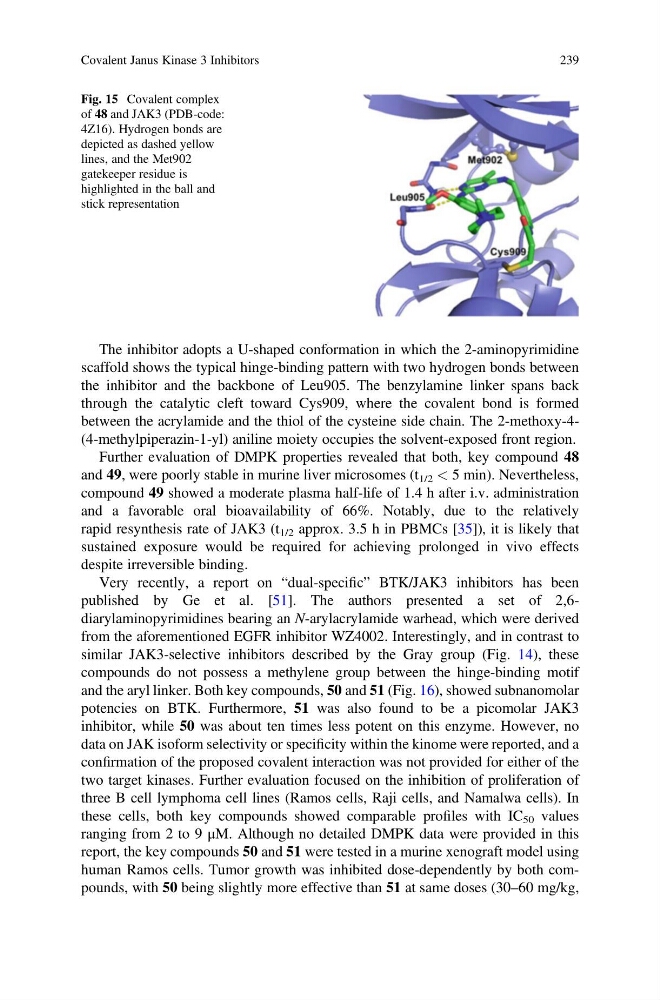
The inhibitor adopts a U-shaped conformation in which the 2-aminopyrimidine
scaffold shows the typical hinge-binding pattern with two hydrogen bonds between
the inhibitor and the backbone of Leu905. The benzylamine linker spans back
through the catalytic cleft toward Cys909, where the covalent bond is formed
between the acrylamide and the thiol of the cysteine side chain. The 2-methoxy-4(4-methylpiperazin-1-yl) aniline moiety occupies the solvent-exposed front region.
Further evaluation of DMPK properties revealed that both, key compound 48
and 49, were poorly stable in murine liver microsomes (t 1/2 < 5 min). Nevertheless,
compound 49 showed a moderate plasma half-life of 1.4 h after i.v. administration
and a favorable oral bioavailability of 66%. Notably, due to the relatively
rapid resynthesis rate of JAK3 (t 1/2 approx. 3.5 h in PBMCs [35]), it is likely that
sustained exposure would be required for achieving prolonged in vivo effects
despite irreversible binding.
Very recently, a report on “dual-specific” BTK/JAK3 inhibitors has been
published by Ge et al. [51]. The authors presented a set of 2,6diarylaminopyrimidines bearing an N-arylacrylamide warhead, which were derived
from the aforementioned EGFR inhibitor WZ4002. Interestingly, and in contrast to
similar JAK3-selective inhibitors described by the Gray group (Fig. 14), these
compounds do not possess a methylene group between the hinge-binding motif
and the aryl linker. Both key compounds, 50 and 51 (Fig. 16), showed subnanomolar
potencies on BTK. Furthermore, 51 was also found to be a picomolar JAK3
inhibitor, while 50 was about ten times less potent on this enzyme. However, no
data on JAK isoform selectivity or specificity within the kinome were reported, and a
confirmation of the proposed covalent interaction was not provided for either of the
two target kinases. Further evaluation focused on the inhibition of proliferation of
three B cell lymphoma cell lines (Ramos cells, Raji cells, and Namalwa cells). In
these cells, both key compounds showed comparable profiles with IC 50 values
ranging from 2 to 9 μM. Although no detailed DMPK data were provided in this
report, the key compounds 50 and 51 were tested in a murine xenograft model using
human Ramos cells. Tumor growth was inhibited dose-dependently by both compounds, with 50 being slightly more effective than 51 at same doses (30–60 mg/kg,
Fig. 15 Covalent complex
of 48 and JAK3 (PDB-code:
4Z16). Hydrogen bonds are
depicted as dashed yellow
lines, and the Met902
gatekeeper residue is
highlighted in the ball and
stick representation
Covalent Janus Kinase 3 Inhibitors
239
scaffold shows the typical hinge-binding pattern with two hydrogen bonds between
the inhibitor and the backbone of Leu905. The benzylamine linker spans back
through the catalytic cleft toward Cys909, where the covalent bond is formed
between the acrylamide and the thiol of the cysteine side chain. The 2-methoxy-4(4-methylpiperazin-1-yl) aniline moiety occupies the solvent-exposed front region.
Further evaluation of DMPK properties revealed that both, key compound 48
and 49, were poorly stable in murine liver microsomes (t 1/2 < 5 min). Nevertheless,
compound 49 showed a moderate plasma half-life of 1.4 h after i.v. administration
and a favorable oral bioavailability of 66%. Notably, due to the relatively
rapid resynthesis rate of JAK3 (t 1/2 approx. 3.5 h in PBMCs [35]), it is likely that
sustained exposure would be required for achieving prolonged in vivo effects
despite irreversible binding.
Very recently, a report on “dual-specific” BTK/JAK3 inhibitors has been
published by Ge et al. [51]. The authors presented a set of 2,6diarylaminopyrimidines bearing an N-arylacrylamide warhead, which were derived
from the aforementioned EGFR inhibitor WZ4002. Interestingly, and in contrast to
similar JAK3-selective inhibitors described by the Gray group (Fig. 14), these
compounds do not possess a methylene group between the hinge-binding motif
and the aryl linker. Both key compounds, 50 and 51 (Fig. 16), showed subnanomolar
potencies on BTK. Furthermore, 51 was also found to be a picomolar JAK3
inhibitor, while 50 was about ten times less potent on this enzyme. However, no
data on JAK isoform selectivity or specificity within the kinome were reported, and a
confirmation of the proposed covalent interaction was not provided for either of the
two target kinases. Further evaluation focused on the inhibition of proliferation of
three B cell lymphoma cell lines (Ramos cells, Raji cells, and Namalwa cells). In
these cells, both key compounds showed comparable profiles with IC 50 values
ranging from 2 to 9 μM. Although no detailed DMPK data were provided in this
report, the key compounds 50 and 51 were tested in a murine xenograft model using
human Ramos cells. Tumor growth was inhibited dose-dependently by both compounds, with 50 being slightly more effective than 51 at same doses (30–60 mg/kg,
Fig. 15 Covalent complex
of 48 and JAK3 (PDB-code:
4Z16). Hydrogen bonds are
depicted as dashed yellow
lines, and the Met902
gatekeeper residue is
highlighted in the ball and
stick representation
Covalent Janus Kinase 3 Inhibitors
239