

this campaign was carried out by a cellular viability assay utilizing Ba/F3 cells,
which were dependent on the constitutive activity of the respective Tel-JAK1–3
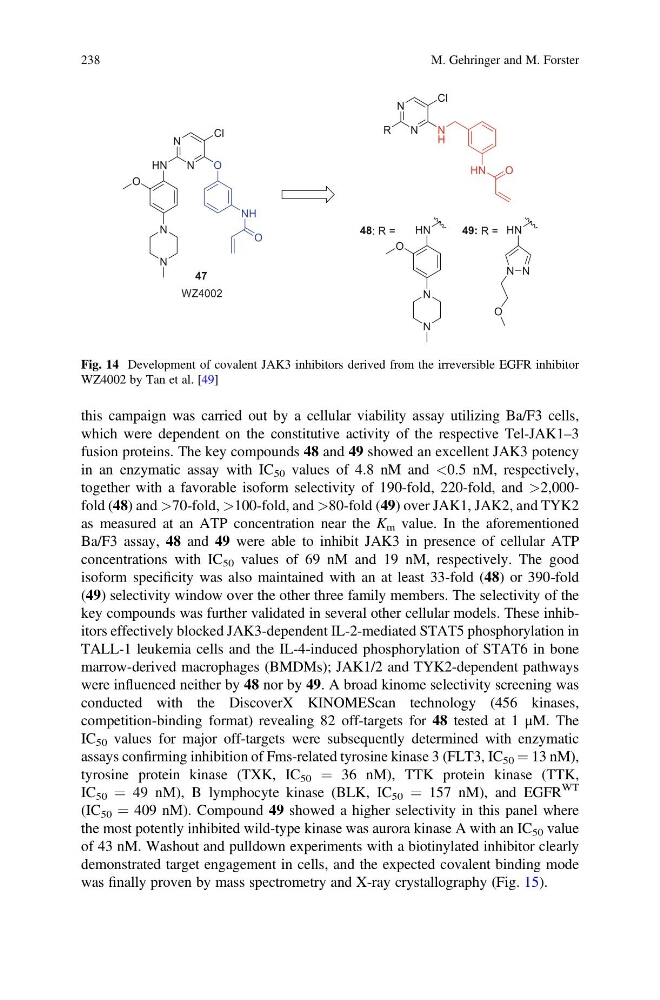
fusion proteins. The key compounds 48 and 49 showed an excellent JAK3 potency
in an enzymatic assay with IC 50 values of 4.8 nM and <0.5 nM, respectively,
together with a favorable isoform selectivity of 190-fold, 220-fold, and >2,000fold (48) and >70-fold, >100-fold, and >80-fold (49) over JAK1, JAK2, and TYK2
as measured at an ATP concentration near the K m value. In the aforementioned
Ba/F3 assay, 48 and 49 were able to inhibit JAK3 in presence of cellular ATP
concentrations with IC 50 values of 69 nM and 19 nM, respectively. The good
isoform specificity was also maintained with an at least 33-fold (48) or 390-fold
(49) selectivity window over the other three family members. The selectivity of the
key compounds was further validated in several other cellular models. These inhibitors effectively blocked JAK3-dependent IL-2-mediated STAT5 phosphorylation in
TALL-1 leukemia cells and the IL-4-induced phosphorylation of STAT6 in bone
marrow-derived macrophages (BMDMs); JAK1/2 and TYK2-dependent pathways
were influenced neither by 48 nor by 49. A broad kinome selectivity screening was
conducted with the DiscoverX KINOMEScan technology (456 kinases,
competition-binding format) revealing 82 off-targets for 48 tested at 1 μM. The
IC 50 values for major off-targets were subsequently determined with enzymatic
assays confirming inhibition of Fms-related tyrosine kinase 3 (FLT3, IC 50 ¼ 13 nM),
tyrosine protein kinase (TXK, IC 50 ¼ 36 nM), TTK protein kinase (TTK,
IC 50 ¼ 49 nM), B lymphocyte kinase (BLK, IC 50 ¼ 157 nM), and EGFR
WT
(IC 50 ¼ 409 nM). Compound 49 showed a higher selectivity in this panel where
the most potently inhibited wild-type kinase was aurora kinase A with an IC 50 value
of 43 nM. Washout and pulldown experiments with a biotinylated inhibitor clearly
demonstrated target engagement in cells, and the expected covalent binding mode
was finally proven by mass spectrometry and X-ray crystallography (Fig. 15).
Fig. 14 Development of covalent JAK3 inhibitors derived from the irreversible EGFR inhibitor
WZ4002 by Tan et al. [49]
238
M. Gehringer and M. Forster
which were dependent on the constitutive activity of the respective Tel-JAK1–3
fusion proteins. The key compounds 48 and 49 showed an excellent JAK3 potency
in an enzymatic assay with IC 50 values of 4.8 nM and <0.5 nM, respectively,
together with a favorable isoform selectivity of 190-fold, 220-fold, and >2,000fold (48) and >70-fold, >100-fold, and >80-fold (49) over JAK1, JAK2, and TYK2
as measured at an ATP concentration near the K m value. In the aforementioned
Ba/F3 assay, 48 and 49 were able to inhibit JAK3 in presence of cellular ATP
concentrations with IC 50 values of 69 nM and 19 nM, respectively. The good
isoform specificity was also maintained with an at least 33-fold (48) or 390-fold
(49) selectivity window over the other three family members. The selectivity of the
key compounds was further validated in several other cellular models. These inhibitors effectively blocked JAK3-dependent IL-2-mediated STAT5 phosphorylation in
TALL-1 leukemia cells and the IL-4-induced phosphorylation of STAT6 in bone
marrow-derived macrophages (BMDMs); JAK1/2 and TYK2-dependent pathways
were influenced neither by 48 nor by 49. A broad kinome selectivity screening was
conducted with the DiscoverX KINOMEScan technology (456 kinases,
competition-binding format) revealing 82 off-targets for 48 tested at 1 μM. The
IC 50 values for major off-targets were subsequently determined with enzymatic
assays confirming inhibition of Fms-related tyrosine kinase 3 (FLT3, IC 50 ¼ 13 nM),
tyrosine protein kinase (TXK, IC 50 ¼ 36 nM), TTK protein kinase (TTK,
IC 50 ¼ 49 nM), B lymphocyte kinase (BLK, IC 50 ¼ 157 nM), and EGFR
WT
(IC 50 ¼ 409 nM). Compound 49 showed a higher selectivity in this panel where
the most potently inhibited wild-type kinase was aurora kinase A with an IC 50 value
of 43 nM. Washout and pulldown experiments with a biotinylated inhibitor clearly
demonstrated target engagement in cells, and the expected covalent binding mode
was finally proven by mass spectrometry and X-ray crystallography (Fig. 15).
Fig. 14 Development of covalent JAK3 inhibitors derived from the irreversible EGFR inhibitor
WZ4002 by Tan et al. [49]
238
M. Gehringer and M. Forster