

However, in cell-based assays, JNK-IN-8 shows slightly lower inhibitory activity
compared to JNK-IN-7 (IC 50 values of 486 nM and 333 nM in Hela and A375
cells, respectively) [18]. In a panel of 442 different protein kinases (also including
mutants), JNK-IN-8 only bound to two Kit mutants (V559D and V557D,T650I).
In a cellular kinase profiling versus distinct protein kinases, JNK-IN-8 exclusively
inhibited JNK1,2,3. Due to its excellent selectivity profile, the covalent pan-JNKinhibitor JNK-IN-8 was selected by the chemical probes portal as a tool compound
to further investigate the role of JNK1/2/3 inhibition (www.chemicalprobesportal.
org). However, the same portal recommends using JNK-IN-8 along with validated
JNK inhibitors as a positive control.
3.2 Pyridinylimidazole-Based Covalent Inhibitors
The concept of covalently targeting the JNK3 was also transferred to the reversible
JNK inhibitors of the 2-alkylsulfanyl-5-(pyridin-4-yl)imidazole series, which are
already optimized to interact with different regions in the ATP-binding site of
JNK3 (see Sect. 2.3) [34]. For targeting the mentioned cysteine side chain in the
JNKs, the electrophilic warhead was attached to the pyridine-C2-amino function
via a suitable linker (Fig. 16).
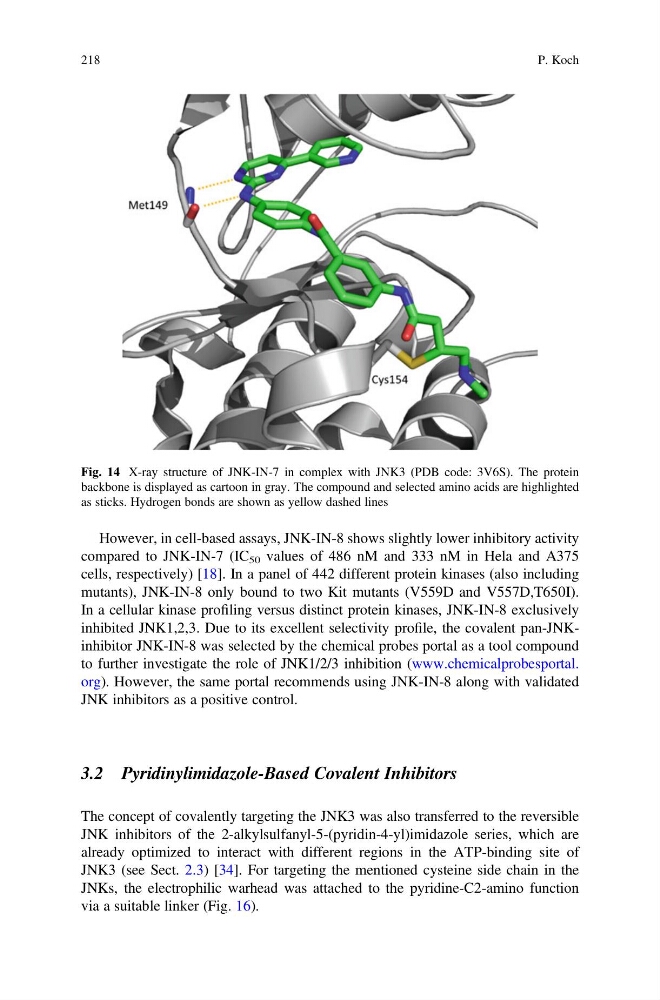
Fig. 14 X-ray structure of JNK-IN-7 in complex with JNK3 (PDB code: 3V6S). The protein
backbone is displayed as cartoon in gray. The compound and selected amino acids are highlighted
as sticks. Hydrogen bonds are shown as yellow dashed lines
218
P. Koch
compared to JNK-IN-7 (IC 50 values of 486 nM and 333 nM in Hela and A375
cells, respectively) [18]. In a panel of 442 different protein kinases (also including
mutants), JNK-IN-8 only bound to two Kit mutants (V559D and V557D,T650I).
In a cellular kinase profiling versus distinct protein kinases, JNK-IN-8 exclusively
inhibited JNK1,2,3. Due to its excellent selectivity profile, the covalent pan-JNKinhibitor JNK-IN-8 was selected by the chemical probes portal as a tool compound
to further investigate the role of JNK1/2/3 inhibition (www.chemicalprobesportal.
org). However, the same portal recommends using JNK-IN-8 along with validated
JNK inhibitors as a positive control.
3.2 Pyridinylimidazole-Based Covalent Inhibitors
The concept of covalently targeting the JNK3 was also transferred to the reversible
JNK inhibitors of the 2-alkylsulfanyl-5-(pyridin-4-yl)imidazole series, which are
already optimized to interact with different regions in the ATP-binding site of
JNK3 (see Sect. 2.3) [34]. For targeting the mentioned cysteine side chain in the
JNKs, the electrophilic warhead was attached to the pyridine-C2-amino function
via a suitable linker (Fig. 16).
Fig. 14 X-ray structure of JNK-IN-7 in complex with JNK3 (PDB code: 3V6S). The protein
backbone is displayed as cartoon in gray. The compound and selected amino acids are highlighted
as sticks. Hydrogen bonds are shown as yellow dashed lines
218
P. Koch