

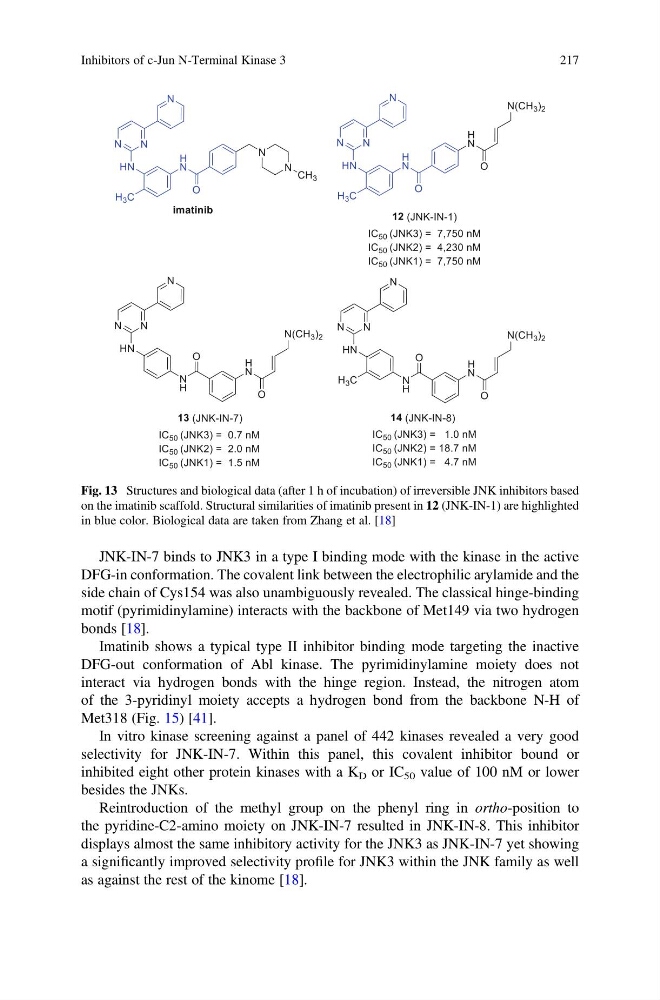
JNK-IN-7 binds to JNK3 in a type I binding mode with the kinase in the active
DFG-in conformation. The covalent link between the electrophilic arylamide and the
side chain of Cys154 was also unambiguously revealed. The classical hinge-binding
motif (pyrimidinylamine) interacts with the backbone of Met149 via two hydrogen
bonds [18].
Imatinib shows a typical type II inhibitor binding mode targeting the inactive
DFG-out conformation of Abl kinase. The pyrimidinylamine moiety does not
interact via hydrogen bonds with the hinge region. Instead, the nitrogen atom
of the 3-pyridinyl moiety accepts a hydrogen bond from the backbone N-H of
Met318 (Fig. 15) [41].
In vitro kinase screening against a panel of 442 kinases revealed a very good
selectivity for JNK-IN-7. Within this panel, this covalent inhibitor bound or
inhibited eight other protein kinases with a K D or IC 50 value of 100 nM or lower
besides the JNKs.
Reintroduction of the methyl group on the phenyl ring in ortho-position to
the pyridine-C2-amino moiety on JNK-IN-7 resulted in JNK-IN-8. This inhibitor
displays almost the same inhibitory activity for the JNK3 as JNK-IN-7 yet showing
a significantly improved selectivity profile for JNK3 within the JNK family as well
as against the rest of the kinome [18].
Fig. 13 Structures and biological data (after 1 h of incubation) of irreversible JNK inhibitors based
on the imatinib scaffold. Structural similarities of imatinib present in 12 (JNK-IN-1) are highlighted
in blue color. Biological data are taken from Zhang et al. [18]
Inhibitors of c-Jun N-Terminal Kinase 3
217
DFG-in conformation. The covalent link between the electrophilic arylamide and the
side chain of Cys154 was also unambiguously revealed. The classical hinge-binding
motif (pyrimidinylamine) interacts with the backbone of Met149 via two hydrogen
bonds [18].
Imatinib shows a typical type II inhibitor binding mode targeting the inactive
DFG-out conformation of Abl kinase. The pyrimidinylamine moiety does not
interact via hydrogen bonds with the hinge region. Instead, the nitrogen atom
of the 3-pyridinyl moiety accepts a hydrogen bond from the backbone N-H of
Met318 (Fig. 15) [41].
In vitro kinase screening against a panel of 442 kinases revealed a very good
selectivity for JNK-IN-7. Within this panel, this covalent inhibitor bound or
inhibited eight other protein kinases with a K D or IC 50 value of 100 nM or lower
besides the JNKs.
Reintroduction of the methyl group on the phenyl ring in ortho-position to
the pyridine-C2-amino moiety on JNK-IN-7 resulted in JNK-IN-8. This inhibitor
displays almost the same inhibitory activity for the JNK3 as JNK-IN-7 yet showing
a significantly improved selectivity profile for JNK3 within the JNK family as well
as against the rest of the kinome [18].
Fig. 13 Structures and biological data (after 1 h of incubation) of irreversible JNK inhibitors based
on the imatinib scaffold. Structural similarities of imatinib present in 12 (JNK-IN-1) are highlighted
in blue color. Biological data are taken from Zhang et al. [18]
Inhibitors of c-Jun N-Terminal Kinase 3
217