

Using a structure-based design, a series of analogs was established, and the
pan-JNK inhibitor JNK-IN-1 was further optimized regarding its inhibitory activity.
Removing the methyl group of the benzene ring at the pyrimidine-C2-amino
position and changing the substitution pattern on both benzene rings in the linker
bearing the electrophilic warhead resulted in compound JNK-IN-7. This potential
covalent inhibitor displayed IC 50 values in the low single-digit nanomolar range
for JNK1 and JNK2 as well as in the subnanomolar range for JNK3 (1 h incubation).
In case of JNK3, JNK-IN-7 shows a 1,000-fold higher activity compared to parent
compound JNK-IN-1. JNK-IN-7 also inhibits c-Jun phosphorylation in HeLa and
A375 cells with IC 50 values of 130 nM and 244 nM, respectively [18].
The X-ray structure of JNK-IN-7 in complex with JNK3 (PDB code: 3V6S)
(Fig. 14) reveals that this covalent inhibitor has a different binding mode in
the ATP-binding site of JNK3 than imatinib in Abl kinase (PDB code: 1IEP)
(Fig. 15) [41].
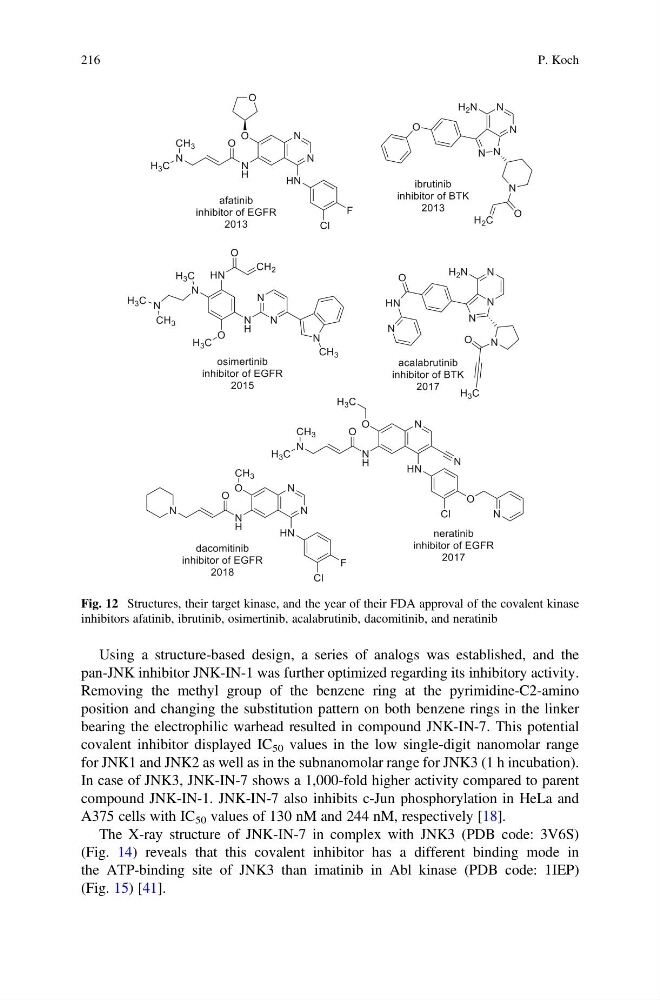
Fig. 12 Structures, their target kinase, and the year of their FDA approval of the covalent kinase
inhibitors afatinib, ibrutinib, osimertinib, acalabrutinib, dacomitinib, and neratinib
216
P. Koch
pan-JNK inhibitor JNK-IN-1 was further optimized regarding its inhibitory activity.
Removing the methyl group of the benzene ring at the pyrimidine-C2-amino
position and changing the substitution pattern on both benzene rings in the linker
bearing the electrophilic warhead resulted in compound JNK-IN-7. This potential
covalent inhibitor displayed IC 50 values in the low single-digit nanomolar range
for JNK1 and JNK2 as well as in the subnanomolar range for JNK3 (1 h incubation).
In case of JNK3, JNK-IN-7 shows a 1,000-fold higher activity compared to parent
compound JNK-IN-1. JNK-IN-7 also inhibits c-Jun phosphorylation in HeLa and
A375 cells with IC 50 values of 130 nM and 244 nM, respectively [18].
The X-ray structure of JNK-IN-7 in complex with JNK3 (PDB code: 3V6S)
(Fig. 14) reveals that this covalent inhibitor has a different binding mode in
the ATP-binding site of JNK3 than imatinib in Abl kinase (PDB code: 1IEP)
(Fig. 15) [41].
Fig. 12 Structures, their target kinase, and the year of their FDA approval of the covalent kinase
inhibitors afatinib, ibrutinib, osimertinib, acalabrutinib, dacomitinib, and neratinib
216
P. Koch