

Pyridinylimidazole 6 was evaluated further pharmacologically. This inhibitor
is metabolically stable in human liver microsomes, and it possesses only low
to moderate affinity toward four out of five tested pharmacologically relevant
cytochrome P450 isoenzymes as well as toward hERG channels [33].
2.4 Aminopyrazole Derivatives
In another study, LoGrasso, Feng, and coworkers reported about a series of
aminopyrazole-based JNK3 inhibitors, which show high isoform selectivity over
JNK1 and in some cases also versus JNK2 (Fig. 10) [37].
Starting from lead compound SR-4326, a large SAR study comprising derivatives
with modifications on the urea moiety as well as on the amide moiety was generated.
Replacement of the methylpyridine moiety present in SR-4326 by a
pyrrolidinylpyrazole moiety resulted in aminopyrazole 10 showing a subnanomolar
IC 50 value in the JNK3 activity assay as well as a good intra-JNK selectivity
(Fig. 10). JNK3 inhibitor 10 displays a more than 500- and 200-fold selectivity
over JNK1 and JNK2, respectively. However, data from a selectivity screening
of 10 has not been reported so far.
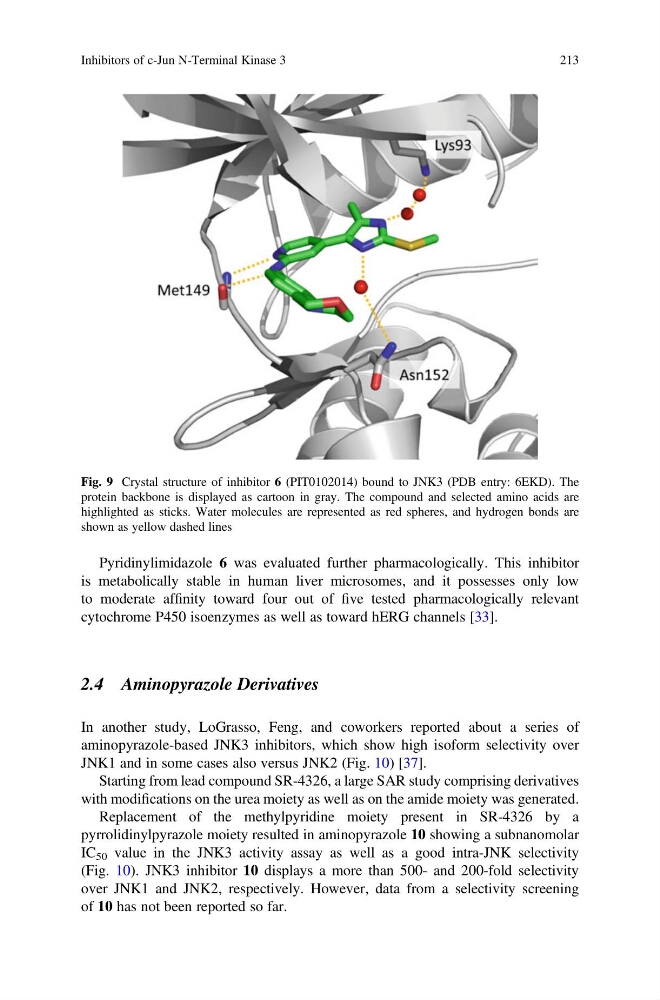
Fig. 9 Crystal structure of inhibitor 6 (PIT0102014) bound to JNK3 (PDB entry: 6EKD). The
protein backbone is displayed as cartoon in gray. The compound and selected amino acids are
highlighted as sticks. Water molecules are represented as red spheres, and hydrogen bonds are
shown as yellow dashed lines
Inhibitors of c-Jun N-Terminal Kinase 3
213
is metabolically stable in human liver microsomes, and it possesses only low
to moderate affinity toward four out of five tested pharmacologically relevant
cytochrome P450 isoenzymes as well as toward hERG channels [33].
2.4 Aminopyrazole Derivatives
In another study, LoGrasso, Feng, and coworkers reported about a series of
aminopyrazole-based JNK3 inhibitors, which show high isoform selectivity over
JNK1 and in some cases also versus JNK2 (Fig. 10) [37].
Starting from lead compound SR-4326, a large SAR study comprising derivatives
with modifications on the urea moiety as well as on the amide moiety was generated.
Replacement of the methylpyridine moiety present in SR-4326 by a
pyrrolidinylpyrazole moiety resulted in aminopyrazole 10 showing a subnanomolar
IC 50 value in the JNK3 activity assay as well as a good intra-JNK selectivity
(Fig. 10). JNK3 inhibitor 10 displays a more than 500- and 200-fold selectivity
over JNK1 and JNK2, respectively. However, data from a selectivity screening
of 10 has not been reported so far.
Fig. 9 Crystal structure of inhibitor 6 (PIT0102014) bound to JNK3 (PDB entry: 6EKD). The
protein backbone is displayed as cartoon in gray. The compound and selected amino acids are
highlighted as sticks. Water molecules are represented as red spheres, and hydrogen bonds are
shown as yellow dashed lines
Inhibitors of c-Jun N-Terminal Kinase 3
213