

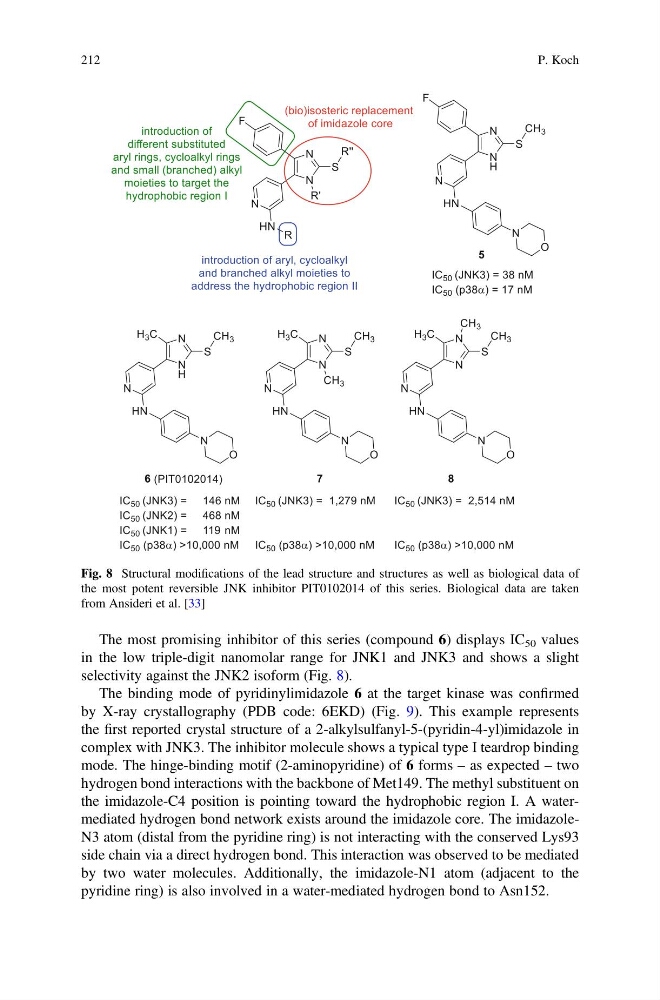
The most promising inhibitor of this series (compound 6) displays IC 50 values
in the low triple-digit nanomolar range for JNK1 and JNK3 and shows a slight
selectivity against the JNK2 isoform (Fig. 8).
The binding mode of pyridinylimidazole 6 at the target kinase was confirmed
by X-ray crystallography (PDB code: 6EKD) (Fig. 9). This example represents
the first reported crystal structure of a 2-alkylsulfanyl-5-(pyridin-4-yl)imidazole in
complex with JNK3. The inhibitor molecule shows a typical type I teardrop binding
mode. The hinge-binding motif (2-aminopyridine) of 6 forms – as expected – two
hydrogen bond interactions with the backbone of Met149. The methyl substituent on
the imidazole-C4 position is pointing toward the hydrophobic region I. A watermediated hydrogen bond network exists around the imidazole core. The imidazoleN3 atom (distal from the pyridine ring) is not interacting with the conserved Lys93
side chain via a direct hydrogen bond. This interaction was observed to be mediated
by two water molecules. Additionally, the imidazole-N1 atom (adjacent to the
pyridine ring) is also involved in a water-mediated hydrogen bond to Asn152.
Fig. 8 Structural modifications of the lead structure and structures as well as biological data of
the most potent reversible JNK inhibitor PIT0102014 of this series. Biological data are taken
from Ansideri et al. [33]
212
P. Koch
in the low triple-digit nanomolar range for JNK1 and JNK3 and shows a slight
selectivity against the JNK2 isoform (Fig. 8).
The binding mode of pyridinylimidazole 6 at the target kinase was confirmed
by X-ray crystallography (PDB code: 6EKD) (Fig. 9). This example represents
the first reported crystal structure of a 2-alkylsulfanyl-5-(pyridin-4-yl)imidazole in
complex with JNK3. The inhibitor molecule shows a typical type I teardrop binding
mode. The hinge-binding motif (2-aminopyridine) of 6 forms – as expected – two
hydrogen bond interactions with the backbone of Met149. The methyl substituent on
the imidazole-C4 position is pointing toward the hydrophobic region I. A watermediated hydrogen bond network exists around the imidazole core. The imidazoleN3 atom (distal from the pyridine ring) is not interacting with the conserved Lys93
side chain via a direct hydrogen bond. This interaction was observed to be mediated
by two water molecules. Additionally, the imidazole-N1 atom (adjacent to the
pyridine ring) is also involved in a water-mediated hydrogen bond to Asn152.
Fig. 8 Structural modifications of the lead structure and structures as well as biological data of
the most potent reversible JNK inhibitor PIT0102014 of this series. Biological data are taken
from Ansideri et al. [33]
212
P. Koch