

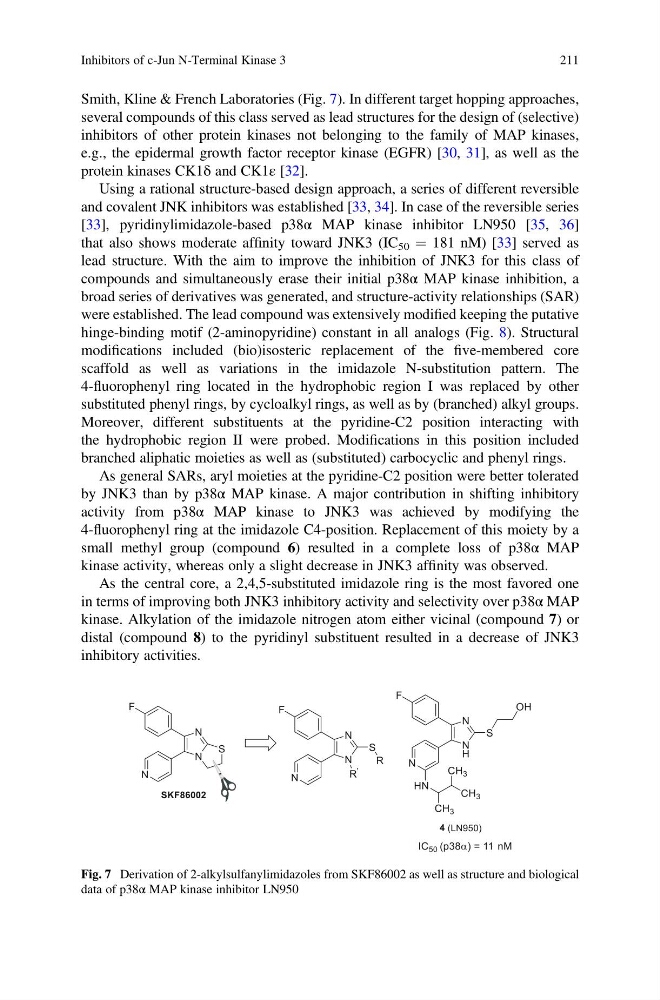
Smith, Kline & French Laboratories (Fig. 7). In different target hopping approaches,
several compounds of this class served as lead structures for the design of (selective)
inhibitors of other protein kinases not belonging to the family of MAP kinases,
e.g., the epidermal growth factor receptor kinase (EGFR) [30, 31], as well as the
protein kinases CK1δ and CK1ε [32].
Using a rational structure-based design approach, a series of different reversible
and covalent JNK inhibitors was established [33, 34]. In case of the reversible series
[33], pyridinylimidazole-based p38α MAP kinase inhibitor LN950 [35, 36]
that also shows moderate affinity toward JNK3 (IC 50 ¼ 181 nM) [33] served as
lead structure. With the aim to improve the inhibition of JNK3 for this class of
compounds and simultaneously erase their initial p38α MAP kinase inhibition, a
broad series of derivatives was generated, and structure-activity relationships (SAR)
were established. The lead compound was extensively modified keeping the putative
hinge-binding motif (2-aminopyridine) constant in all analogs (Fig. 8). Structural
modifications included (bio)isosteric replacement of the five-membered core
scaffold as well as variations in the imidazole N-substitution pattern. The
4-fluorophenyl ring located in the hydrophobic region I was replaced by other
substituted phenyl rings, by cycloalkyl rings, as well as by (branched) alkyl groups.
Moreover, different substituents at the pyridine-C2 position interacting with
the hydrophobic region II were probed. Modifications in this position included
branched aliphatic moieties as well as (substituted) carbocyclic and phenyl rings.
As general SARs, aryl moieties at the pyridine-C2 position were better tolerated
by JNK3 than by p38α MAP kinase. A major contribution in shifting inhibitory
activity from p38α MAP kinase to JNK3 was achieved by modifying the
4-fluorophenyl ring at the imidazole C4-position. Replacement of this moiety by a
small methyl group (compound 6) resulted in a complete loss of p38α MAP
kinase activity, whereas only a slight decrease in JNK3 affinity was observed.
As the central core, a 2,4,5-substituted imidazole ring is the most favored one
in terms of improving both JNK3 inhibitory activity and selectivity over p38α MAP
kinase. Alkylation of the imidazole nitrogen atom either vicinal (compound 7) or
distal (compound 8) to the pyridinyl substituent resulted in a decrease of JNK3
inhibitory activities.
Fig. 7 Derivation of 2-alkylsulfanylimidazoles from SKF86002 as well as structure and biological
data of p38α MAP kinase inhibitor LN950
Inhibitors of c-Jun N-Terminal Kinase 3
211
several compounds of this class served as lead structures for the design of (selective)
inhibitors of other protein kinases not belonging to the family of MAP kinases,
e.g., the epidermal growth factor receptor kinase (EGFR) [30, 31], as well as the
protein kinases CK1δ and CK1ε [32].
Using a rational structure-based design approach, a series of different reversible
and covalent JNK inhibitors was established [33, 34]. In case of the reversible series
[33], pyridinylimidazole-based p38α MAP kinase inhibitor LN950 [35, 36]
that also shows moderate affinity toward JNK3 (IC 50 ¼ 181 nM) [33] served as
lead structure. With the aim to improve the inhibition of JNK3 for this class of
compounds and simultaneously erase their initial p38α MAP kinase inhibition, a
broad series of derivatives was generated, and structure-activity relationships (SAR)
were established. The lead compound was extensively modified keeping the putative
hinge-binding motif (2-aminopyridine) constant in all analogs (Fig. 8). Structural
modifications included (bio)isosteric replacement of the five-membered core
scaffold as well as variations in the imidazole N-substitution pattern. The
4-fluorophenyl ring located in the hydrophobic region I was replaced by other
substituted phenyl rings, by cycloalkyl rings, as well as by (branched) alkyl groups.
Moreover, different substituents at the pyridine-C2 position interacting with
the hydrophobic region II were probed. Modifications in this position included
branched aliphatic moieties as well as (substituted) carbocyclic and phenyl rings.
As general SARs, aryl moieties at the pyridine-C2 position were better tolerated
by JNK3 than by p38α MAP kinase. A major contribution in shifting inhibitory
activity from p38α MAP kinase to JNK3 was achieved by modifying the
4-fluorophenyl ring at the imidazole C4-position. Replacement of this moiety by a
small methyl group (compound 6) resulted in a complete loss of p38α MAP
kinase activity, whereas only a slight decrease in JNK3 affinity was observed.
As the central core, a 2,4,5-substituted imidazole ring is the most favored one
in terms of improving both JNK3 inhibitory activity and selectivity over p38α MAP
kinase. Alkylation of the imidazole nitrogen atom either vicinal (compound 7) or
distal (compound 8) to the pyridinyl substituent resulted in a decrease of JNK3
inhibitory activities.
Fig. 7 Derivation of 2-alkylsulfanylimidazoles from SKF86002 as well as structure and biological
data of p38α MAP kinase inhibitor LN950
Inhibitors of c-Jun N-Terminal Kinase 3
211