

Another example of the aminopyrimidinyl-based JNK inhibitors is compound
3 (SR-3306) (Fig. 5) [25]. Compared to inhibitor 2, pan-JNK inhibitor 3 lacks the
fluoro substituent on one of the benzene rings, and the morpholino moiety
at the triazole moiety is replaced by a methylpyridine. In terms of JNK3 inhibition
in the biochemical activity assay, compound 3 is an equipotent inhibitor as
compound 2. However, in the cellular assay, JNK inhibitor 3 showed a fourfold
reduced activity (IC 50 ¼ 216 nM) than 2. Pyrimidinylamine 3 possesses a moderate
selectivity. At a test concentration of 3 μM, compound 3 inhibited 35 out of the
tested 347 kinases. Additionally, compound 3 showed a clean human ether-à-go-gorelated gene (hERG) (IC 50 > 30 μM) as well as CYP profile (IC 50 > 50 μM against
1A2, 2A6, 2B6, 2C8, 2C9, 2C19, 2D6, 2E1, and 3A4 isoenzymes). Furthermore,
inhibitor 3 is able to cross the blood-brain barrier (plasma/brain ratio: 30–40%).
Inhibitor 3 displayed a neuroprotective effect in different in vitro and
in vivo models of Parkinson’s disease [25, 27] and effectively protects against
ischemia/reperfusion injury in rats at a test concentration of 5 mg/kg [28].
2.3 2-Alkylsulfanyl-5-(pyridin-4-yl)imidazoles
2-Alkylsulfanyl-4-(4-fluorophenyl)-5-(pyridin-4-yl)imidazoles are a prominent
class of kinase inhibitors and can be considered as open analogs of the early
lead p38α MAP kinase inhibitor SKF86002 [29] developed by researchers from
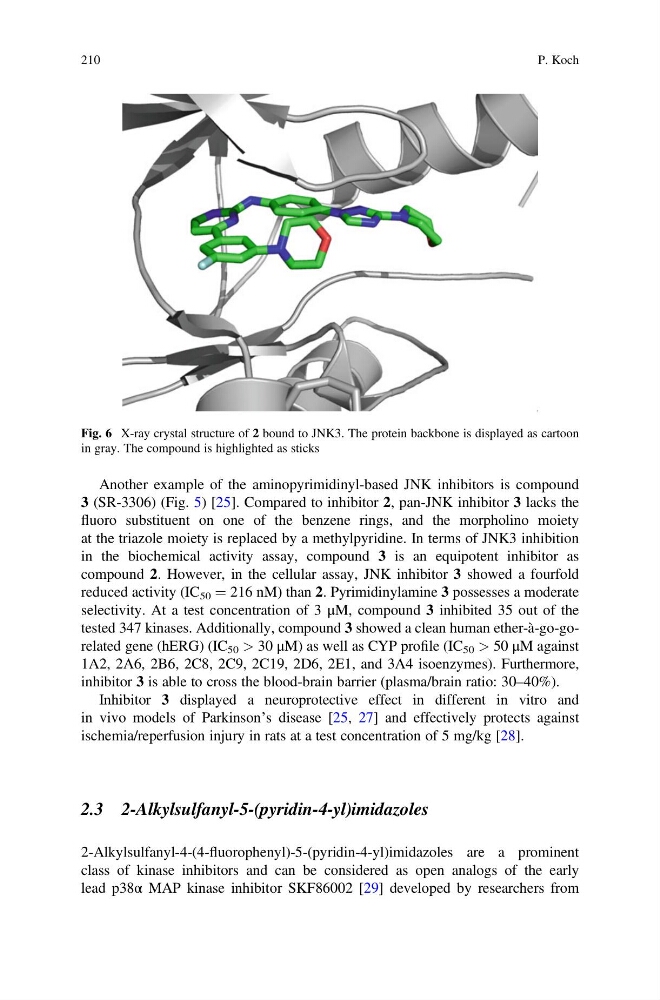
Fig. 6 X-ray crystal structure of 2 bound to JNK3. The protein backbone is displayed as cartoon
in gray. The compound is highlighted as sticks
210
P. Koch
3 (SR-3306) (Fig. 5) [25]. Compared to inhibitor 2, pan-JNK inhibitor 3 lacks the
fluoro substituent on one of the benzene rings, and the morpholino moiety
at the triazole moiety is replaced by a methylpyridine. In terms of JNK3 inhibition
in the biochemical activity assay, compound 3 is an equipotent inhibitor as
compound 2. However, in the cellular assay, JNK inhibitor 3 showed a fourfold
reduced activity (IC 50 ¼ 216 nM) than 2. Pyrimidinylamine 3 possesses a moderate
selectivity. At a test concentration of 3 μM, compound 3 inhibited 35 out of the
tested 347 kinases. Additionally, compound 3 showed a clean human ether-à-go-gorelated gene (hERG) (IC 50 > 30 μM) as well as CYP profile (IC 50 > 50 μM against
1A2, 2A6, 2B6, 2C8, 2C9, 2C19, 2D6, 2E1, and 3A4 isoenzymes). Furthermore,
inhibitor 3 is able to cross the blood-brain barrier (plasma/brain ratio: 30–40%).
Inhibitor 3 displayed a neuroprotective effect in different in vitro and
in vivo models of Parkinson’s disease [25, 27] and effectively protects against
ischemia/reperfusion injury in rats at a test concentration of 5 mg/kg [28].
2.3 2-Alkylsulfanyl-5-(pyridin-4-yl)imidazoles
2-Alkylsulfanyl-4-(4-fluorophenyl)-5-(pyridin-4-yl)imidazoles are a prominent
class of kinase inhibitors and can be considered as open analogs of the early
lead p38α MAP kinase inhibitor SKF86002 [29] developed by researchers from
Fig. 6 X-ray crystal structure of 2 bound to JNK3. The protein backbone is displayed as cartoon
in gray. The compound is highlighted as sticks
210
P. Koch