

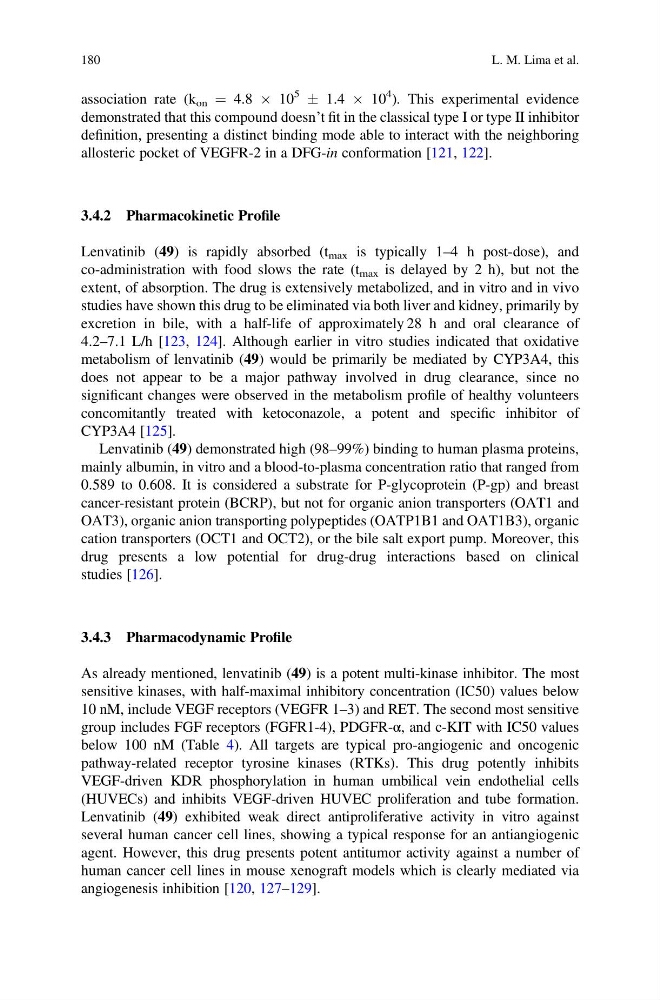
association rate (k on ¼ 4.8 Â 10
5
Æ 1.4 Â 10
4 ). This experimental evidence
demonstrated that this compound doesn’t fit in the classical type I or type II inhibitor
definition, presenting a distinct binding mode able to interact with the neighboring
allosteric pocket of VEGFR-2 in a DFG-in conformation [121, 122].
3.4.2 Pharmacokinetic Profile
Lenvatinib (49) is rapidly absorbed (t max is typically 1–4 h post-dose), and
co-administration with food slows the rate (t max is delayed by 2 h), but not the
extent, of absorption. The drug is extensively metabolized, and in vitro and in vivo
studies have shown this drug to be eliminated via both liver and kidney, primarily by
excretion in bile, with a half-life of approximately 28 h and oral clearance of
4.2–7.1 L/h [123, 124]. Although earlier in vitro studies indicated that oxidative
metabolism of lenvatinib (49) would be primarily be mediated by CYP3A4, this
does not appear to be a major pathway involved in drug clearance, since no
significant changes were observed in the metabolism profile of healthy volunteers
concomitantly treated with ketoconazole, a potent and specific inhibitor of
CYP3A4 [125].
Lenvatinib (49) demonstrated high (98–99%) binding to human plasma proteins,
mainly albumin, in vitro and a blood-to-plasma concentration ratio that ranged from
0.589 to 0.608. It is considered a substrate for P-glycoprotein (P-gp) and breast
cancer-resistant protein (BCRP), but not for organic anion transporters (OAT1 and
OAT3), organic anion transporting polypeptides (OATP1B1 and OAT1B3), organic
cation transporters (OCT1 and OCT2), or the bile salt export pump. Moreover, this
drug presents a low potential for drug-drug interactions based on clinical
studies [126].
3.4.3 Pharmacodynamic Profile
As already mentioned, lenvatinib (49) is a potent multi-kinase inhibitor. The most
sensitive kinases, with half-maximal inhibitory concentration (IC50) values below
10 nM, include VEGF receptors (VEGFR 1–3) and RET. The second most sensitive
group includes FGF receptors (FGFR1-4), PDGFR-α, and c-KIT with IC50 values
below 100 nM (Table 4). All targets are typical pro-angiogenic and oncogenic
pathway-related receptor tyrosine kinases (RTKs). This drug potently inhibits
VEGF-driven KDR phosphorylation in human umbilical vein endothelial cells
(HUVECs) and inhibits VEGF-driven HUVEC proliferation and tube formation.
Lenvatinib (49) exhibited weak direct antiproliferative activity in vitro against
several human cancer cell lines, showing a typical response for an antiangiogenic
agent. However, this drug presents potent antitumor activity against a number of
human cancer cell lines in mouse xenograft models which is clearly mediated via
angiogenesis inhibition [120, 127–129].
180
L. M. Lima et al.
5
Æ 1.4 Â 10
4 ). This experimental evidence
demonstrated that this compound doesn’t fit in the classical type I or type II inhibitor
definition, presenting a distinct binding mode able to interact with the neighboring
allosteric pocket of VEGFR-2 in a DFG-in conformation [121, 122].
3.4.2 Pharmacokinetic Profile
Lenvatinib (49) is rapidly absorbed (t max is typically 1–4 h post-dose), and
co-administration with food slows the rate (t max is delayed by 2 h), but not the
extent, of absorption. The drug is extensively metabolized, and in vitro and in vivo
studies have shown this drug to be eliminated via both liver and kidney, primarily by
excretion in bile, with a half-life of approximately 28 h and oral clearance of
4.2–7.1 L/h [123, 124]. Although earlier in vitro studies indicated that oxidative
metabolism of lenvatinib (49) would be primarily be mediated by CYP3A4, this
does not appear to be a major pathway involved in drug clearance, since no
significant changes were observed in the metabolism profile of healthy volunteers
concomitantly treated with ketoconazole, a potent and specific inhibitor of
CYP3A4 [125].
Lenvatinib (49) demonstrated high (98–99%) binding to human plasma proteins,
mainly albumin, in vitro and a blood-to-plasma concentration ratio that ranged from
0.589 to 0.608. It is considered a substrate for P-glycoprotein (P-gp) and breast
cancer-resistant protein (BCRP), but not for organic anion transporters (OAT1 and
OAT3), organic anion transporting polypeptides (OATP1B1 and OAT1B3), organic
cation transporters (OCT1 and OCT2), or the bile salt export pump. Moreover, this
drug presents a low potential for drug-drug interactions based on clinical
studies [126].
3.4.3 Pharmacodynamic Profile
As already mentioned, lenvatinib (49) is a potent multi-kinase inhibitor. The most
sensitive kinases, with half-maximal inhibitory concentration (IC50) values below
10 nM, include VEGF receptors (VEGFR 1–3) and RET. The second most sensitive
group includes FGF receptors (FGFR1-4), PDGFR-α, and c-KIT with IC50 values
below 100 nM (Table 4). All targets are typical pro-angiogenic and oncogenic
pathway-related receptor tyrosine kinases (RTKs). This drug potently inhibits
VEGF-driven KDR phosphorylation in human umbilical vein endothelial cells
(HUVECs) and inhibits VEGF-driven HUVEC proliferation and tube formation.
Lenvatinib (49) exhibited weak direct antiproliferative activity in vitro against
several human cancer cell lines, showing a typical response for an antiangiogenic
agent. However, this drug presents potent antitumor activity against a number of
human cancer cell lines in mouse xenograft models which is clearly mediated via
angiogenesis inhibition [120, 127–129].
180
L. M. Lima et al.