

Lenvatinib (49) has demonstrated antiangiogenic and/or antitumor properties in
preclinical in vitro and in vivo studies, showing promising anticancer activity in
11 human thyroid cancer xenograft models derived from the following human cell
lines: (a) differentiated thyroid cancer (DTC) – the most prevalent type of thyroid
cancer; (b) medullary thyroid cancer (MTC); and (c) and anaplastic thyroid cancer
(ATC) – one of the most deadly human diseases with prevalence below 2%. The
broad antitumor activity observed for most of the human thyroid cancer models is
attributed to the potent antiangiogenic effect, as a result of a multiple inhibition of
RTKs that play an essential role in the development of tumor-dependent angiogenesis, e.g., VEGFR-2, PDGFR, and FGFR [128, 129].
Particularly, the efficacy of lenvatinib (49) in patients with radioiodine-refractory
differentiated thyroid cancer (RR-DTC) was established based on a randomized,
double-blind, multinational phase III SELECT study, in which this anticancer drug
significantly improved median progression-free survival (PFS) and the overall
response rate when compared with placebo. The beneficial effect of lenvatinib (49)
on PFS was also seen across all pre-specified subgroups including those based on
sex, race, geographic region, prior or no prior VEGF-targeted therapy, age (aged
65 or >65 years), histological (sub)type, and baseline TSH level [130, 131]. Taken
together, these clinical findings validate lenvatinib (49) as an oral active multi-kinase
inhibitor with potential to modify the role of systemic treatment in the management
of patients with radioiodine-refractory thyroid cancer, representing an exciting
therapeutic option to RR-DTC treatment.
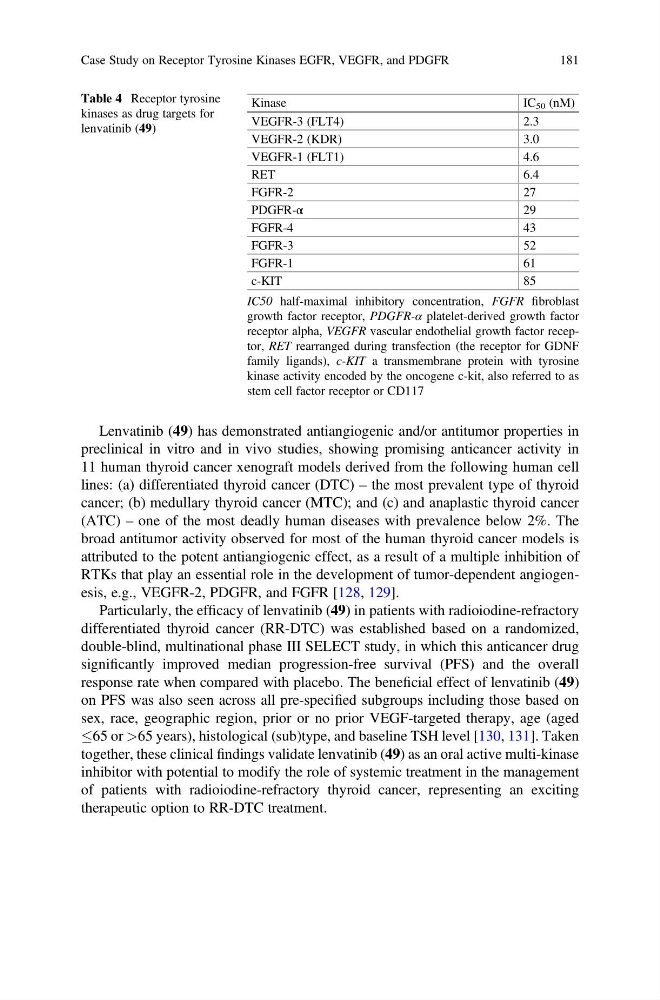
Table 4 Receptor tyrosine
kinases as drug targets for
lenvatinib (49)
Kinase
IC 50 (nM)
VEGFR-3 (FLT4)
2.3
VEGFR-2 (KDR)
3.0
VEGFR-1 (FLT1)
4.6
RET
6.4
FGFR-2
27
PDGFR-α
29
FGFR-4
43
FGFR-3
52
FGFR-1
61
c-KIT
85
IC50 half-maximal inhibitory concentration, FGFR fibroblast
growth factor receptor, PDGFR-α platelet-derived growth factor
receptor alpha, VEGFR vascular endothelial growth factor receptor, RET rearranged during transfection (the receptor for GDNF
family ligands), c-KIT a transmembrane protein with tyrosine
kinase activity encoded by the oncogene c-kit, also referred to as
stem cell factor receptor or CD117
Case Study on Receptor Tyrosine Kinases EGFR, VEGFR, and PDGFR
181
preclinical in vitro and in vivo studies, showing promising anticancer activity in
11 human thyroid cancer xenograft models derived from the following human cell
lines: (a) differentiated thyroid cancer (DTC) – the most prevalent type of thyroid
cancer; (b) medullary thyroid cancer (MTC); and (c) and anaplastic thyroid cancer
(ATC) – one of the most deadly human diseases with prevalence below 2%. The
broad antitumor activity observed for most of the human thyroid cancer models is
attributed to the potent antiangiogenic effect, as a result of a multiple inhibition of
RTKs that play an essential role in the development of tumor-dependent angiogenesis, e.g., VEGFR-2, PDGFR, and FGFR [128, 129].
Particularly, the efficacy of lenvatinib (49) in patients with radioiodine-refractory
differentiated thyroid cancer (RR-DTC) was established based on a randomized,
double-blind, multinational phase III SELECT study, in which this anticancer drug
significantly improved median progression-free survival (PFS) and the overall
response rate when compared with placebo. The beneficial effect of lenvatinib (49)
on PFS was also seen across all pre-specified subgroups including those based on
sex, race, geographic region, prior or no prior VEGF-targeted therapy, age (aged
65 or >65 years), histological (sub)type, and baseline TSH level [130, 131]. Taken
together, these clinical findings validate lenvatinib (49) as an oral active multi-kinase
inhibitor with potential to modify the role of systemic treatment in the management
of patients with radioiodine-refractory thyroid cancer, representing an exciting
therapeutic option to RR-DTC treatment.
Table 4 Receptor tyrosine
kinases as drug targets for
lenvatinib (49)
Kinase
IC 50 (nM)
VEGFR-3 (FLT4)
2.3
VEGFR-2 (KDR)
3.0
VEGFR-1 (FLT1)
4.6
RET
6.4
FGFR-2
27
PDGFR-α
29
FGFR-4
43
FGFR-3
52
FGFR-1
61
c-KIT
85
IC50 half-maximal inhibitory concentration, FGFR fibroblast
growth factor receptor, PDGFR-α platelet-derived growth factor
receptor alpha, VEGFR vascular endothelial growth factor receptor, RET rearranged during transfection (the receptor for GDNF
family ligands), c-KIT a transmembrane protein with tyrosine
kinase activity encoded by the oncogene c-kit, also referred to as
stem cell factor receptor or CD117
Case Study on Receptor Tyrosine Kinases EGFR, VEGFR, and PDGFR
181