

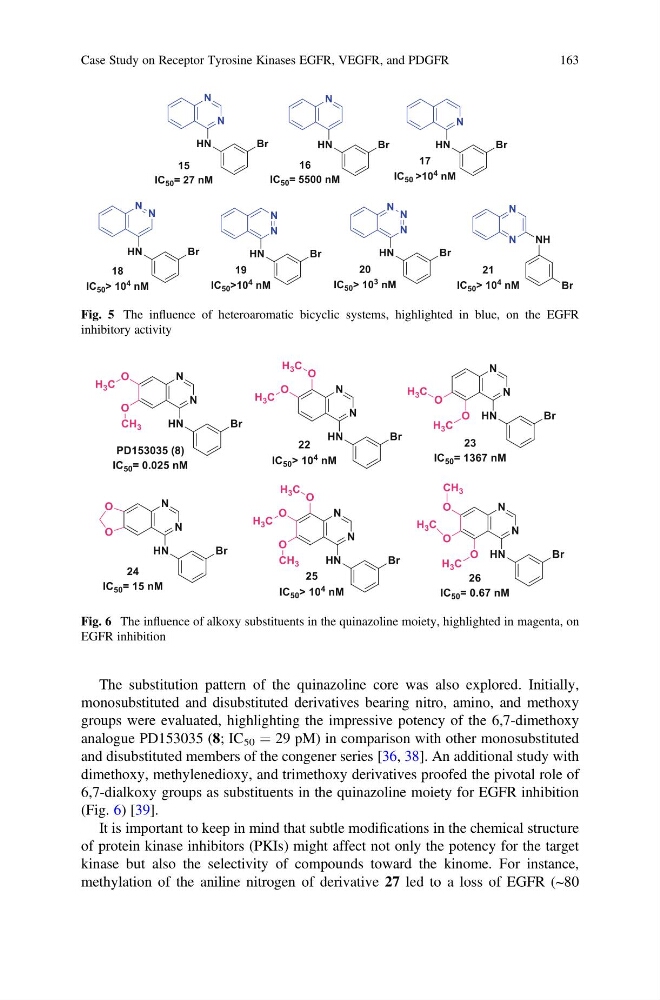
The substitution pattern of the quinazoline core was also explored. Initially,
monosubstituted and disubstituted derivatives bearing nitro, amino, and methoxy
groups were evaluated, highlighting the impressive potency of the 6,7-dimethoxy
analogue PD153035 (8; IC 50 ¼ 29 pM) in comparison with other monosubstituted
and disubstituted members of the congener series [36, 38]. An additional study with
dimethoxy, methylenedioxy, and trimethoxy derivatives proofed the pivotal role of
6,7-dialkoxy groups as substituents in the quinazoline moiety for EGFR inhibition
(Fig. 6) [39].
It is important to keep in mind that subtle modifications in the chemical structure
of protein kinase inhibitors (PKIs) might affect not only the potency for the target
kinase but also the selectivity of compounds toward the kinome. For instance,
methylation of the aniline nitrogen of derivative 27 led to a loss of EGFR (~80
Fig. 5 The influence of heteroaromatic bicyclic systems, highlighted in blue, on the EGFR
inhibitory activity
Fig. 6 The influence of alkoxy substituents in the quinazoline moiety, highlighted in magenta, on
EGFR inhibition
Case Study on Receptor Tyrosine Kinases EGFR, VEGFR, and PDGFR
163
monosubstituted and disubstituted derivatives bearing nitro, amino, and methoxy
groups were evaluated, highlighting the impressive potency of the 6,7-dimethoxy
analogue PD153035 (8; IC 50 ¼ 29 pM) in comparison with other monosubstituted
and disubstituted members of the congener series [36, 38]. An additional study with
dimethoxy, methylenedioxy, and trimethoxy derivatives proofed the pivotal role of
6,7-dialkoxy groups as substituents in the quinazoline moiety for EGFR inhibition
(Fig. 6) [39].
It is important to keep in mind that subtle modifications in the chemical structure
of protein kinase inhibitors (PKIs) might affect not only the potency for the target
kinase but also the selectivity of compounds toward the kinome. For instance,
methylation of the aniline nitrogen of derivative 27 led to a loss of EGFR (~80
Fig. 5 The influence of heteroaromatic bicyclic systems, highlighted in blue, on the EGFR
inhibitory activity
Fig. 6 The influence of alkoxy substituents in the quinazoline moiety, highlighted in magenta, on
EGFR inhibition
Case Study on Receptor Tyrosine Kinases EGFR, VEGFR, and PDGFR
163