

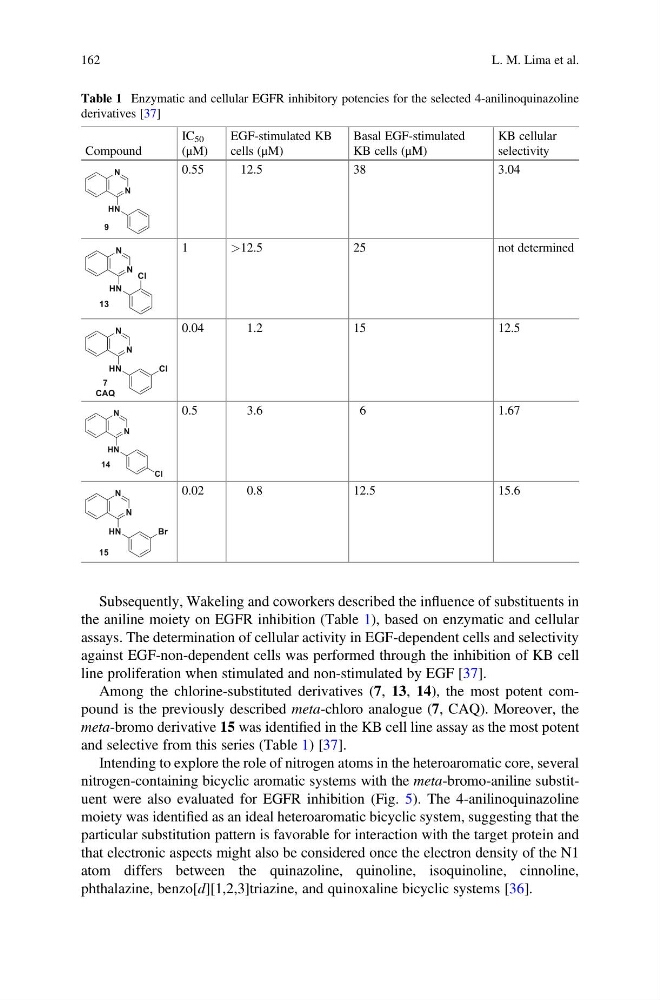
Subsequently, Wakeling and coworkers described the influence of substituents in
the aniline moiety on EGFR inhibition (Table 1), based on enzymatic and cellular
assays. The determination of cellular activity in EGF-dependent cells and selectivity
against EGF-non-dependent cells was performed through the inhibition of KB cell
line proliferation when stimulated and non-stimulated by EGF [37].
Among the chlorine-substituted derivatives (7, 13, 14), the most potent compound is the previously described meta-chloro analogue (7, CAQ). Moreover, the
meta-bromo derivative 15 was identified in the KB cell line assay as the most potent
and selective from this series (Table 1) [37].
Intending to explore the role of nitrogen atoms in the heteroaromatic core, several
nitrogen-containing bicyclic aromatic systems with the meta-bromo-aniline substituent were also evaluated for EGFR inhibition (Fig. 5). The 4-anilinoquinazoline
moiety was identified as an ideal heteroaromatic bicyclic system, suggesting that the
particular substitution pattern is favorable for interaction with the target protein and
that electronic aspects might also be considered once the electron density of the N1
atom differs between the quinazoline, quinoline, isoquinoline, cinnoline,
phthalazine, benzo[d][1,2,3]triazine, and quinoxaline bicyclic systems [36].
Table 1 Enzymatic and cellular EGFR inhibitory potencies for the selected 4-anilinoquinazoline
derivatives [37]
Compound
IC 50
(μM)
EGF-stimulated KB
cells (μM)
Basal EGF-stimulated
KB cells (μM)
KB cellular
selectivity
0.55
12.5
38
3.04
1
>12.5
25
not determined
0.04
1.2
15
12.5
0.5
3.6
6
1.67
0.02
0.8
12.5
15.6
162
L. M. Lima et al.
the aniline moiety on EGFR inhibition (Table 1), based on enzymatic and cellular
assays. The determination of cellular activity in EGF-dependent cells and selectivity
against EGF-non-dependent cells was performed through the inhibition of KB cell
line proliferation when stimulated and non-stimulated by EGF [37].
Among the chlorine-substituted derivatives (7, 13, 14), the most potent compound is the previously described meta-chloro analogue (7, CAQ). Moreover, the
meta-bromo derivative 15 was identified in the KB cell line assay as the most potent
and selective from this series (Table 1) [37].
Intending to explore the role of nitrogen atoms in the heteroaromatic core, several
nitrogen-containing bicyclic aromatic systems with the meta-bromo-aniline substituent were also evaluated for EGFR inhibition (Fig. 5). The 4-anilinoquinazoline
moiety was identified as an ideal heteroaromatic bicyclic system, suggesting that the
particular substitution pattern is favorable for interaction with the target protein and
that electronic aspects might also be considered once the electron density of the N1
atom differs between the quinazoline, quinoline, isoquinoline, cinnoline,
phthalazine, benzo[d][1,2,3]triazine, and quinoxaline bicyclic systems [36].
Table 1 Enzymatic and cellular EGFR inhibitory potencies for the selected 4-anilinoquinazoline
derivatives [37]
Compound
IC 50
(μM)
EGF-stimulated KB
cells (μM)
Basal EGF-stimulated
KB cells (μM)
KB cellular
selectivity
0.55
12.5
38
3.04
1
>12.5
25
not determined
0.04
1.2
15
12.5
0.5
3.6
6
1.67
0.02
0.8
12.5
15.6
162
L. M. Lima et al.