

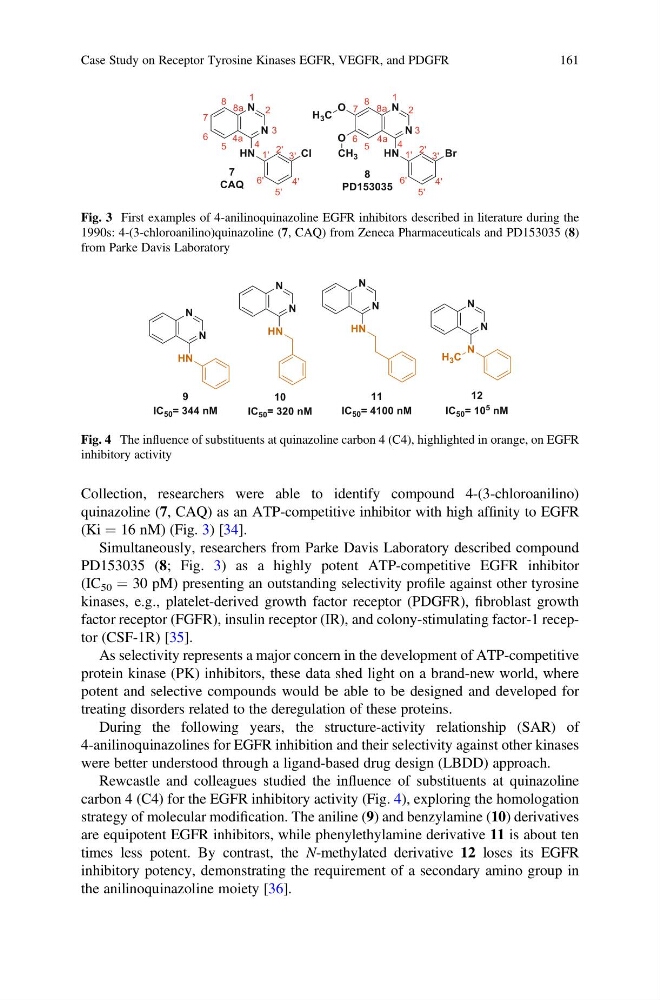
Collection, researchers were able to identify compound 4-(3-chloroanilino)
quinazoline (7, CAQ) as an ATP-competitive inhibitor with high affinity to EGFR
(Ki ¼ 16 nM) (Fig. 3) [34].
Simultaneously, researchers from Parke Davis Laboratory described compound
PD153035 (8; Fig. 3) as a highly potent ATP-competitive EGFR inhibitor
(IC 50 ¼ 30 pM) presenting an outstanding selectivity profile against other tyrosine
kinases, e.g., platelet-derived growth factor receptor (PDGFR), fibroblast growth
factor receptor (FGFR), insulin receptor (IR), and colony-stimulating factor-1 receptor (CSF-1R) [35].
As selectivity represents a major concern in the development of ATP-competitive
protein kinase (PK) inhibitors, these data shed light on a brand-new world, where
potent and selective compounds would be able to be designed and developed for
treating disorders related to the deregulation of these proteins.
During the following years, the structure-activity relationship (SAR) of
4-anilinoquinazolines for EGFR inhibition and their selectivity against other kinases
were better understood through a ligand-based drug design (LBDD) approach.
Rewcastle and colleagues studied the influence of substituents at quinazoline
carbon 4 (C4) for the EGFR inhibitory activity (Fig. 4), exploring the homologation
strategy of molecular modification. The aniline (9) and benzylamine (10) derivatives
are equipotent EGFR inhibitors, while phenylethylamine derivative 11 is about ten
times less potent. By contrast, the N-methylated derivative 12 loses its EGFR
inhibitory potency, demonstrating the requirement of a secondary amino group in
the anilinoquinazoline moiety [36].
Fig. 3 First examples of 4-anilinoquinazoline EGFR inhibitors described in literature during the
1990s: 4-(3-chloroanilino)quinazoline (7, CAQ) from Zeneca Pharmaceuticals and PD153035 (8)
from Parke Davis Laboratory
Fig. 4 The influence of substituents at quinazoline carbon 4 (C4), highlighted in orange, on EGFR
inhibitory activity
Case Study on Receptor Tyrosine Kinases EGFR, VEGFR, and PDGFR
161
quinazoline (7, CAQ) as an ATP-competitive inhibitor with high affinity to EGFR
(Ki ¼ 16 nM) (Fig. 3) [34].
Simultaneously, researchers from Parke Davis Laboratory described compound
PD153035 (8; Fig. 3) as a highly potent ATP-competitive EGFR inhibitor
(IC 50 ¼ 30 pM) presenting an outstanding selectivity profile against other tyrosine
kinases, e.g., platelet-derived growth factor receptor (PDGFR), fibroblast growth
factor receptor (FGFR), insulin receptor (IR), and colony-stimulating factor-1 receptor (CSF-1R) [35].
As selectivity represents a major concern in the development of ATP-competitive
protein kinase (PK) inhibitors, these data shed light on a brand-new world, where
potent and selective compounds would be able to be designed and developed for
treating disorders related to the deregulation of these proteins.
During the following years, the structure-activity relationship (SAR) of
4-anilinoquinazolines for EGFR inhibition and their selectivity against other kinases
were better understood through a ligand-based drug design (LBDD) approach.
Rewcastle and colleagues studied the influence of substituents at quinazoline
carbon 4 (C4) for the EGFR inhibitory activity (Fig. 4), exploring the homologation
strategy of molecular modification. The aniline (9) and benzylamine (10) derivatives
are equipotent EGFR inhibitors, while phenylethylamine derivative 11 is about ten
times less potent. By contrast, the N-methylated derivative 12 loses its EGFR
inhibitory potency, demonstrating the requirement of a secondary amino group in
the anilinoquinazoline moiety [36].
Fig. 3 First examples of 4-anilinoquinazoline EGFR inhibitors described in literature during the
1990s: 4-(3-chloroanilino)quinazoline (7, CAQ) from Zeneca Pharmaceuticals and PD153035 (8)
from Parke Davis Laboratory
Fig. 4 The influence of substituents at quinazoline carbon 4 (C4), highlighted in orange, on EGFR
inhibitory activity
Case Study on Receptor Tyrosine Kinases EGFR, VEGFR, and PDGFR
161