

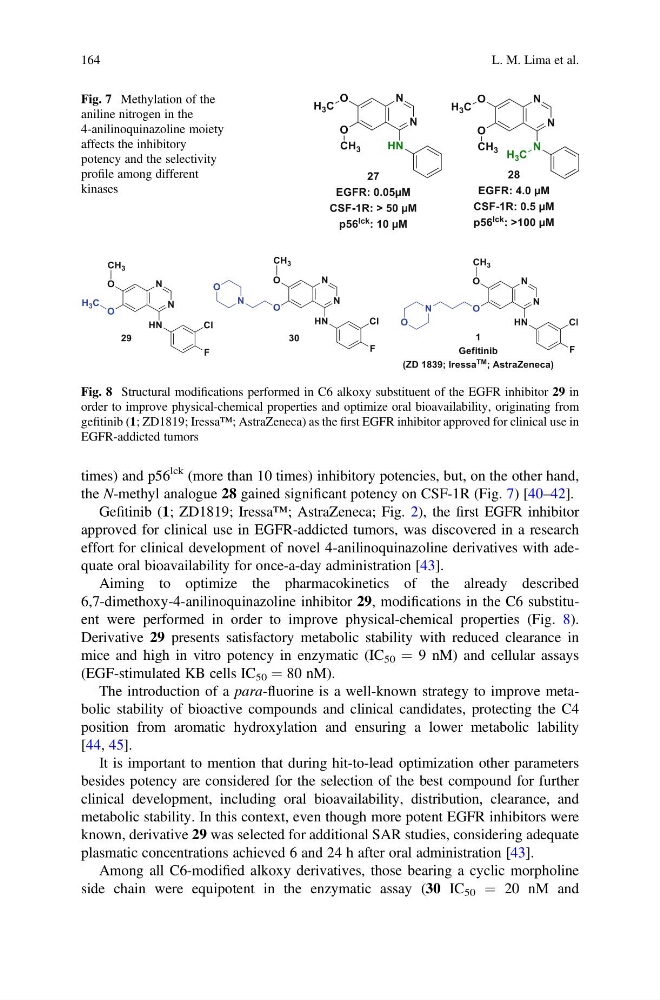
times) and p56
lck (more than 10 times) inhibitory potencies, but, on the other hand,
the N-methyl analogue 28 gained significant potency on CSF-1R (Fig. 7) [40–42].
Gefitinib (1; ZD1819; Iressa™; AstraZeneca; Fig. 2), the first EGFR inhibitor
approved for clinical use in EGFR-addicted tumors, was discovered in a research
effort for clinical development of novel 4-anilinoquinazoline derivatives with adequate oral bioavailability for once-a-day administration [43].
Aiming to optimize the pharmacokinetics of the already described
6,7-dimethoxy-4-anilinoquinazoline inhibitor 29, modifications in the C6 substituent were performed in order to improve physical-chemical properties (Fig. 8).
Derivative 29 presents satisfactory metabolic stability with reduced clearance in
mice and high in vitro potency in enzymatic (IC 50 ¼ 9 nM) and cellular assays
(EGF-stimulated KB cells IC 50 ¼ 80 nM).
The introduction of a para-fluorine is a well-known strategy to improve metabolic stability of bioactive compounds and clinical candidates, protecting the C4
position from aromatic hydroxylation and ensuring a lower metabolic lability
[44, 45].
It is important to mention that during hit-to-lead optimization other parameters
besides potency are considered for the selection of the best compound for further
clinical development, including oral bioavailability, distribution, clearance, and
metabolic stability. In this context, even though more potent EGFR inhibitors were
known, derivative 29 was selected for additional SAR studies, considering adequate
plasmatic concentrations achieved 6 and 24 h after oral administration [43].
Among all C6-modified alkoxy derivatives, those bearing a cyclic morpholine
side chain were equipotent in the enzymatic assay (30 IC 50 ¼ 20 nM and
Fig. 7 Methylation of the
aniline nitrogen in the
4-anilinoquinazoline moiety
affects the inhibitory
potency and the selectivity
profile among different
kinases
Fig. 8 Structural modifications performed in C6 alkoxy substituent of the EGFR inhibitor 29 in
order to improve physical-chemical properties and optimize oral bioavailability, originating from
gefitinib (1; ZD1819; Iressa™; AstraZeneca) as the first EGFR inhibitor approved for clinical use in
EGFR-addicted tumors
164
L. M. Lima et al.
lck (more than 10 times) inhibitory potencies, but, on the other hand,
the N-methyl analogue 28 gained significant potency on CSF-1R (Fig. 7) [40–42].
Gefitinib (1; ZD1819; Iressa™; AstraZeneca; Fig. 2), the first EGFR inhibitor
approved for clinical use in EGFR-addicted tumors, was discovered in a research
effort for clinical development of novel 4-anilinoquinazoline derivatives with adequate oral bioavailability for once-a-day administration [43].
Aiming to optimize the pharmacokinetics of the already described
6,7-dimethoxy-4-anilinoquinazoline inhibitor 29, modifications in the C6 substituent were performed in order to improve physical-chemical properties (Fig. 8).
Derivative 29 presents satisfactory metabolic stability with reduced clearance in
mice and high in vitro potency in enzymatic (IC 50 ¼ 9 nM) and cellular assays
(EGF-stimulated KB cells IC 50 ¼ 80 nM).
The introduction of a para-fluorine is a well-known strategy to improve metabolic stability of bioactive compounds and clinical candidates, protecting the C4
position from aromatic hydroxylation and ensuring a lower metabolic lability
[44, 45].
It is important to mention that during hit-to-lead optimization other parameters
besides potency are considered for the selection of the best compound for further
clinical development, including oral bioavailability, distribution, clearance, and
metabolic stability. In this context, even though more potent EGFR inhibitors were
known, derivative 29 was selected for additional SAR studies, considering adequate
plasmatic concentrations achieved 6 and 24 h after oral administration [43].
Among all C6-modified alkoxy derivatives, those bearing a cyclic morpholine
side chain were equipotent in the enzymatic assay (30 IC 50 ¼ 20 nM and
Fig. 7 Methylation of the
aniline nitrogen in the
4-anilinoquinazoline moiety
affects the inhibitory
potency and the selectivity
profile among different
kinases
Fig. 8 Structural modifications performed in C6 alkoxy substituent of the EGFR inhibitor 29 in
order to improve physical-chemical properties and optimize oral bioavailability, originating from
gefitinib (1; ZD1819; Iressa™; AstraZeneca) as the first EGFR inhibitor approved for clinical use in
EGFR-addicted tumors
164
L. M. Lima et al.