

promising selectivity profile. Co-crystallization trials were promptly initiated in
order to define the binding mode of this rather unusual class of kinase inhibitors.
The 3D structure elucidation of 1 in complex with Aurora A protein highlighted
the molecule in the S-configuration bound in the ATP site (Fig. 4b) and interacting
with the hinge residue Ala213 via the central ring NH through a bridging water
molecule and via the pyrazole moiety. Compound 1 developed an additional hydrogen bond with Glu211, at the vicinity of the gatekeeper residue, again with the
pyrazole (Fig. 4c). Looking at the conformation of the complex, the DFG moiety was
found positioned “mid-in / mid-out,” the phenylalanine side chain of Phe275 being
oriented toward the N-lobe and in contact with the αC-helix, the latter being shifted
compared to a canonical active conformation, and the salt bridge between the
Nlobe Lys162 and the
αC-helix
Glu181 being disrupted. Therefore, the observed conformation of the complex with 1 was considered as non-competent or inactive [40].
As this chemical series is readily accessible in a one-step three-component
Hantzsch reaction, a library of analogs of 1 was produced in a racemic form using
various aldehydes (Scheme 1).
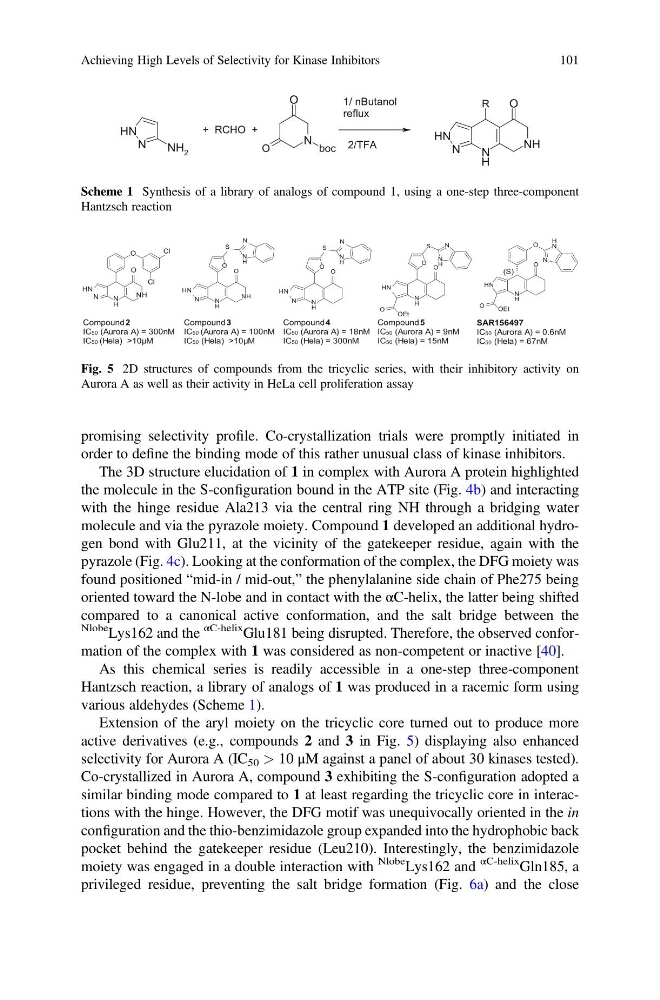
Extension of the aryl moiety on the tricyclic core turned out to produce more
active derivatives (e.g., compounds 2 and 3 in Fig. 5) displaying also enhanced
selectivity for Aurora A (IC 50 > 10 μM against a panel of about 30 kinases tested).
Co-crystallized in Aurora A, compound 3 exhibiting the S-configuration adopted a
similar binding mode compared to 1 at least regarding the tricyclic core in interactions with the hinge. However, the DFG motif was unequivocally oriented in the in
configuration and the thio-benzimidazole group expanded into the hydrophobic back
pocket behind the gatekeeper residue (Leu210). Interestingly, the benzimidazole
moiety was engaged in a double interaction with
Nlobe Lys162 and
αC-helix Gln185, a
privileged residue, preventing the salt bridge formation (Fig. 6a) and the close
NH
N
H
N
H
N
O
R
NH 2
N
H
N
N
O
O
boc
+ RCHO +
1/ nButanol
reflux
2/TFA
Scheme 1 Synthesis of a library of analogs of compound 1, using a one-step three-component
Hantzsch reaction
Compound 2
IC50 (Aurora A) = 300nM
IC50 (Hela) >10µM
Compound 3
IC50 (Aurora A) = 100nM
IC50 (Hela) >10µM
Compound 4
IC50 (Aurora A) = 18nM
IC50 (Hela) = 300nM
Compound 5
IC50 (Aurora A) = 9nM
IC50 (Hela) = 15nM
SAR156497
IC50 (Aurora A) = 0.6nM
IC50 (Hela) = 67nM
(S)
OEt
O
N
H
N
H
O
N
H
N
O
OEt
O
N
H
N
H
O
N
H
N
S
O
N
H
N
N
H
O
N
H
N
S
O
N
H
N
N
H
NH
O
N
H
N
S
O
N
H
N
N
H
Cl
Cl
O
O
NH
Fig. 5 2D structures of compounds from the tricyclic series, with their inhibitory activity on
Aurora A as well as their activity in HeLa cell proliferation assay
Achieving High Levels of Selectivity for Kinase Inhibitors
101
order to define the binding mode of this rather unusual class of kinase inhibitors.
The 3D structure elucidation of 1 in complex with Aurora A protein highlighted
the molecule in the S-configuration bound in the ATP site (Fig. 4b) and interacting
with the hinge residue Ala213 via the central ring NH through a bridging water
molecule and via the pyrazole moiety. Compound 1 developed an additional hydrogen bond with Glu211, at the vicinity of the gatekeeper residue, again with the
pyrazole (Fig. 4c). Looking at the conformation of the complex, the DFG moiety was
found positioned “mid-in / mid-out,” the phenylalanine side chain of Phe275 being
oriented toward the N-lobe and in contact with the αC-helix, the latter being shifted
compared to a canonical active conformation, and the salt bridge between the
Nlobe Lys162 and the
αC-helix
Glu181 being disrupted. Therefore, the observed conformation of the complex with 1 was considered as non-competent or inactive [40].
As this chemical series is readily accessible in a one-step three-component
Hantzsch reaction, a library of analogs of 1 was produced in a racemic form using
various aldehydes (Scheme 1).
Extension of the aryl moiety on the tricyclic core turned out to produce more
active derivatives (e.g., compounds 2 and 3 in Fig. 5) displaying also enhanced
selectivity for Aurora A (IC 50 > 10 μM against a panel of about 30 kinases tested).
Co-crystallized in Aurora A, compound 3 exhibiting the S-configuration adopted a
similar binding mode compared to 1 at least regarding the tricyclic core in interactions with the hinge. However, the DFG motif was unequivocally oriented in the in
configuration and the thio-benzimidazole group expanded into the hydrophobic back
pocket behind the gatekeeper residue (Leu210). Interestingly, the benzimidazole
moiety was engaged in a double interaction with
Nlobe Lys162 and
αC-helix Gln185, a
privileged residue, preventing the salt bridge formation (Fig. 6a) and the close
NH
N
H
N
H
N
O
R
NH 2
N
H
N
N
O
O
boc
+ RCHO +
1/ nButanol
reflux
2/TFA
Scheme 1 Synthesis of a library of analogs of compound 1, using a one-step three-component
Hantzsch reaction
Compound 2
IC50 (Aurora A) = 300nM
IC50 (Hela) >10µM
Compound 3
IC50 (Aurora A) = 100nM
IC50 (Hela) >10µM
Compound 4
IC50 (Aurora A) = 18nM
IC50 (Hela) = 300nM
Compound 5
IC50 (Aurora A) = 9nM
IC50 (Hela) = 15nM
SAR156497
IC50 (Aurora A) = 0.6nM
IC50 (Hela) = 67nM
(S)
OEt
O
N
H
N
H
O
N
H
N
O
OEt
O
N
H
N
H
O
N
H
N
S
O
N
H
N
N
H
O
N
H
N
S
O
N
H
N
N
H
NH
O
N
H
N
S
O
N
H
N
N
H
Cl
Cl
O
O
NH
Fig. 5 2D structures of compounds from the tricyclic series, with their inhibitory activity on
Aurora A as well as their activity in HeLa cell proliferation assay
Achieving High Levels of Selectivity for Kinase Inhibitors
101