

The Aurora kinases have been found aberrantly expressed in several solid tumors
(bladder, breast, gastro-intestinal, liver, pancreatic, and thyroid) and in hematopoietic malignancies such as acute myeloid leukemia (AML), chronic myeloid leukemia
(CML), multiple myeloma (MM) and lymphomas. Moreover, Aurora A and B
overexpression has been associated with poor prognosis in ovarian carcinoma and
non-small cell lung cancer, respectively. Also, Aurora A gene has been detected
amplified in 50% colon, 25% ovarian, 12% breast, more than 90% pancreatic, and
50% bladder carcinomas. In tumors, Aurora A overexpression correlates with
aneuploidy and Aurora B with genomic instability [34–36].
These observations have lent interest to this family of kinases as potential drug
targets for the development of new anti-cancer therapies [37]. At the time we
embarked in a discovery program to identify novel Aurora inhibitors, several
compounds with various levels of selectivity either with respect to Aurora A vs
Aurora B or regarding off-target kinases were advancing into preclinical phases or
early clinical trials [38]. Our objective was to design and develop exquisitely
selective inhibitors of the Aurora proteins in order to assess the intrinsic efficacy
and tolerance of such neo-cytotoxic agents in relevant pharmacological tumor
models.
Based on a pharmacophoric model established from publicly reported X-ray
structures of Aurora A, about a million of internal compounds were screened in
silico for their ability to match at least partially the model with the requirement to
potentially interact with the hinge residues (e.g., Ala 213, Fig. 2b) [39]. After several
runs of docking studies and probabilistic analysis, a set of 3,500 compounds was
selected for assessing in vitro their inhibition potency of the Aurora kinase activity at
10 μM. Among the few chemical series which emerged in this assay with decent
activity, our interest rapidly focused on the 1,2,4,6,7,8-hexahydro-5H-pyrazolo
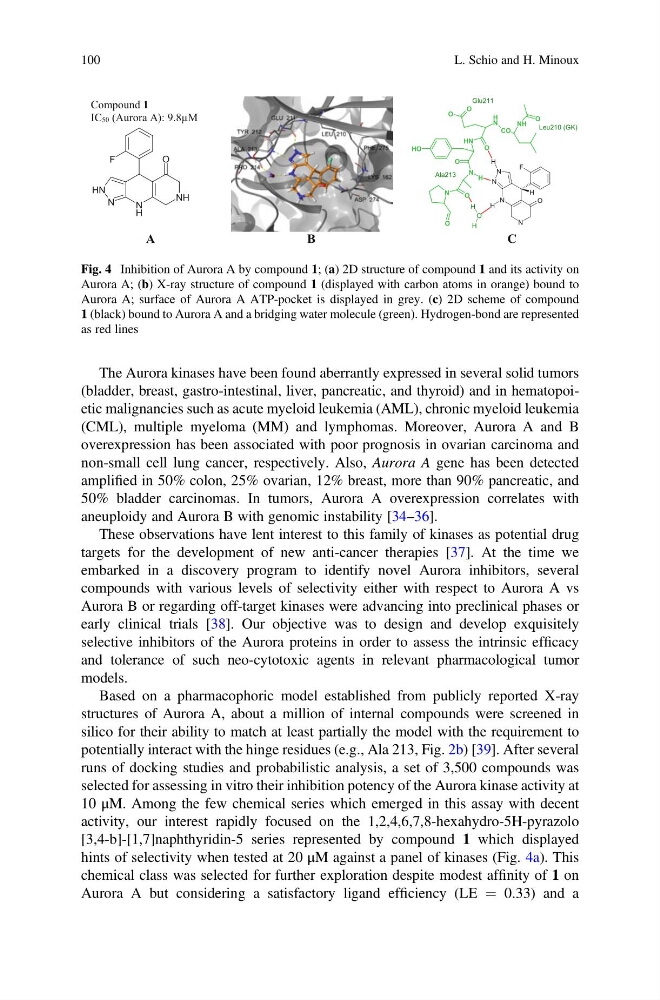
[3,4-b]-[1,7]naphthyridin-5 series represented by compound 1 which displayed
hints of selectivity when tested at 20 μM against a panel of kinases (Fig. 4a). This
chemical class was selected for further exploration despite modest affinity of 1 on
Aurora A but considering a satisfactory ligand efficiency (LE ¼ 0.33) and a
NH
O
N
O
N
H
O
N
H
O
O
H
O
O
N
H
CO
O
N
N
H
N
N
O
H
H
F
O
H
H
Leu210 (GK)
Ala213
Glu211
A
B
C
Compound 1
IC50 (Aurora A): 9.8µM
N
H
NH
N
N
H
O
F
Fig. 4 Inhibition of Aurora A by compound 1; (a) 2D structure of compound 1 and its activity on
Aurora A; (b) X-ray structure of compound 1 (displayed with carbon atoms in orange) bound to
Aurora A; surface of Aurora A ATP-pocket is displayed in grey. (c) 2D scheme of compound
1 (black) bound to Aurora A and a bridging water molecule (green). Hydrogen-bond are represented
as red lines
100
L. Schio and H. Minoux
(bladder, breast, gastro-intestinal, liver, pancreatic, and thyroid) and in hematopoietic malignancies such as acute myeloid leukemia (AML), chronic myeloid leukemia
(CML), multiple myeloma (MM) and lymphomas. Moreover, Aurora A and B
overexpression has been associated with poor prognosis in ovarian carcinoma and
non-small cell lung cancer, respectively. Also, Aurora A gene has been detected
amplified in 50% colon, 25% ovarian, 12% breast, more than 90% pancreatic, and
50% bladder carcinomas. In tumors, Aurora A overexpression correlates with
aneuploidy and Aurora B with genomic instability [34–36].
These observations have lent interest to this family of kinases as potential drug
targets for the development of new anti-cancer therapies [37]. At the time we
embarked in a discovery program to identify novel Aurora inhibitors, several
compounds with various levels of selectivity either with respect to Aurora A vs
Aurora B or regarding off-target kinases were advancing into preclinical phases or
early clinical trials [38]. Our objective was to design and develop exquisitely
selective inhibitors of the Aurora proteins in order to assess the intrinsic efficacy
and tolerance of such neo-cytotoxic agents in relevant pharmacological tumor
models.
Based on a pharmacophoric model established from publicly reported X-ray
structures of Aurora A, about a million of internal compounds were screened in
silico for their ability to match at least partially the model with the requirement to
potentially interact with the hinge residues (e.g., Ala 213, Fig. 2b) [39]. After several
runs of docking studies and probabilistic analysis, a set of 3,500 compounds was
selected for assessing in vitro their inhibition potency of the Aurora kinase activity at
10 μM. Among the few chemical series which emerged in this assay with decent
activity, our interest rapidly focused on the 1,2,4,6,7,8-hexahydro-5H-pyrazolo
[3,4-b]-[1,7]naphthyridin-5 series represented by compound 1 which displayed
hints of selectivity when tested at 20 μM against a panel of kinases (Fig. 4a). This
chemical class was selected for further exploration despite modest affinity of 1 on
Aurora A but considering a satisfactory ligand efficiency (LE ¼ 0.33) and a
NH
O
N
O
N
H
O
N
H
O
O
H
O
O
N
H
CO
O
N
N
H
N
N
O
H
H
F
O
H
H
Leu210 (GK)
Ala213
Glu211
A
B
C
Compound 1
IC50 (Aurora A): 9.8µM
N
H
NH
N
N
H
O
F
Fig. 4 Inhibition of Aurora A by compound 1; (a) 2D structure of compound 1 and its activity on
Aurora A; (b) X-ray structure of compound 1 (displayed with carbon atoms in orange) bound to
Aurora A; surface of Aurora A ATP-pocket is displayed in grey. (c) 2D scheme of compound
1 (black) bound to Aurora A and a bridging water molecule (green). Hydrogen-bond are represented
as red lines
100
L. Schio and H. Minoux