

Dissipative Particle Dynamics Approaches to Modeling …
83
one particle interacts with another. The random force imposes thermal agitation and
random collision to the particles, similar to Brownian or Langevin Dynamics [101].
The physical quantities in the DPD technique are expressed in dimensionless units
with cutoff r c , energy scale k B T and time scale τ estimated by τ =
mr 2
c
k B T .
The dissipative and random forces enable DPD to capture the hydrodynamics of the
systems.
While DPD provides an efficient technique for large scale simulations of BCPs
micellization and assembly in solutions, as with any coarse-grained technique, there
are several limitations that must be considered. Studies have examined the connections between the coarse-graining scheme and the dissipative force parameters [102–
104]. Limitations such as the loss of chemical specificity, oversimplification of
the forces and the dissipation of energy inhibit the DPD technique as a means of
modeling all phenomena. Moreover, the DPD method lacks the ability to capture
realistic thermodynamic quantities related to pressure and temperature gradients
[105]. Also, important features such as the prevention of chain crossing and electrostatic interaction were not part of the original DPD framework but developed later to
extend the capability of DPD for simulating entangled polymer aggregates and ionic
copolymers.
To prevent chain crossing, Liu et al. and Nikunen et al. increased the strength of
the conservative force to a constant value at a certain threshold distance between the
particles [106, 107]. This approach has limitations in modeling long chains and generating unwanted dynamics. A bond-bond repulsive potential, called the Segmental
Repulsive potential (SRP), can be introduced into the polymer models to prevent
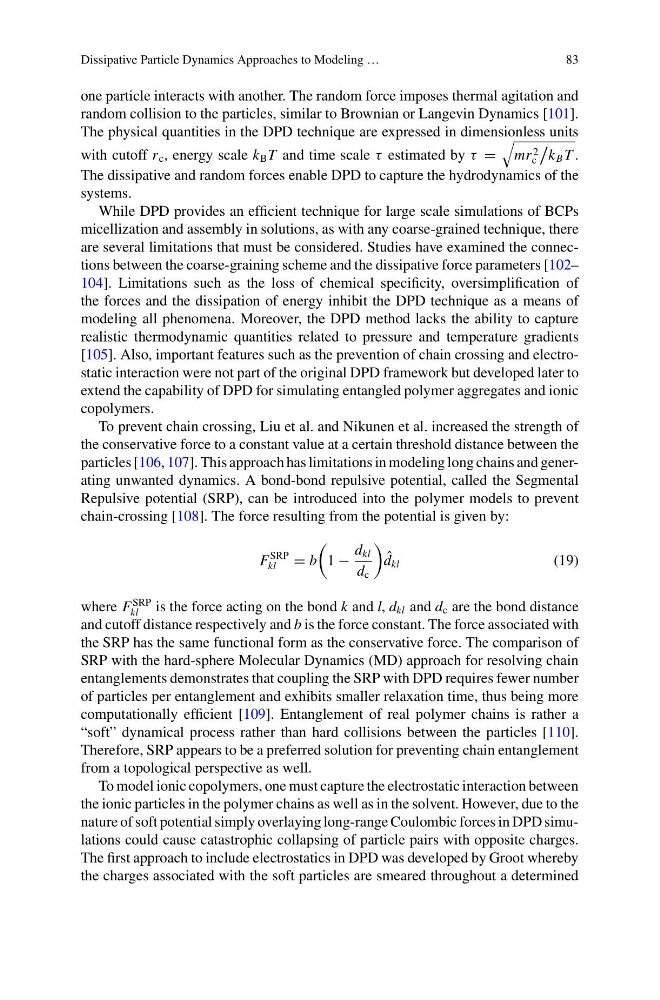
chain-crossing [108]. The force resulting from the potential is given by:
F
SRP
kl
= b
1 −
d kl
d c
ˆ
d kl
(19)
where F
SRP
kl
is the force acting on the bond k and l, d kl and d c are the bond distance
and cutoff distance respectively and b is the force constant. The force associated with
the SRP has the same functional form as the conservative force. The comparison of
SRP with the hard-sphere Molecular Dynamics (MD) approach for resolving chain
entanglements demonstrates that coupling the SRP with DPD requires fewer number
of particles per entanglement and exhibits smaller relaxation time, thus being more
computationally efficient [109]. Entanglement of real polymer chains is rather a
“soft” dynamical process rather than hard collisions between the particles [110].
Therefore, SRP appears to be a preferred solution for preventing chain entanglement
from a topological perspective as well.
To model ionic copolymers, one must capture the electrostatic interaction between
the ionic particles in the polymer chains as well as in the solvent. However, due to the
nature of soft potential simply overlaying long-range Coulombic forces in DPD simulations could cause catastrophic collapsing of particle pairs with opposite charges.
The first approach to include electrostatics in DPD was developed by Groot whereby
the charges associated with the soft particles are smeared throughout a determined
83
one particle interacts with another. The random force imposes thermal agitation and
random collision to the particles, similar to Brownian or Langevin Dynamics [101].
The physical quantities in the DPD technique are expressed in dimensionless units
with cutoff r c , energy scale k B T and time scale τ estimated by τ =
mr 2
c
k B T .
The dissipative and random forces enable DPD to capture the hydrodynamics of the
systems.
While DPD provides an efficient technique for large scale simulations of BCPs
micellization and assembly in solutions, as with any coarse-grained technique, there
are several limitations that must be considered. Studies have examined the connections between the coarse-graining scheme and the dissipative force parameters [102–
104]. Limitations such as the loss of chemical specificity, oversimplification of
the forces and the dissipation of energy inhibit the DPD technique as a means of
modeling all phenomena. Moreover, the DPD method lacks the ability to capture
realistic thermodynamic quantities related to pressure and temperature gradients
[105]. Also, important features such as the prevention of chain crossing and electrostatic interaction were not part of the original DPD framework but developed later to
extend the capability of DPD for simulating entangled polymer aggregates and ionic
copolymers.
To prevent chain crossing, Liu et al. and Nikunen et al. increased the strength of
the conservative force to a constant value at a certain threshold distance between the
particles [106, 107]. This approach has limitations in modeling long chains and generating unwanted dynamics. A bond-bond repulsive potential, called the Segmental
Repulsive potential (SRP), can be introduced into the polymer models to prevent
chain-crossing [108]. The force resulting from the potential is given by:
F
SRP
kl
= b
1 −
d kl
d c
ˆ
d kl
(19)
where F
SRP
kl
is the force acting on the bond k and l, d kl and d c are the bond distance
and cutoff distance respectively and b is the force constant. The force associated with
the SRP has the same functional form as the conservative force. The comparison of
SRP with the hard-sphere Molecular Dynamics (MD) approach for resolving chain
entanglements demonstrates that coupling the SRP with DPD requires fewer number
of particles per entanglement and exhibits smaller relaxation time, thus being more
computationally efficient [109]. Entanglement of real polymer chains is rather a
“soft” dynamical process rather than hard collisions between the particles [110].
Therefore, SRP appears to be a preferred solution for preventing chain entanglement
from a topological perspective as well.
To model ionic copolymers, one must capture the electrostatic interaction between
the ionic particles in the polymer chains as well as in the solvent. However, due to the
nature of soft potential simply overlaying long-range Coulombic forces in DPD simulations could cause catastrophic collapsing of particle pairs with opposite charges.
The first approach to include electrostatics in DPD was developed by Groot whereby
the charges associated with the soft particles are smeared throughout a determined