

84
T. A. Deaton et al.
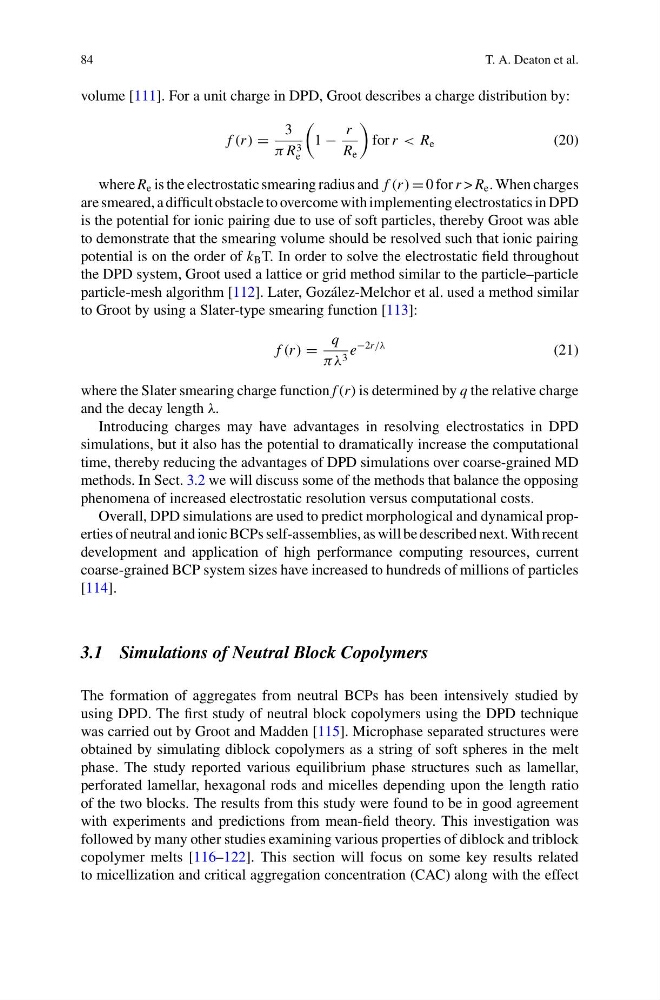
volume [111]. For a unit charge in DPD, Groot describes a charge distribution by:
f (r ) =
3
π R 3
e
1 −
r
R e
for r < R e
(20)
where R e is the electrostatic smearing radius and f (r ) = 0 for r > R e . When charges
are smeared, a difficult obstacle to overcome with implementing electrostatics in DPD
is the potential for ionic pairing due to use of soft particles, thereby Groot was able
to demonstrate that the smearing volume should be resolved such that ionic pairing
potential is on the order of k B T. In order to solve the electrostatic field throughout
the DPD system, Groot used a lattice or grid method similar to the particle–particle
particle-mesh algorithm [112]. Later, Gozález-Melchor et al. used a method similar
to Groot by using a Slater-type smearing function [113]:
f (r ) =
q
πλ 3 e
−2r/λ
(21)
where the Slater smearing charge function f (r) is determined by q the relative charge
and the decay length λ.
Introducing charges may have advantages in resolving electrostatics in DPD
simulations, but it also has the potential to dramatically increase the computational
time, thereby reducing the advantages of DPD simulations over coarse-grained MD
methods. In Sect. 3.2 we will discuss some of the methods that balance the opposing
phenomena of increased electrostatic resolution versus computational costs.
Overall, DPD simulations are used to predict morphological and dynamical properties of neutral and ionic BCPs self-assemblies, as will be described next. With recent
development and application of high performance computing resources, current
coarse-grained BCP system sizes have increased to hundreds of millions of particles
[114].
3.1 Simulations of Neutral Block Copolymers
The formation of aggregates from neutral BCPs has been intensively studied by
using DPD. The first study of neutral block copolymers using the DPD technique
was carried out by Groot and Madden [115]. Microphase separated structures were
obtained by simulating diblock copolymers as a string of soft spheres in the melt
phase. The study reported various equilibrium phase structures such as lamellar,
perforated lamellar, hexagonal rods and micelles depending upon the length ratio
of the two blocks. The results from this study were found to be in good agreement
with experiments and predictions from mean-field theory. This investigation was
followed by many other studies examining various properties of diblock and triblock
copolymer melts [116–122]. This section will focus on some key results related
to micellization and critical aggregation concentration (CAC) along with the effect
T. A. Deaton et al.
volume [111]. For a unit charge in DPD, Groot describes a charge distribution by:
f (r ) =
3
π R 3
e
1 −
r
R e
for r < R e
(20)
where R e is the electrostatic smearing radius and f (r ) = 0 for r > R e . When charges
are smeared, a difficult obstacle to overcome with implementing electrostatics in DPD
is the potential for ionic pairing due to use of soft particles, thereby Groot was able
to demonstrate that the smearing volume should be resolved such that ionic pairing
potential is on the order of k B T. In order to solve the electrostatic field throughout
the DPD system, Groot used a lattice or grid method similar to the particle–particle
particle-mesh algorithm [112]. Later, Gozález-Melchor et al. used a method similar
to Groot by using a Slater-type smearing function [113]:
f (r ) =
q
πλ 3 e
−2r/λ
(21)
where the Slater smearing charge function f (r) is determined by q the relative charge
and the decay length λ.
Introducing charges may have advantages in resolving electrostatics in DPD
simulations, but it also has the potential to dramatically increase the computational
time, thereby reducing the advantages of DPD simulations over coarse-grained MD
methods. In Sect. 3.2 we will discuss some of the methods that balance the opposing
phenomena of increased electrostatic resolution versus computational costs.
Overall, DPD simulations are used to predict morphological and dynamical properties of neutral and ionic BCPs self-assemblies, as will be described next. With recent
development and application of high performance computing resources, current
coarse-grained BCP system sizes have increased to hundreds of millions of particles
[114].
3.1 Simulations of Neutral Block Copolymers
The formation of aggregates from neutral BCPs has been intensively studied by
using DPD. The first study of neutral block copolymers using the DPD technique
was carried out by Groot and Madden [115]. Microphase separated structures were
obtained by simulating diblock copolymers as a string of soft spheres in the melt
phase. The study reported various equilibrium phase structures such as lamellar,
perforated lamellar, hexagonal rods and micelles depending upon the length ratio
of the two blocks. The results from this study were found to be in good agreement
with experiments and predictions from mean-field theory. This investigation was
followed by many other studies examining various properties of diblock and triblock
copolymer melts [116–122]. This section will focus on some key results related
to micellization and critical aggregation concentration (CAC) along with the effect