

82
T. A. Deaton et al.
type potential [93–95]; the impact of solvophobicity and polymer architecture on
micellization of BCPs can be investigated using Polymer Reference Interaction Site
Model (PRISM) model [67, 96]. Whereas greater resolution of pairwise interactions
can be achieved by adoption of Lennard–Jones type potentials, such approaches typically increase the computational cost in comparison to the cost associated with the
use of soft repulsive potentials in DPD.
Dissipative Particle Dynamics (DPD) is a mesoscale simulation technique where
both hydrodynamics and excluded volume effects are considered while soft potentials enable the use of larger time steps, thereby enabling large scale studies with a
considerable computational efficiency [97–99]. These characteristics make DPD a
suitable simulation technique for studying the self-assembly processes of BCPs in
solutions.
In order to resolve the mesoscopic properties of polymer materials over large
spatiotemporal scales, a coarse-graining representation of BCPs has to be applied.
Coarse-graining a polymer molecule involves lumping a group of atoms into one
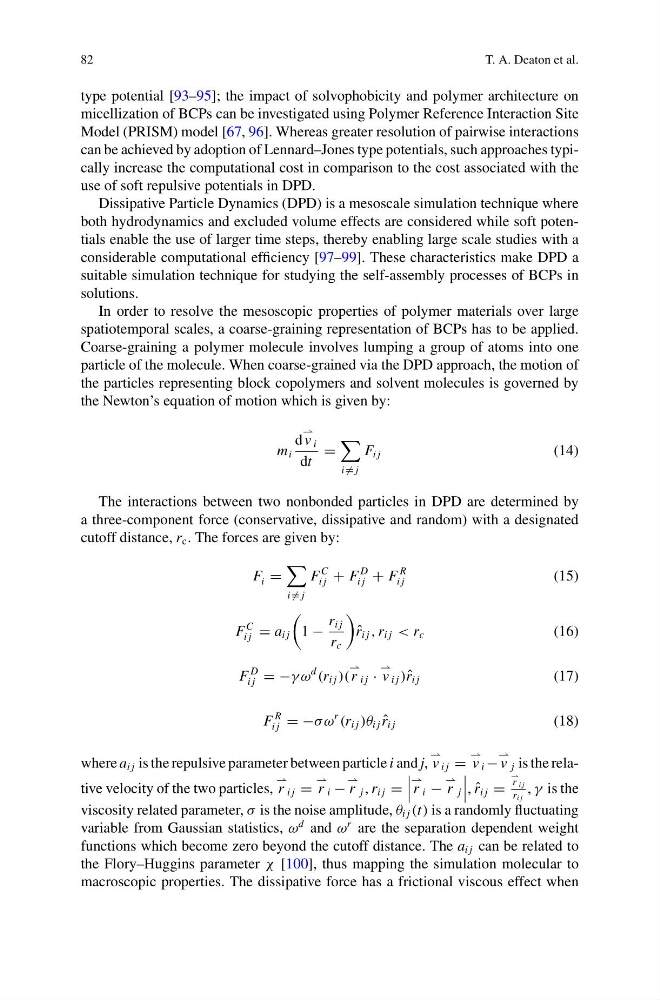
particle of the molecule. When coarse-grained via the DPD approach, the motion of
the particles representing block copolymers and solvent molecules is governed by
the Newton’s equation of motion which is given by:
m i
d
v i
dt
=
i = j
F i j
(14)
The interactions between two nonbonded particles in DPD are determined by
a three-component force (conservative, dissipative and random) with a designated
cutoff distance, r c . The forces are given by:
F i =
i = j
F
C
i j + F
D
i j + F
R
i j
(15)
F
C
i j = a i j
1 −
r i j
r c
ˆ
r i j , r i j < r c
(16)
F
D
i j = −γ ω
d
(r i j )(
r i j ·
v i j )ˆ r i j
(17)
F
R
i j = −σ ω
r
(r i j )θ i j ˆ
r i j
(18)
where a i j is the repulsive parameter between particle i and j,
v i j =
v i −
v j is the relative velocity of the two particles,
r i j =
r i −
r j , r i j =
r i −
r j
, ˆ
r i j =
r i j
r i j
, γ is the
viscosity related parameter, σ is the noise amplitude, θ i j (t) is a randomly fluctuating
variable from Gaussian statistics, ω
d and ω
r are the separation dependent weight
functions which become zero beyond the cutoff distance. The a i j can be related to
the Flory–Huggins parameter χ [100], thus mapping the simulation molecular to
macroscopic properties. The dissipative force has a frictional viscous effect when
T. A. Deaton et al.
type potential [93–95]; the impact of solvophobicity and polymer architecture on
micellization of BCPs can be investigated using Polymer Reference Interaction Site
Model (PRISM) model [67, 96]. Whereas greater resolution of pairwise interactions
can be achieved by adoption of Lennard–Jones type potentials, such approaches typically increase the computational cost in comparison to the cost associated with the
use of soft repulsive potentials in DPD.
Dissipative Particle Dynamics (DPD) is a mesoscale simulation technique where
both hydrodynamics and excluded volume effects are considered while soft potentials enable the use of larger time steps, thereby enabling large scale studies with a
considerable computational efficiency [97–99]. These characteristics make DPD a
suitable simulation technique for studying the self-assembly processes of BCPs in
solutions.
In order to resolve the mesoscopic properties of polymer materials over large
spatiotemporal scales, a coarse-graining representation of BCPs has to be applied.
Coarse-graining a polymer molecule involves lumping a group of atoms into one
particle of the molecule. When coarse-grained via the DPD approach, the motion of
the particles representing block copolymers and solvent molecules is governed by
the Newton’s equation of motion which is given by:
m i
d
v i
dt
=
i = j
F i j
(14)
The interactions between two nonbonded particles in DPD are determined by
a three-component force (conservative, dissipative and random) with a designated
cutoff distance, r c . The forces are given by:
F i =
i = j
F
C
i j + F
D
i j + F
R
i j
(15)
F
C
i j = a i j
1 −
r i j
r c
ˆ
r i j , r i j < r c
(16)
F
D
i j = −γ ω
d
(r i j )(
r i j ·
v i j )ˆ r i j
(17)
F
R
i j = −σ ω
r
(r i j )θ i j ˆ
r i j
(18)
where a i j is the repulsive parameter between particle i and j,
v i j =
v i −
v j is the relative velocity of the two particles,
r i j =
r i −
r j , r i j =
r i −
r j
, ˆ
r i j =
r i j
r i j
, γ is the
viscosity related parameter, σ is the noise amplitude, θ i j (t) is a randomly fluctuating
variable from Gaussian statistics, ω
d and ω
r are the separation dependent weight
functions which become zero beyond the cutoff distance. The a i j can be related to
the Flory–Huggins parameter χ [100], thus mapping the simulation molecular to
macroscopic properties. The dissipative force has a frictional viscous effect when