

How Molecular Modelling Tools Can Help …
203
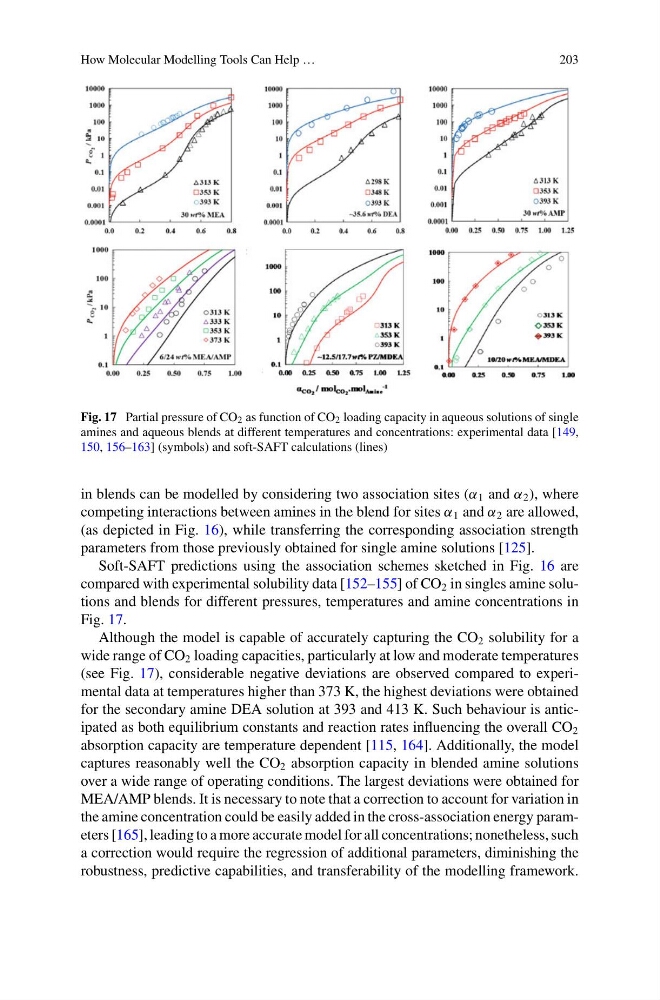
Fig. 17 Partial pressure of CO 2 as function of CO 2 loading capacity in aqueous solutions of single
amines and aqueous blends at different temperatures and concentrations: experimental data [149,
150, 156–163] (symbols) and soft-SAFT calculations (lines)
in blends can be modelled by considering two association sites (α 1 and α 2 ), where
competing interactions between amines in the blend for sites α 1 and α 2 are allowed,
(as depicted in Fig. 16), while transferring the corresponding association strength
parameters from those previously obtained for single amine solutions [125].
Soft-SAFT predictions using the association schemes sketched in Fig. 16 are
compared with experimental solubility data [152–155] of CO 2 in singles amine solutions and blends for different pressures, temperatures and amine concentrations in
Fig. 17.
Although the model is capable of accurately capturing the CO 2 solubility for a
wide range of CO 2 loading capacities, particularly at low and moderate temperatures
(see Fig. 17), considerable negative deviations are observed compared to experimental data at temperatures higher than 373 K, the highest deviations were obtained
for the secondary amine DEA solution at 393 and 413 K. Such behaviour is anticipated as both equilibrium constants and reaction rates influencing the overall CO 2
absorption capacity are temperature dependent [115, 164]. Additionally, the model
captures reasonably well the CO 2 absorption capacity in blended amine solutions
over a wide range of operating conditions. The largest deviations were obtained for
MEA/AMP blends. It is necessary to note that a correction to account for variation in
the amine concentration could be easily added in the cross-association energy parameters [165], leading to a more accurate model for all concentrations; nonetheless, such
a correction would require the regression of additional parameters, diminishing the
robustness, predictive capabilities, and transferability of the modelling framework.
203
Fig. 17 Partial pressure of CO 2 as function of CO 2 loading capacity in aqueous solutions of single
amines and aqueous blends at different temperatures and concentrations: experimental data [149,
150, 156–163] (symbols) and soft-SAFT calculations (lines)
in blends can be modelled by considering two association sites (α 1 and α 2 ), where
competing interactions between amines in the blend for sites α 1 and α 2 are allowed,
(as depicted in Fig. 16), while transferring the corresponding association strength
parameters from those previously obtained for single amine solutions [125].
Soft-SAFT predictions using the association schemes sketched in Fig. 16 are
compared with experimental solubility data [152–155] of CO 2 in singles amine solutions and blends for different pressures, temperatures and amine concentrations in
Fig. 17.
Although the model is capable of accurately capturing the CO 2 solubility for a
wide range of CO 2 loading capacities, particularly at low and moderate temperatures
(see Fig. 17), considerable negative deviations are observed compared to experimental data at temperatures higher than 373 K, the highest deviations were obtained
for the secondary amine DEA solution at 393 and 413 K. Such behaviour is anticipated as both equilibrium constants and reaction rates influencing the overall CO 2
absorption capacity are temperature dependent [115, 164]. Additionally, the model
captures reasonably well the CO 2 absorption capacity in blended amine solutions
over a wide range of operating conditions. The largest deviations were obtained for
MEA/AMP blends. It is necessary to note that a correction to account for variation in
the amine concentration could be easily added in the cross-association energy parameters [165], leading to a more accurate model for all concentrations; nonetheless, such
a correction would require the regression of additional parameters, diminishing the
robustness, predictive capabilities, and transferability of the modelling framework.