

202
L. F. Vega et al.
to any other SAFT approach), it is crucial to identify the set of governing main
reactions affecting the solubility process. The overall chemical reaction of CO 2 with
amines primarily progresses through the formation of carbamate and bicarbonate, as
such:
CO 2 + 2R 1 R 2 NH ↔ R 1 R 2 NCOO
−
+ R 1 R 2 NH
+
2
(8)
CO 2 + R 1 R 2 NH + H 2 O ↔ HCO
−
3 + R 1 R 2 NH
+
2
(9)
In regard to the CO 2 absorption capacity, the formation of bicarbonate (HCO
−
3 ) is
more efficient than that for carbamate (R 1 R 2 NCOO
− ) formation, as the CO 2 : amine
ratio for bicarbonate formation is 1:1, as opposed to the 1:2 CO 2: amine ratio for the
carbamate formation. Regardless, the kinetics of the carbamate reaction are faster
than that for the bicarbonate reaction [148]. The overall idea, then, is to emulate the
formation of carbamate and bicarbonate as physically bounded molecular aggregates
using a strong association strength according to an association scheme chosen a priori
[49, 149, 150].
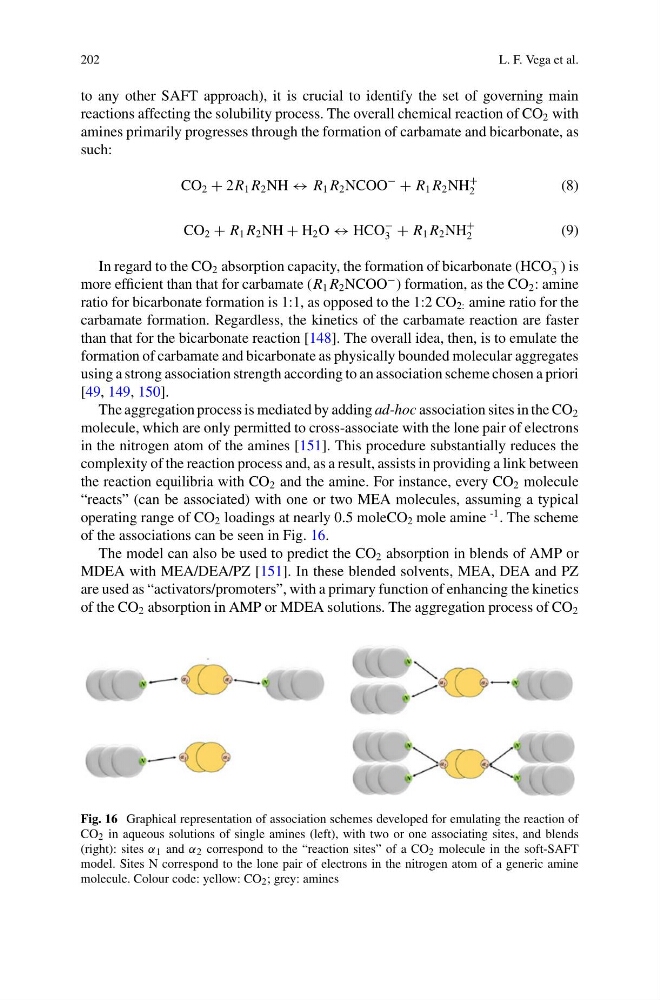
The aggregation process is mediated by adding ad-hoc association sites in the CO 2
molecule, which are only permitted to cross-associate with the lone pair of electrons
in the nitrogen atom of the amines [151]. This procedure substantially reduces the
complexity of the reaction process and, as a result, assists in providing a link between
the reaction equilibria with CO 2 and the amine. For instance, every CO 2 molecule
“reacts” (can be associated) with one or two MEA molecules, assuming a typical
operating range of CO 2 loadings at nearly 0.5 moleCO 2 mole amine
-1 . The scheme
of the associations can be seen in Fig. 16.
The model can also be used to predict the CO 2 absorption in blends of AMP or
MDEA with MEA/DEA/PZ [151]. In these blended solvents, MEA, DEA and PZ
are used as “activators/promoters”, with a primary function of enhancing the kinetics
of the CO 2 absorption in AMP or MDEA solutions. The aggregation process of CO 2
Fig. 16 Graphical representation of association schemes developed for emulating the reaction of
CO 2 in aqueous solutions of single amines (left), with two or one associating sites, and blends
(right): sites α 1 and α 2 correspond to the “reaction sites” of a CO 2 molecule in the soft-SAFT
model. Sites N correspond to the lone pair of electrons in the nitrogen atom of a generic amine
molecule. Colour code: yellow: CO 2 ; grey: amines
L. F. Vega et al.
to any other SAFT approach), it is crucial to identify the set of governing main
reactions affecting the solubility process. The overall chemical reaction of CO 2 with
amines primarily progresses through the formation of carbamate and bicarbonate, as
such:
CO 2 + 2R 1 R 2 NH ↔ R 1 R 2 NCOO
−
+ R 1 R 2 NH
+
2
(8)
CO 2 + R 1 R 2 NH + H 2 O ↔ HCO
−
3 + R 1 R 2 NH
+
2
(9)
In regard to the CO 2 absorption capacity, the formation of bicarbonate (HCO
−
3 ) is
more efficient than that for carbamate (R 1 R 2 NCOO
− ) formation, as the CO 2 : amine
ratio for bicarbonate formation is 1:1, as opposed to the 1:2 CO 2: amine ratio for the
carbamate formation. Regardless, the kinetics of the carbamate reaction are faster
than that for the bicarbonate reaction [148]. The overall idea, then, is to emulate the
formation of carbamate and bicarbonate as physically bounded molecular aggregates
using a strong association strength according to an association scheme chosen a priori
[49, 149, 150].
The aggregation process is mediated by adding ad-hoc association sites in the CO 2
molecule, which are only permitted to cross-associate with the lone pair of electrons
in the nitrogen atom of the amines [151]. This procedure substantially reduces the
complexity of the reaction process and, as a result, assists in providing a link between
the reaction equilibria with CO 2 and the amine. For instance, every CO 2 molecule
“reacts” (can be associated) with one or two MEA molecules, assuming a typical
operating range of CO 2 loadings at nearly 0.5 moleCO 2 mole amine
-1 . The scheme
of the associations can be seen in Fig. 16.
The model can also be used to predict the CO 2 absorption in blends of AMP or
MDEA with MEA/DEA/PZ [151]. In these blended solvents, MEA, DEA and PZ
are used as “activators/promoters”, with a primary function of enhancing the kinetics
of the CO 2 absorption in AMP or MDEA solutions. The aggregation process of CO 2
Fig. 16 Graphical representation of association schemes developed for emulating the reaction of
CO 2 in aqueous solutions of single amines (left), with two or one associating sites, and blends
(right): sites α 1 and α 2 correspond to the “reaction sites” of a CO 2 molecule in the soft-SAFT
model. Sites N correspond to the lone pair of electrons in the nitrogen atom of a generic amine
molecule. Colour code: yellow: CO 2 ; grey: amines